
About this resource
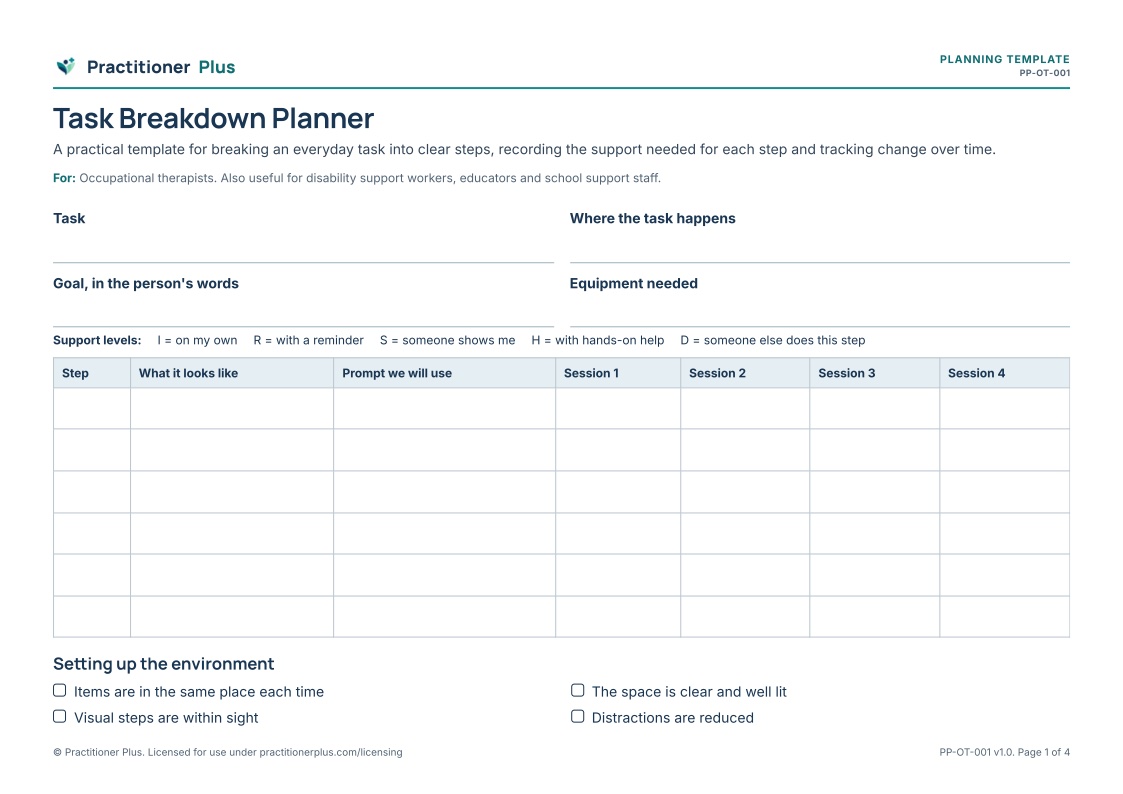
Many everyday tasks are made of several small steps. This planner helps you and the person break a task down, note what each step looks like, set up the environment and record the level of support needed at each step, so independence can grow one step at a time.
Purpose
To make a task learnable by breaking it into observable steps, agreeing the support needed for each step and seeing progress over several sessions.
Who it is for
Primary profession: Occupational therapists. Also relevant for disability support workers, educators and school support staff.
Client or participant group: Children and adults building independence in everyday tasks, with an occupational therapist, support worker or educator.
Practice setting: Home, supported living, school or clinic, in the environment where the task usually happens.
Suggested uses
- Teaching a daily living task such as making a sandwich or doing laundry
- Agreeing a consistent approach across support workers
- Identifying which steps need environmental changes
- Tracking progress over four sessions
Instructions for practitioners
- Choose a task that matters to the person and agree the goal with them.
- Watch or walk through the task in its usual setting before writing the steps.
- Write each step as an observable action, in the order it happens.
- Agree the support level for each step and the prompts everyone will use.
- Record support levels over several sessions and review which steps to work on next.
Instructions for clients or participants
- Choose a task you want to do more on your own.
- Help decide the steps.
- Try the task and talk about which steps felt easy or hard.
Accessibility considerations
Steps can be paired with photos or symbols. Keep each step to one action. Use the person's preferred words and prompts consistently.
Scope and limitations
An informal planning and tracking tool. It is not a standardised occupational therapy assessment and does not replace a functional assessment by an occupational therapist.
Research basis
Visual schedules and other visual supports are established evidence-based practices for autistic children and young people, and are widely used with others who benefit from visual information. Active support, which gives people real opportunities and just-enough help to take part in everyday activities, increases engagement for people with intellectual disability. Executive functions such as planning, working memory and self-control develop over time and can be supported with external structure and practice.
- Diamond, A. (2013). Executive Functions. Annual Review of Psychology, 64(1), 135–168. https://doi.org/10.1146/annurev-psych-113011-143750
- Knight, V., Sartini, E., & Spriggs, A. D. (2015). Evaluating Visual Activity Schedules as Evidence-Based Practice for Individuals with Autism Spectrum Disorders. Journal of Autism and Developmental Disorders, 45(1), 157–178. https://doi.org/10.1007/s10803-014-2201-z
- Mansell, J., & Beadle-Brown, J. (2012). Active support: Enabling and empowering people with intellectual disabilities. Jessica Kingsley Publishers.
- Steinbrenner, J. R., Hume, K., Odom, S. L., Morin, K. L., Nowell, S. W., Tomaszewski, B., Szendrey, S., McIntyre, N. S., Yücesoy-Özkan, S., & Savage, M. N. (2020). Evidence-based practices for children, youth, and young adults with autism. FPG Child Development Institute, University of North Carolina. https://ncaep.fpg.unc.edu/wp-content/uploads/EBP-Report-2020.pdf
What is included
A 4-page printable A4 PDF, including a practitioner notes page with the research basis (version 1.0).
Originality
Original Practitioner Plus content: wording, activity structure, layout and icons were created for this resource. No third-party worksheets, illustrations or text were reproduced. Draws on widely used task analysis and graded support principles in occupational therapy practice.


