
About this resource
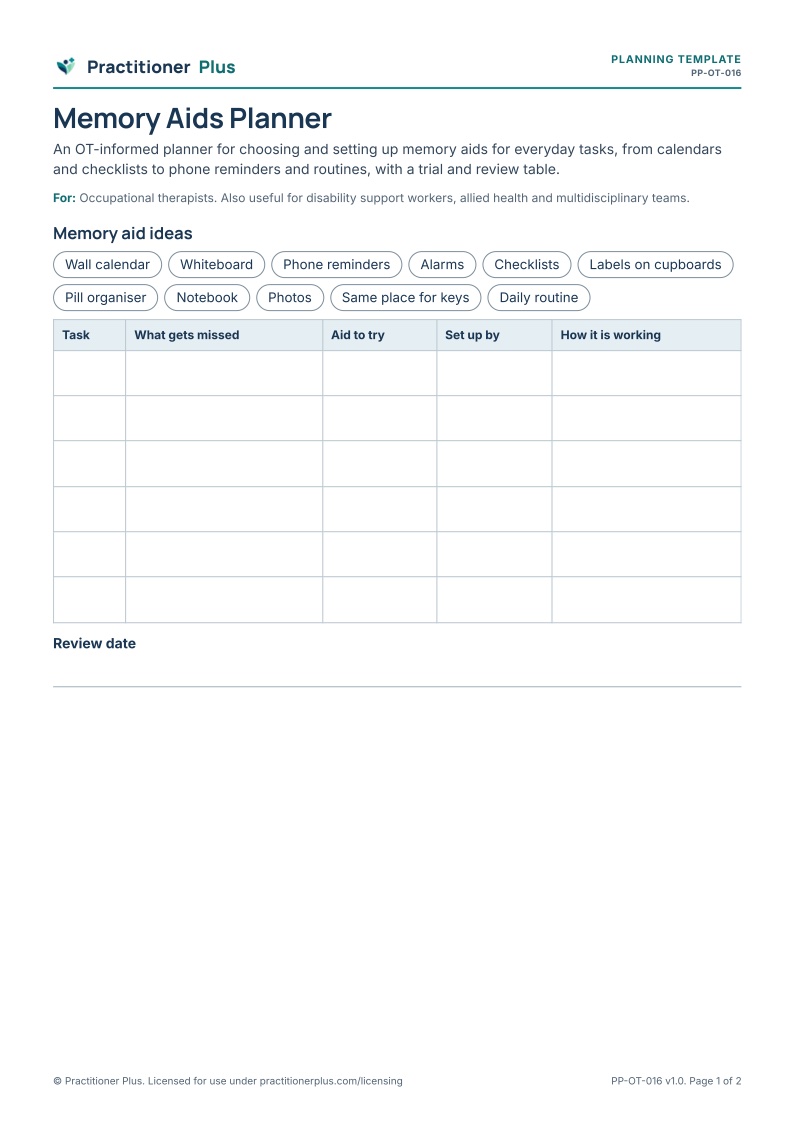
Memory aids work best when they fit the person and the task. This planner helps identify everyday tasks that are affected, choose aids such as calendars, checklists, phone reminders, labels and routines, set them up and review how well they work.
Purpose
To match memory aids to the everyday tasks that matter to the person.
Who it is for
Primary profession: Occupational therapists. Also relevant for disability support workers, allied health and multidisciplinary teams.
Client or participant group: Adults with memory changes after brain injury, stroke, illness or with cognitive disability, and their supporters.
Practice setting: Home, rehabilitation and community occupational therapy.
Suggested uses
- Rehabilitation after brain injury or stroke
- Supporting independence at home
- Training support workers and families
- Reviewing strategies
Instructions for practitioners
- Start with tasks that matter most to the person.
- Choose aids that fit the person's habits and skills.
- Practise using the aid until it becomes routine.
- Review and adjust.
Instructions for clients or participants
- Choose tasks you want help remembering.
- Try the aid for two weeks.
- Say what is working.
Accessibility considerations
Large print. Supporters can complete it with the person.
Scope and limitations
A planning tool. It does not assess memory or cognition.
Research basis
External memory aids and strategy training are recommended practice in cognitive rehabilitation after brain injury. Executive functions such as planning, working memory and self-control develop over time and can be supported with external structure and practice.
- Cicerone, K. D., Goldin, Y., Ganci, K., Rosenbaum, A., Wethe, J. V., Langenbahn, D. M., Malec, J. F., Bergquist, T. F., Kingsley, K., Nagele, D., Trexler, L., Fraas, M., Bogdanova, Y., & Harley, J. P. (2019). Evidence-Based Cognitive Rehabilitation: Systematic Review of the Literature From 2009 Through 2014. Archives of Physical Medicine and Rehabilitation, 100(8), 1515–1533. https://doi.org/10.1016/j.apmr.2019.02.011
- Diamond, A. (2013). Executive Functions. Annual Review of Psychology, 64(1), 135–168. https://doi.org/10.1146/annurev-psych-113011-143750
What is included
A 2-page printable A4 PDF, including a practitioner notes page with the research basis (version 1.0).
Originality
Original Practitioner Plus content: wording, activity structure, layout and icons were created for this resource. No third-party worksheets, illustrations or text were reproduced.


