
About this resource
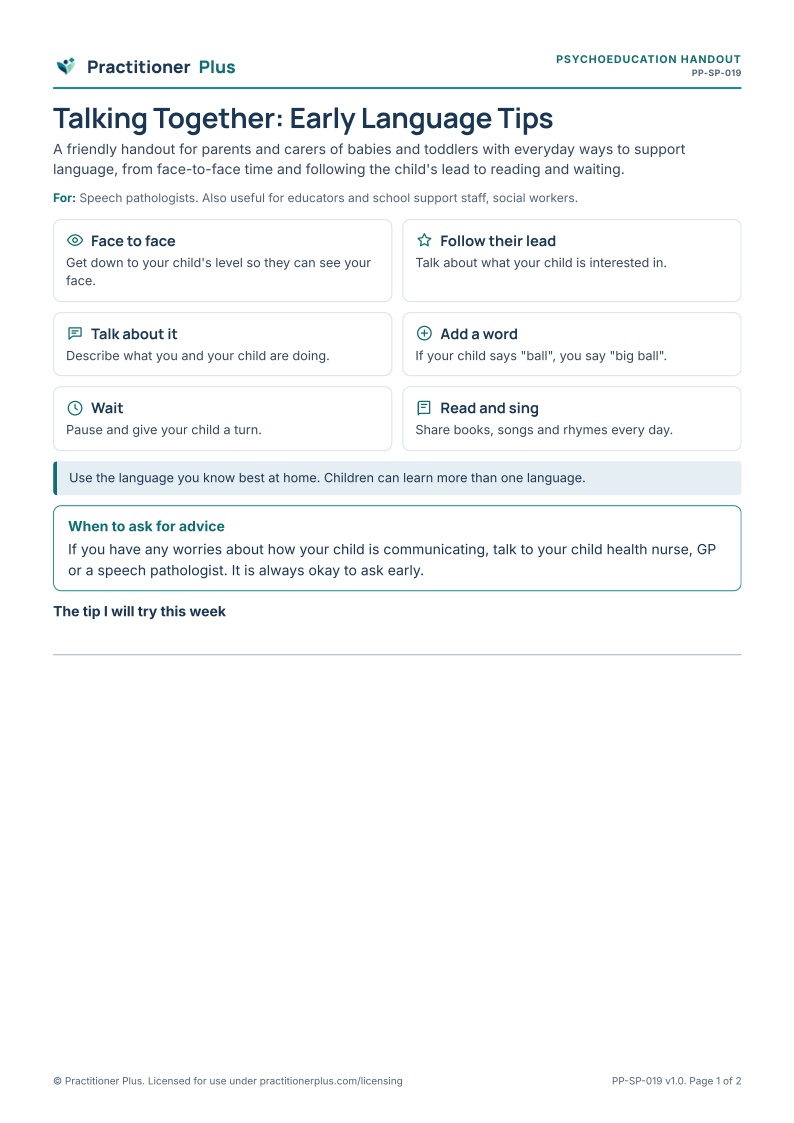
Children learn language through everyday moments with the people who love them. This handout shares simple strategies: getting face to face, following the child's lead, talking about what they are doing, adding a word, waiting, reading and singing together, and when to ask for advice.
Purpose
To share simple, everyday strategies that support early language.
Who it is for
Primary profession: Speech pathologists. Also relevant for educators and school support staff, social workers.
Client or participant group: Parents and carers of babies and toddlers.
Practice setting: Early childhood services, child health and speech pathology.
Suggested uses
- Early childhood education
- Child health visits
- Parent groups
- Speech pathology home programs
Instructions for practitioners
- Model strategies with the family.
- Choose one or two strategies to start.
- Respect home languages; talking in the language the family knows best is important.
- Encourage families to seek advice early if they have concerns.
Instructions for clients or participants
- Pick one tip to try this week.
- Use it in everyday routines.
- Notice what your child does.
Accessibility considerations
Plain language. Can be translated. Pictures support the text.
Scope and limitations
General information. It does not assess language development. Families with concerns should talk to a child health nurse, GP or speech pathologist.
Research basis
Parent-implemented language strategies and interactive shared reading support children's language development. Training communication partners improves communication for people who use AAC and people with aphasia. Parent support that builds positive interactions, consistent responses and emotional communication improves child behaviour and family wellbeing.
- Kaminski, J. W., Valle, L. A., Filene, J. H., & Boyle, C. L. (2008). A meta-analytic review of components associated with parent training program effectiveness. Journal of Abnormal Child Psychology, 36(4), 567–589. https://doi.org/10.1007/s10802-007-9201-9
- Kent-Walsh, J., Murza, K. A., Malani, M. D., & Binger, C. (2015). Effects of Communication Partner Instruction on the Communication of Individuals using AAC: A Meta-Analysis. Augmentative and Alternative Communication, 31(4), 271–284. https://doi.org/10.3109/07434618.2015.1052153
- Mol, S. E., Bus, A. G., de Jong, M. T., & Smeets, D. J. H. (2008). Added Value of Dialogic Parent–Child Book Readings: A Meta-Analysis. Early Education and Development, 19(1), 7–26. https://doi.org/10.1080/10409280701838603
- Roberts, M. Y., & Kaiser, A. P. (2011). The Effectiveness of Parent-Implemented Language Interventions: A Meta-Analysis. American Journal of Speech-Language Pathology, 20(3), 180–199. https://doi.org/10.1044/1058-0360(2011/10-0055)
- Simmons-Mackie, N., Raymer, A., & Cherney, L. R. (2016). Communication Partner Training in Aphasia: An Updated Systematic Review. Archives of Physical Medicine and Rehabilitation, 97(12), 2202–2221.e8. https://doi.org/10.1016/j.apmr.2016.03.023
What is included
A 2-page printable A4 PDF, including a practitioner notes page with the research basis (version 1.0).
Originality
Original Practitioner Plus content: wording, activity structure, layout and icons were created for this resource. No third-party worksheets, illustrations or text were reproduced.


