
About this resource
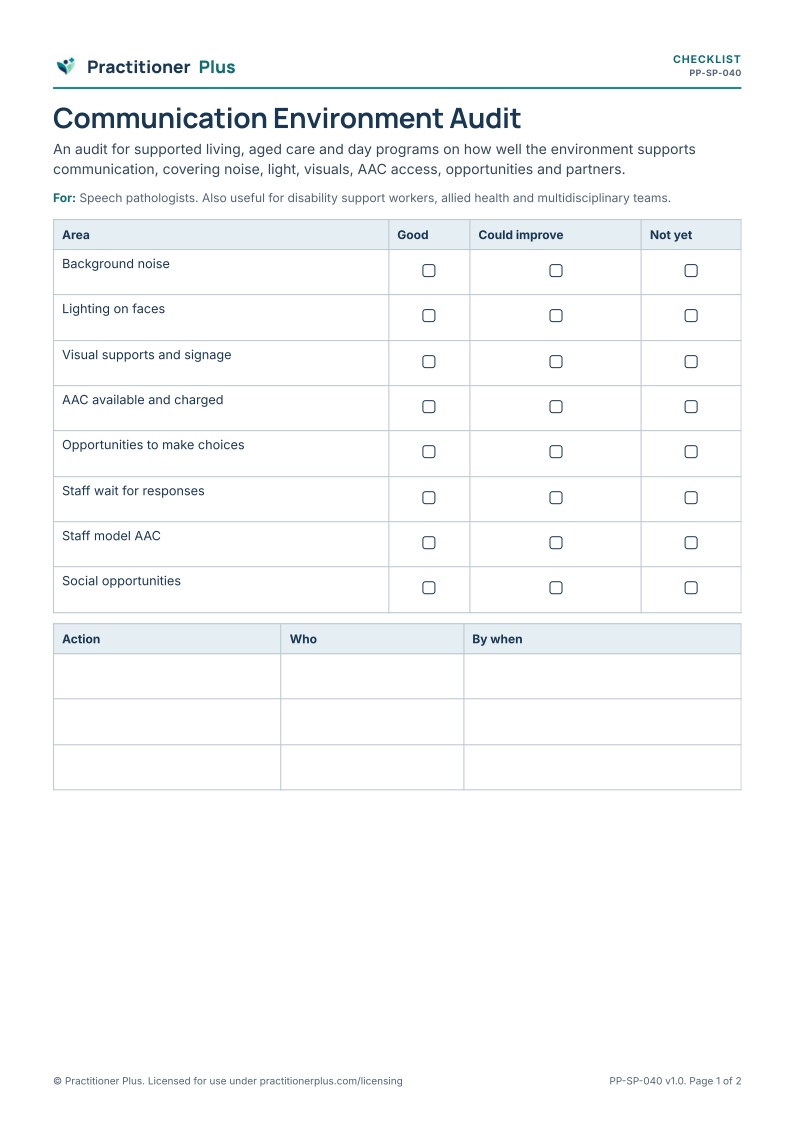
Environments can help or hinder communication. This audit looks at noise, lighting, visual supports, AAC availability, opportunities to communicate during the day and communication partner skills, with an action plan.
Purpose
To identify ways the environment can better support communication.
Who it is for
Primary profession: Speech pathologists. Also relevant for disability support workers, allied health and multidisciplinary teams.
Client or participant group: Speech pathologists and service teams.
Practice setting: Supported living, aged care and day programs.
Suggested uses
- Service quality reviews
- Communication consultation
- Staff training planning
- New services
Instructions for practitioners
- Observe at typical times.
- Include residents' and participants' views.
- Prioritise easy changes.
- Plan partner training.
Accessibility considerations
Editable HTML source available for adaptation.
Scope and limitations
An environmental audit. It does not assess individual communication.
Research basis
Training communication partners improves communication for people who use AAC and people with aphasia.
- Kent-Walsh, J., Murza, K. A., Malani, M. D., & Binger, C. (2015). Effects of Communication Partner Instruction on the Communication of Individuals using AAC: A Meta-Analysis. Augmentative and Alternative Communication, 31(4), 271–284. https://doi.org/10.3109/07434618.2015.1052153
- Simmons-Mackie, N., Raymer, A., & Cherney, L. R. (2016). Communication Partner Training in Aphasia: An Updated Systematic Review. Archives of Physical Medicine and Rehabilitation, 97(12), 2202–2221.e8. https://doi.org/10.1016/j.apmr.2016.03.023
What is included
A 2-page printable A4 PDF, including a practitioner notes page with the research basis (version 1.0).
Originality
Original Practitioner Plus content: wording, activity structure, layout and icons were created for this resource. No third-party worksheets, illustrations or text were reproduced.


