
About this resource
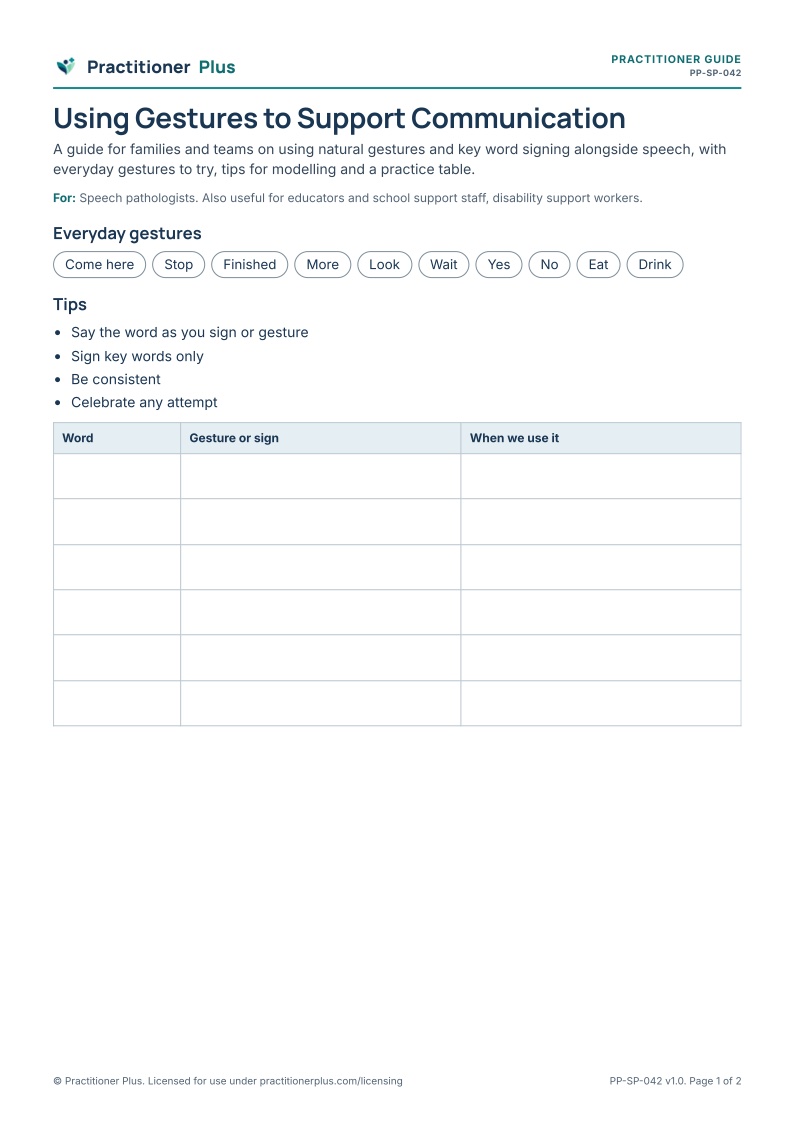
Gestures and signs can support understanding and give people another way to express themselves. This guide covers natural gestures, key word signing alongside speech, tips for modelling, and a table to practise everyday gestures and signs.
Purpose
To support understanding and expression with gestures and signs.
Who it is for
Primary profession: Speech pathologists. Also relevant for educators and school support staff, disability support workers.
Client or participant group: Families and teams of children and adults who benefit from gesture and sign.
Practice setting: Home, early childhood, school and day programs.
Suggested uses
- Early communication
- Supporting people with intellectual disability
- Classrooms
- Home programs
Instructions for practitioners
- Use natural gestures everyone understands.
- Sign key words while speaking.
- Learn signs from an approved key word signing system used locally.
- Model often; do not require the person to copy.
Accessibility considerations
Use photos or video of signs.
Scope and limitations
General guidance. Choose sign systems with a speech pathologist.
Research basis
Training communication partners improves communication for people who use AAC and people with aphasia. Modelling on the person's AAC system (aided language input) improves communication outcomes, especially expressive use, for people with complex communication needs.
- Biggs, E. E., Carter, E. W., & Gilson, C. B. (2018). Systematic Review of Interventions Involving Aided AAC Modeling for Children With Complex Communication Needs. American Journal on Intellectual and Developmental Disabilities, 123(5), 443–473. https://doi.org/10.1352/1944-7558-123.5.443
- Kent-Walsh, J., Murza, K. A., Malani, M. D., & Binger, C. (2015). Effects of Communication Partner Instruction on the Communication of Individuals using AAC: A Meta-Analysis. Augmentative and Alternative Communication, 31(4), 271–284. https://doi.org/10.3109/07434618.2015.1052153
- Sennott, S. C., Light, J. C., & McNaughton, D. (2016). AAC Modeling Intervention Research Review. Research and Practice for Persons with Severe Disabilities, 41(2), 101–115. https://doi.org/10.1177/1540796916638822
- Simmons-Mackie, N., Raymer, A., & Cherney, L. R. (2016). Communication Partner Training in Aphasia: An Updated Systematic Review. Archives of Physical Medicine and Rehabilitation, 97(12), 2202–2221.e8. https://doi.org/10.1016/j.apmr.2016.03.023
What is included
A 2-page printable A4 PDF, including a practitioner notes page with the research basis (version 1.0).
Originality
Original Practitioner Plus content: wording, activity structure, layout and icons were created for this resource. No third-party worksheets, illustrations or text were reproduced.


