
About this resource
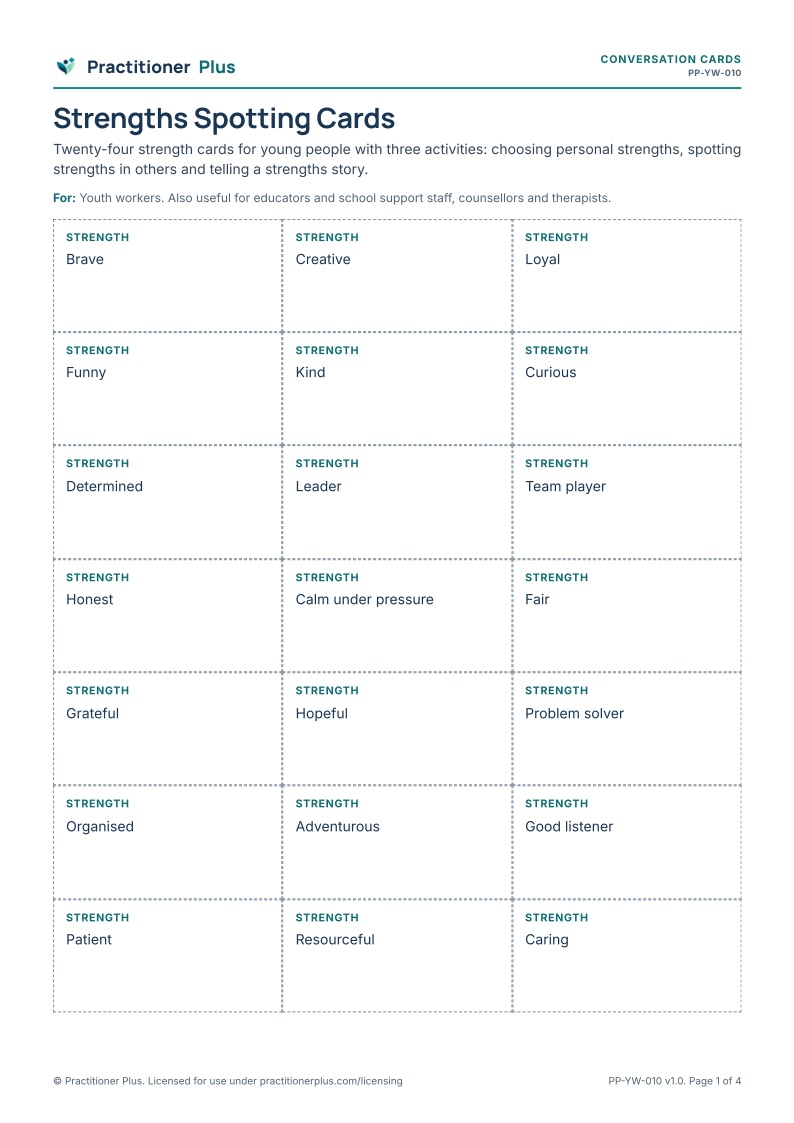
Many young people find it easier to list weaknesses than strengths. These twenty-four cards name everyday strengths in plain language, with three activities: choosing your top strengths, spotting strengths in others, and telling a short story about a time you used one.
Purpose
To help young people recognise and name their strengths and those of others.
Who it is for
Primary profession: Youth workers. Also relevant for educators and school support staff, counsellors and therapists.
Client or participant group: Young people aged about 12 to 25, one to one or in groups.
Practice setting: Youth services, schools, mentoring and group programs.
Suggested uses
- Building rapport and confidence
- Group programs and team building
- Goal setting linked to strengths
- Peer recognition activities
Instructions for practitioners
- Let young people sort cards freely; there are no wrong choices.
- Ask for a real example of each chosen strength.
- In groups, keep strength spotting positive and specific.
- Link strengths to goals the young person cares about.
Instructions for clients or participants
- Pick three cards that fit you.
- Think of a time you used one.
- Spot a strength in someone else.
Accessibility considerations
Cards can be read aloud. Young people can add their own strengths.
Scope and limitations
A strengths-based engagement activity. It is not an assessment.
Research basis
The strengths model, a recovery-oriented approach, builds on people's own abilities, interests and resources.
- Rapp, C. A., & Goscha, R. J. (2012). The strengths model: A recovery-oriented approach to mental health services (3rd ed.). Oxford University Press.
What is included
A 4-page printable A4 PDF, including a practitioner notes page with the research basis (version 1.0).
Originality
Original Practitioner Plus content: wording, activity structure, layout and icons were created for this resource. No third-party worksheets, illustrations or text were reproduced.


