
About this resource
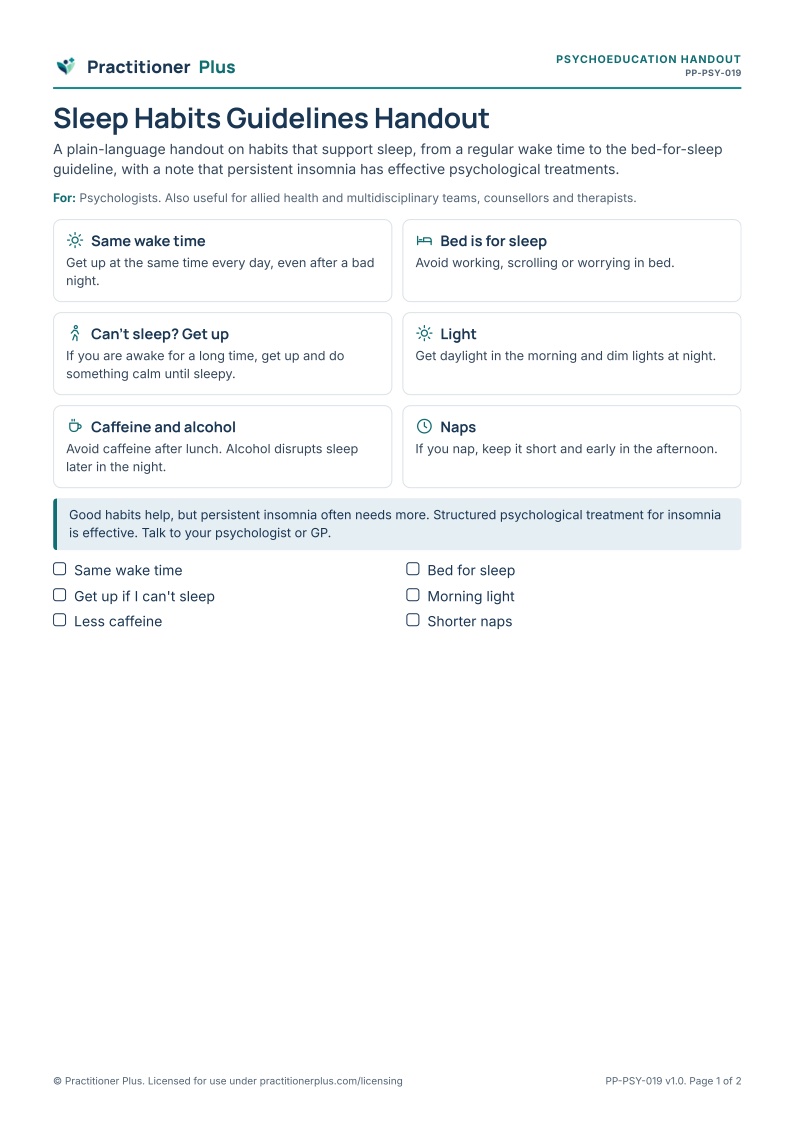
Good sleep habits support sleep, though on their own they are rarely enough for persistent insomnia. This handout covers a regular wake time, using the bed for sleep, getting up if unable to sleep, light, caffeine, alcohol and naps, and explains that structured psychological treatment for insomnia is available.
Purpose
To share practical sleep guidelines and set realistic expectations about what helps.
Who it is for
Primary profession: Psychologists. Also relevant for allied health and multidisciplinary teams, counsellors and therapists.
Client or participant group: Adolescents and adults with sleep difficulties.
Practice setting: Psychology and health settings, as psychoeducation.
Suggested uses
- Psychoeducation
- Paired with a sleep diary
- Preparing for structured insomnia treatment
- General wellbeing
Instructions for practitioners
- Pair with a sleep diary.
- Discuss which guidelines are realistic for the client.
- Consider structured insomnia treatment for persistent insomnia.
- Refer to a GP to rule out other sleep disorders.
Instructions for clients or participants
- Read the guidelines.
- Tick the ones you will try.
- Track your sleep.
Accessibility considerations
Plain language. Can be read aloud.
Scope and limitations
General information. It does not diagnose or treat sleep disorders.
Research basis
Behavioural sleep strategies such as regular sleep and wake times and stimulus control are core parts of cognitive behavioural therapy for insomnia (CBT-I), which improves sleep in adults with chronic insomnia; where poor sleep persists, refer for CBT-I or medical review. Brief psychoeducation can reduce symptoms of depression and psychological distress.
- Donker, T., Griffiths, K. M., Cuijpers, P., & Christensen, H. (2009). Psychoeducation for depression, anxiety and psychological distress: a meta-analysis. BMC Medicine, 7(1), 79. https://doi.org/10.1186/1741-7015-7-79
- Trauer, J. M., Qian, M. Y., Doyle, J. S., Rajaratnam, S. M., & Cunnington, D. (2015). Cognitive Behavioral Therapy for Chronic Insomnia: A Systematic Review and Meta-analysis. Annals of Internal Medicine, 163(3), 191–204. https://doi.org/10.7326/m14-2841
What is included
A 2-page printable A4 PDF, including a practitioner notes page with the research basis (version 1.0).
Originality
Original Practitioner Plus content: wording, activity structure, layout and icons were created for this resource. No third-party worksheets, illustrations or text were reproduced. Reflects widely published sleep guidelines and the established role of cognitive behavioural therapy for insomnia.


