
About this resource
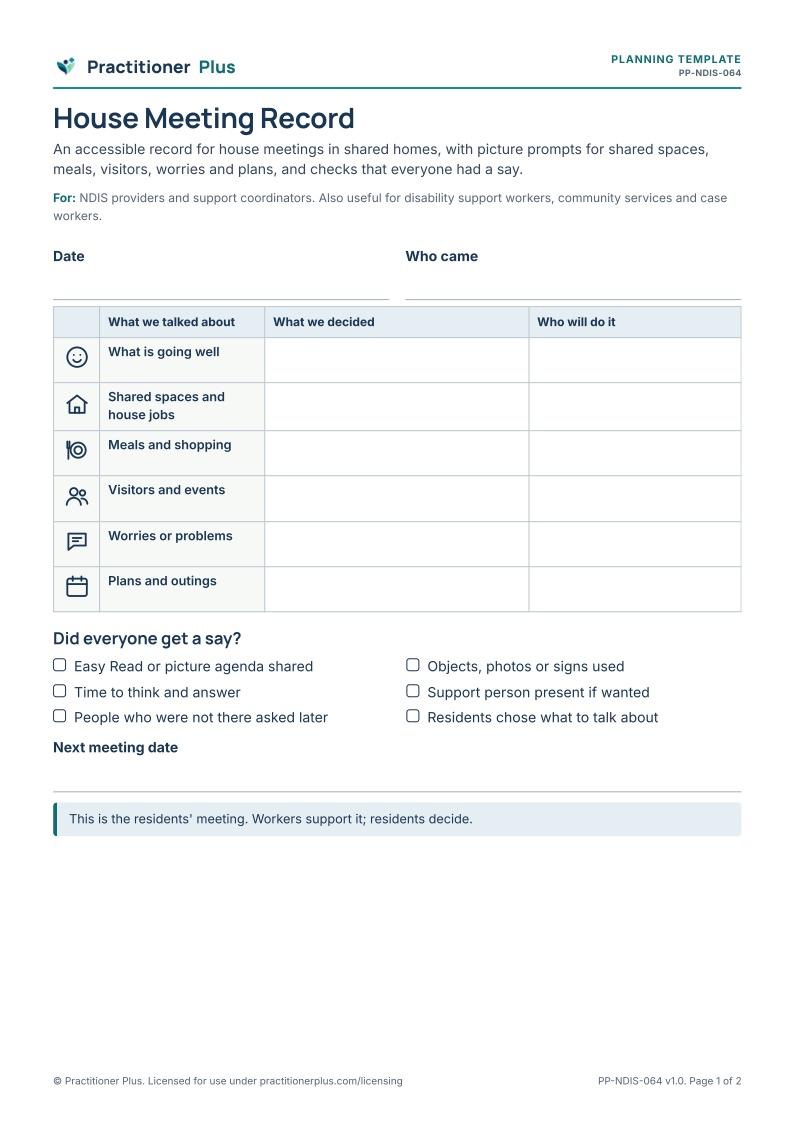
The SIL Practice Standards expect participants to be involved in decisions about their home, including how shared spaces are used, and the SDA and SIL standards both stress participants' voice. A regular house meeting, run for and with residents, is one of the clearest ways to show this. This record uses picture prompts and checks that everyone had a say, including people who communicate without words.
Purpose
To support residents to make decisions about their home together, and to record what they decided.
Who it is for
Primary profession: NDIS providers and support coordinators. Also relevant for disability support workers, community services and case workers.
Client or participant group: People living in shared homes, including supported independent living, with the workers who support their meetings.
Practice setting: Supported independent living and other shared homes.
Suggested uses
- Regular house meetings
- Planning menus, outings and house jobs
- Talking about visitors, shared spaces and changes
- Evidence of participant voice for audits
Instructions for practitioners
- Agree with residents how often to meet, where and who chairs.
- Share the agenda beforehand in Easy Read or with pictures.
- Support each person to have a say in their own way, and ask people who were not there afterwards.
- Record decisions in plain language and follow up actions.
- Bring issues residents raise to the team leader or the SDA provider when needed.
Instructions for clients or participants
- Come to the meeting if you want to.
- Say what is going well and what is not.
- Help decide things about your home.
Accessibility considerations
Picture prompts and short sentences; read aloud or use objects and photos as residents prefer.
Scope and limitations
A meeting and record-keeping tool. Residents' private matters should be discussed privately, not at the house meeting.
Research basis
From 1 July 2026, providers of supported independent living must be registered (class of support 0138) and meet the Core Module and the NDIS Commission's SIL Practice Standards: supported decision-making, safeguarding, practice governance, and agreements about tenancy, housing and support. This resource is organised around those standards; using it does not by itself demonstrate compliance. Easy Read standards and disability rights frameworks support people's right to accessible information; test Easy Read materials with the people who will use them.
- Inclusion Europe. (2009). Information for all: European standards for making information easy to read and understand. https://www.inclusion-europe.eu/easy-to-read-standards-guidelines/
- NDIS Quality and Safeguards Commission. (2026). Mandatory registration and transition pathways for supported independent living (SIL). https://www.ndiscommission.gov.au/about-us/ndis-commission-reform-hub/mandatory-registration/mandatory-registration-SIL
- NDIS Quality and Safeguards Commission. (2026). Supplementary module: Supported independent living (SIL) Practice Standards and Quality Indicators. https://www.ndiscommission.gov.au/rules-and-standards/ndis-practice-standards/sil
- United Nations. (2006). Convention on the Rights of Persons with Disabilities. https://www.ohchr.org/en/instruments-mechanisms/instruments/convention-rights-persons-disabilities
What is included
A 2-page printable A4 PDF, including a practitioner notes page with the research basis (version 1.0).
Originality
Original Practitioner Plus content: wording, activity structure, layout and icons were created for this resource. No third-party worksheets, illustrations or text were reproduced. Written for Practitioner Plus from the NDIS Practice Standards and NDIS rules listed in the research basis; no third-party template was used. It is not an NDIS Commission form.


