
About this resource
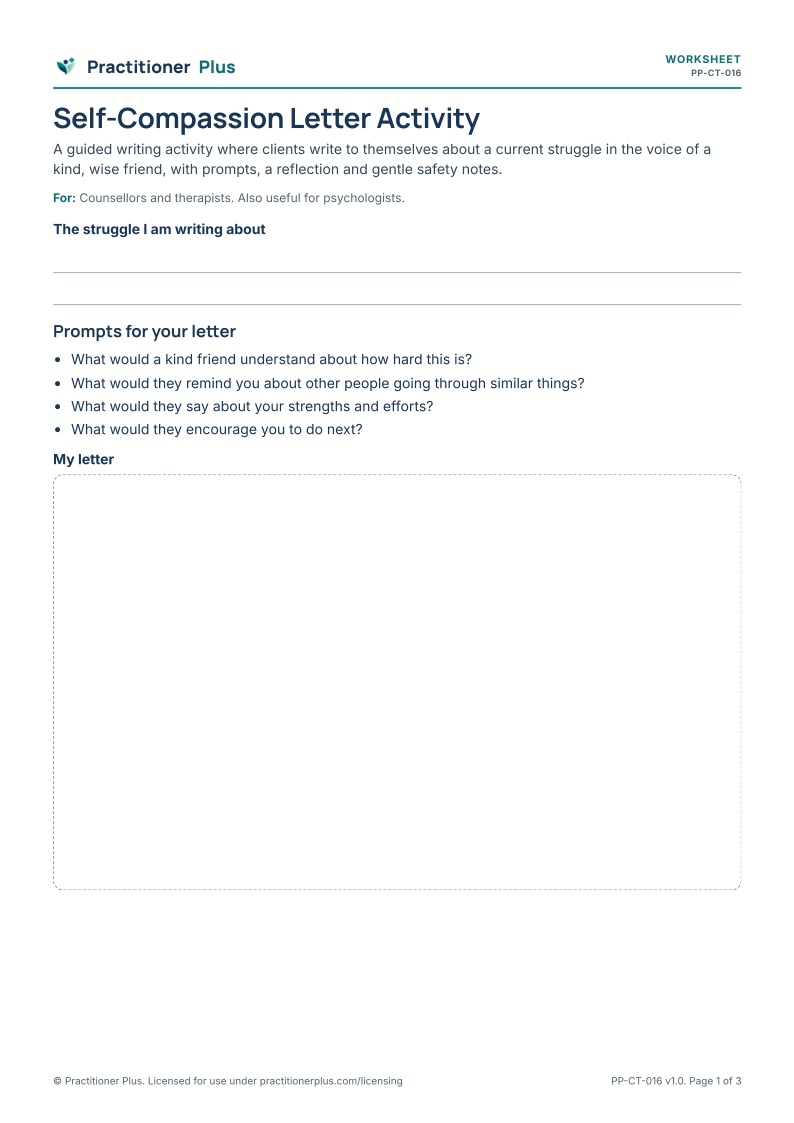
Many people speak to themselves far more harshly than they would speak to a friend. This activity guides clients to write a letter to themselves about a current struggle, in the voice of a kind and wise friend, using prompts about understanding, common humanity and encouragement. A short reflection follows.
Purpose
To help clients practise responding to their own struggles with warmth and understanding.
Who it is for
Primary profession: Counsellors and therapists. Also relevant for psychologists.
Client or participant group: Adolescents and adults who are very self-critical.
Practice setting: Individual counselling, as an in-session or between-session activity.
Suggested uses
- Working with self-criticism and shame
- Building self-kindness
- Between-session writing
- Group programs
Instructions for practitioners
- Introduce self-compassion as a skill, not self-pity.
- Choose a manageable struggle to start with.
- Notice if the activity brings up strong feelings and slow down if it does.
- Discuss the reflection together.
Instructions for clients or participants
- Choose something you are finding hard.
- Write to yourself as a kind friend would.
- Read it back and notice how it feels.
Accessibility considerations
Can be spoken or recorded instead of written.
Scope and limitations
A therapeutic writing activity. For some people it can bring up strong emotions; use within a supportive counselling relationship.
Research basis
Higher self-compassion is associated with lower distress, and compassion-focused approaches target self-criticism and shame. Cognitive behavioural therapy (CBT) has a strong research base for anxiety, depression and many related problems; this resource uses CBT techniques to support, not replace, a structured treatment plan.
- Beck, J. S. (2021). Cognitive behavior therapy: Basics and beyond (3rd ed.). Guilford Press.
- Gilbert, P. (2009). Introducing compassion-focused therapy. Advances in Psychiatric Treatment, 15(3), 199–208. https://doi.org/10.1192/apt.bp.107.005264
- Hofmann, S. G., Asnaani, A., Vonk, I. J. J., Sawyer, A. T., & Fang, A. (2012). The Efficacy of Cognitive Behavioral Therapy: A Review of Meta-analyses. Cognitive Therapy and Research, 36(5), 427–440. https://doi.org/10.1007/s10608-012-9476-1
- MacBeth, A., & Gumley, A. (2012). Exploring compassion: A meta-analysis of the association between self-compassion and psychopathology. Clinical Psychology Review, 32(6), 545–552. https://doi.org/10.1016/j.cpr.2012.06.003
- NEFF, K. (2003). Self-Compassion: An Alternative Conceptualization of a Healthy Attitude Toward Oneself. Self and Identity, 2(2), 85–101. https://doi.org/10.1080/15298860309032
What is included
A 3-page printable A4 PDF, including a practitioner notes page with the research basis (version 1.0).
Originality
Original Practitioner Plus content: wording, activity structure, layout and icons were created for this resource. No third-party worksheets, illustrations or text were reproduced. Reflects widely used self-compassion writing exercises.


