
About this resource
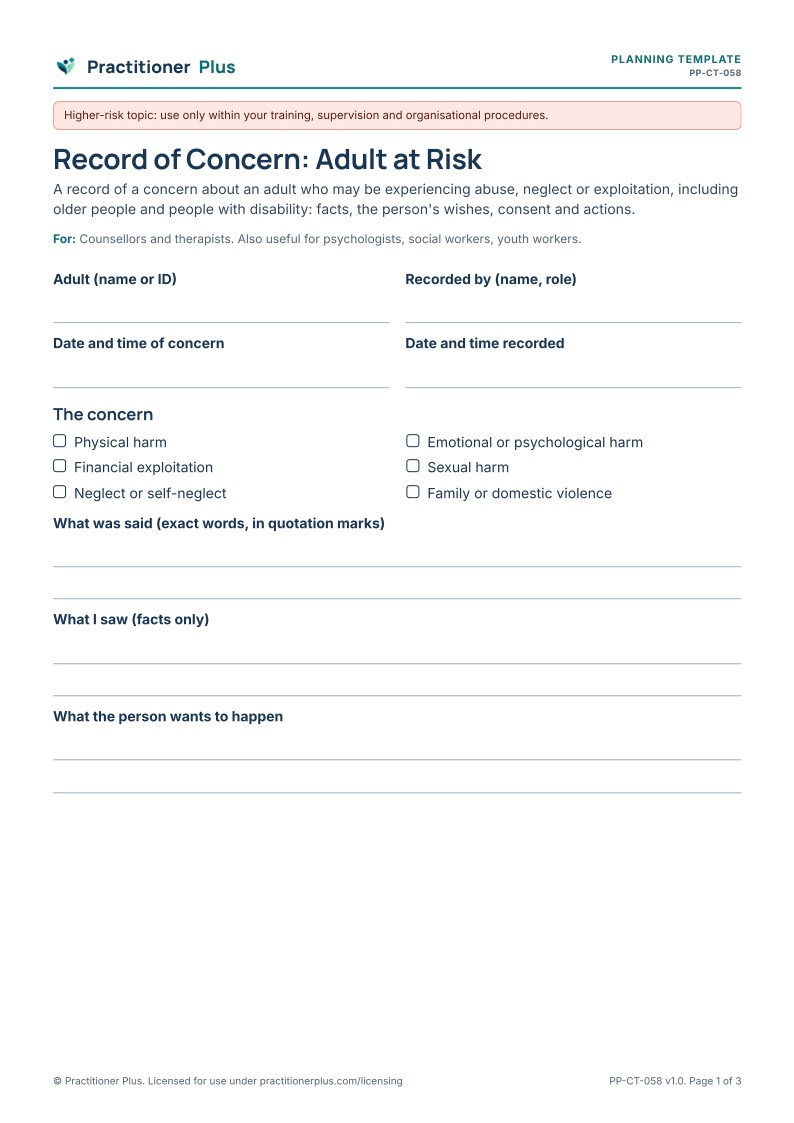
Concerns about adults raise different questions from concerns about children. Most adults have the right to make their own decisions, including decisions others disagree with, so this record starts with what the person wants and whether they consent to sharing. It records facts, the person's wishes, any questions about decision-making capacity, advice sought and actions taken, for concerns such as elder abuse, financial exploitation or neglect.
Purpose
To record a concern about an adult at risk while respecting their rights and wishes.
Who it is for
Primary profession: Counsellors and therapists. Also relevant for psychologists, social workers, youth workers.
Client or participant group: Adults who may be at risk of abuse, neglect or exploitation, including older people and people with disability.
Practice setting: Counselling and therapy services, including private practice, schools and community services.
Suggested uses
- Concerns about elder abuse or financial exploitation
- Concerns about a person with disability
- Self-neglect or carer stress
- Recording decisions about sharing information
Instructions for practitioners
- If anyone is in immediate danger, call 000.
- Talk with the person alone if you can, and ask what they want to happen.
- Record facts separately from opinions.
- Seek consent to share information, unless a serious threat means you may need to act without it.
- Consult your supervisor and consider advocacy or specialist services.
Accessibility considerations
Use the person's own words. Offer an interpreter, a support person or a different format where it helps.
Scope and limitations
A record-keeping tool. It does not decide capacity and does not replace legal advice, your organisation's procedures or specialist assessment. For elder abuse advice, call 1800ELDERHelp on 1800 353 374. For an NDIS participant, the NDIS Commission can be contacted on 1800 035 544. In an emergency, call 000.
Higher-risk topic: use only within your training, supervision and organisational procedures.
Research basis
Australian privacy law allows personal information to be shared without consent where this is reasonably believed necessary to lessen or prevent a serious threat to someone's life, health or safety. Professional guidance asks counsellors to keep accurate records, explain the limits of confidentiality and seek advice. Human rights frameworks and research on the dignity of risk support people's right to make their own choices, including choices that involve some risk.
- Ibrahim, J. E., & Davis, M. (2013). Impediments to applying the ‘dignity of risk’ principle in residential aged care services. Australasian Journal on Ageing, 32(3), 188–193. https://doi.org/10.1111/ajag.12014
- Office of the Australian Information Commissioner. Australian Privacy Principles guidelines, Chapter C: Permitted general situations. https://www.oaic.gov.au/privacy/australian-privacy-principles/australian-privacy-principles-guidelines/chapter-c-permitted-general-situations
- Psychotherapy and Counselling Federation of Australia. Code of Ethics. https://pacfa.org.au/Portal/Prac-Res/Code-of-Ethics.aspx
- Psychotherapy and Counselling Federation of Australia. Good practice guidelines. https://pacfa.org.au/portal/Portal/Prac-Res/Good-Practice-Guidelines.aspx
- United Nations. (2006). Convention on the Rights of Persons with Disabilities. https://www.ohchr.org/en/instruments-mechanisms/instruments/convention-rights-persons-disabilities
What is included
A 3-page printable A4 PDF, including a practitioner notes page with the research basis (version 1.0).
Originality
Original Practitioner Plus content: wording, activity structure, layout and icons were created for this resource. No third-party worksheets, illustrations or text were reproduced. Written for Practitioner Plus from the guidelines and research listed in the research basis; no third-party template was used.


