
About this resource
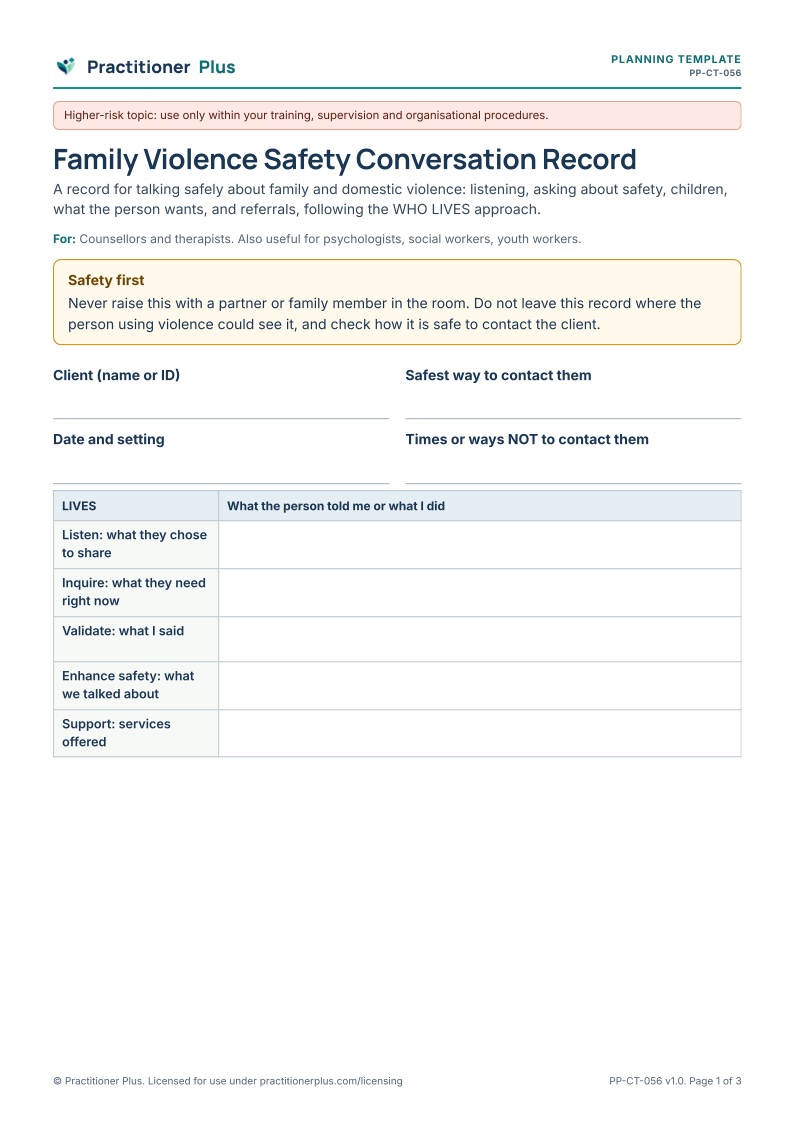
The World Health Organization's first-line support is summarised as LIVES: listen, inquire about needs, validate, enhance safety and support. Australian states have their own risk frameworks, such as MARAM in Victoria, so check what applies to your service. This record follows the LIVES steps and keeps the person's own decisions at the centre. Records about violence can be dangerous if the person using violence sees them, so take particular care with storage and who can access them.
Purpose
To respond safely when a client discloses family or domestic violence, and to record it with care.
Who it is for
Primary profession: Counsellors and therapists. Also relevant for psychologists, social workers, youth workers.
Client or participant group: Adults and young people seeing a counsellor or therapist.
Practice setting: Counselling and therapy services, including private practice, schools and community services.
Suggested uses
- When a client discloses family or domestic violence
- Safety conversations during counselling
- Referral to specialist services
- Supervision
Instructions for practitioners
- Only talk about violence when the person is alone and safe.
- Listen and believe. Do not pressure the person to leave or make decisions.
- Ask about immediate safety and about any children.
- Offer specialist services such as 1800RESPECT on 1800 737 732.
- Consider child protection obligations.
- Store this record securely; never send it to a shared address or home.
Accessibility considerations
Use the person's own words. Offer an interpreter, a support person or a different format where it helps.
Scope and limitations
A conversation and record-keeping tool. It is not a formal family violence risk assessment and does not replace specialist services or your state's risk framework. In an emergency, call 000. 1800RESPECT: 1800 737 732.
Higher-risk topic: use only within your training, supervision and organisational procedures.
Research basis
World Health Organization guidance describes first-line support for people experiencing violence as listening, asking about needs, validating, improving safety and connecting to support (LIVES). Australian states also have their own risk frameworks, such as MARAM in Victoria.
- Victorian Government. MARAM practice guides and resources. https://www.vic.gov.au/maram-practice-guides-and-resources
- World Health Organization. (2014). Health care for women subjected to intimate partner violence or sexual violence: A clinical handbook. https://www.who.int/publications/i/item/WHO-RHR-14.26
What is included
A 3-page printable A4 PDF, including a practitioner notes page with the research basis (version 1.0).
Originality
Original Practitioner Plus content: wording, activity structure, layout and icons were created for this resource. No third-party worksheets, illustrations or text were reproduced. Written for Practitioner Plus from the guidelines and research listed in the research basis; no third-party template was used.


