
About this resource
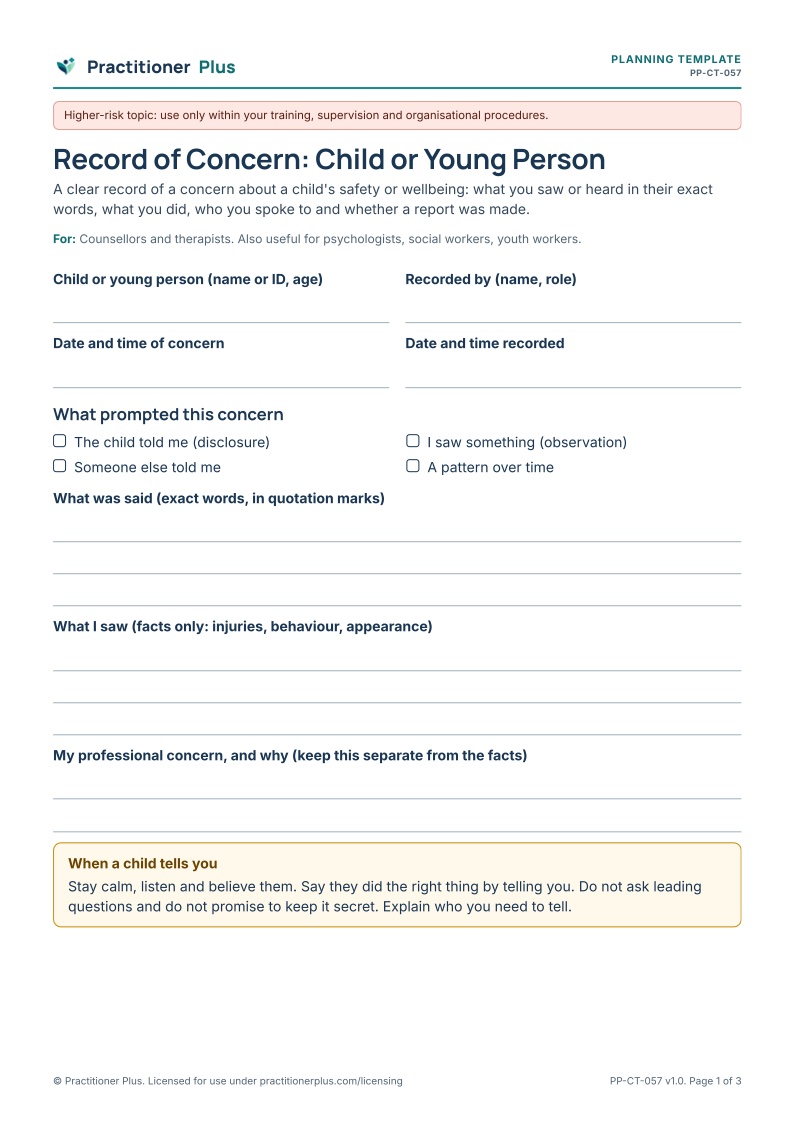
A record of concern captures what you saw or heard, in plain facts, at the time. Mandatory reporting laws differ across Australia, including who must report and what must be reported, so this record prompts you to check your own obligations. Anyone can make a report if they are worried about a child. It keeps facts separate from opinions, records exact words and shows what was done and why.
Purpose
To document a concern about a child or young person accurately and act on it.
Who it is for
Primary profession: Counsellors and therapists. Also relevant for psychologists, social workers, youth workers.
Client or participant group: Children and young people about whom a practitioner has a safety or wellbeing concern.
Practice setting: Counselling and therapy services, including private practice, schools and community services.
Suggested uses
- When a child or young person discloses harm
- When you notice signs that worry you
- When someone else tells you about a concern
- Recording a decision about reporting
Instructions for practitioners
- If a child is in immediate danger, call 000.
- Listen calmly. Do not ask leading questions or promise to keep a secret.
- Write it down as soon as you can, using the child's exact words.
- Separate what you saw and heard from what you think.
- Talk to your supervisor or safeguarding lead, and check your reporting obligations for your state or territory.
- Do not contact parents or carers first if that could put the child at risk; get advice.
Accessibility considerations
Use the person's own words. Offer an interpreter, a support person or a different format where it helps.
Scope and limitations
A record-keeping tool. It does not replace mandatory reporting obligations or your organisation's child safety procedures. Reporting laws differ by state and territory: check who must report, what must be reported and how. In an emergency, call 000.
Higher-risk topic: use only within your training, supervision and organisational procedures.
Research basis
Mandatory reporting laws differ across Australian states and territories, including who must report and which kinds of harm are covered, so practitioners need to check their own obligations. Australian privacy law allows personal information to be shared without consent where this is reasonably believed necessary to lessen or prevent a serious threat to someone's life, health or safety. Professional guidance asks counsellors to keep accurate records, explain the limits of confidentiality and seek advice.
- Australian Institute of Family Studies. Mandatory reporting of child abuse and neglect. https://aifs.gov.au/resources/resource-sheets/mandatory-reporting-child-abuse-and-neglect
- Office of the Australian Information Commissioner. Australian Privacy Principles guidelines, Chapter C: Permitted general situations. https://www.oaic.gov.au/privacy/australian-privacy-principles/australian-privacy-principles-guidelines/chapter-c-permitted-general-situations
- Psychotherapy and Counselling Federation of Australia. Code of Ethics. https://pacfa.org.au/Portal/Prac-Res/Code-of-Ethics.aspx
- Psychotherapy and Counselling Federation of Australia. Good practice guidelines. https://pacfa.org.au/portal/Portal/Prac-Res/Good-Practice-Guidelines.aspx
What is included
A 3-page printable A4 PDF, including a practitioner notes page with the research basis (version 1.0).
Originality
Original Practitioner Plus content: wording, activity structure, layout and icons were created for this resource. No third-party worksheets, illustrations or text were reproduced. Written for Practitioner Plus from the guidelines and research listed in the research basis; no third-party template was used.


