
About this resource
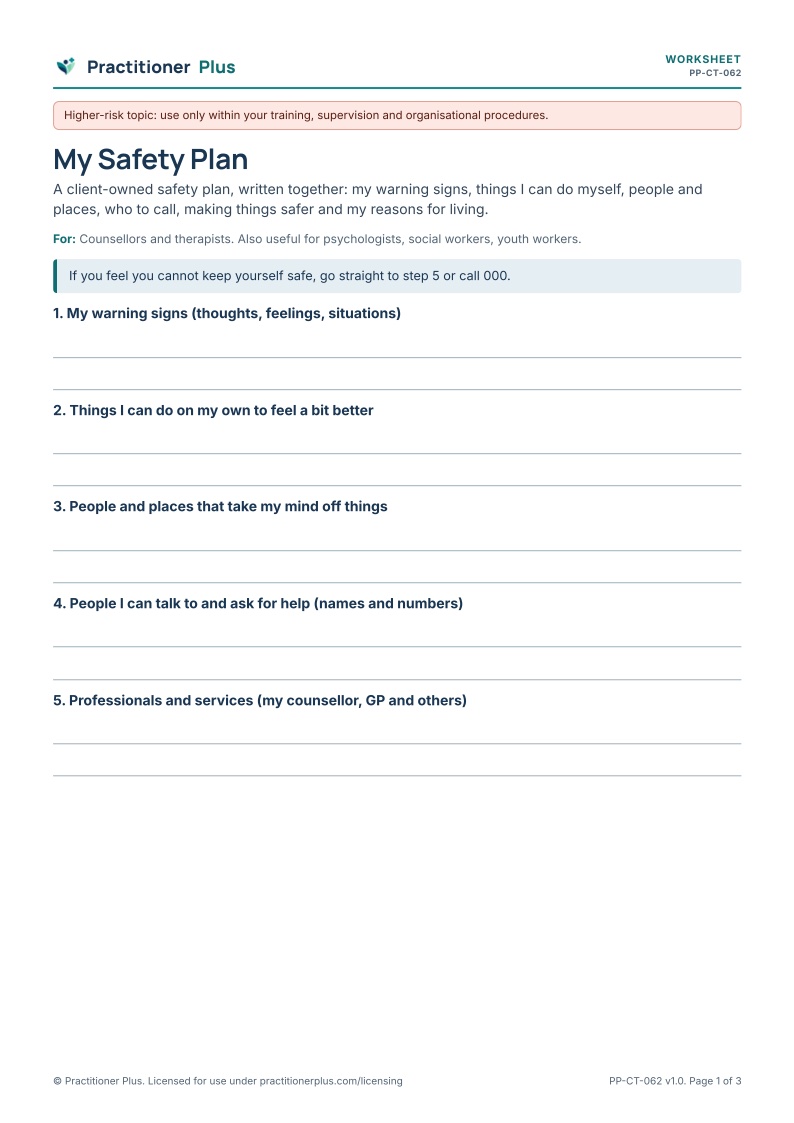
Safety planning is a brief, evidence-based intervention that reduces suicidal behaviour. A good plan is written with the person, in their own words, and kept somewhere easy to find. This original template moves through steps from what the person can do alone to who to contact, with space for making their surroundings safer and for what matters most to them.
Purpose
To help a client write a personal plan for getting through a suicidal crisis.
Who it is for
Primary profession: Counsellors and therapists. Also relevant for psychologists, social workers, youth workers.
Client or participant group: Adults and young people seeing a counsellor or therapist.
Practice setting: Counselling and therapy services, including private practice, schools and community services.
Suggested uses
- After a suicide risk conversation
- Reviewing a plan during therapy
- Sharing with a trusted person, with consent
Instructions for practitioners
- Write the plan together, in the person's words.
- Make each step specific and realistic.
- Talk through making means safer.
- Agree who has a copy and where it is kept.
- Review it regularly and after any crisis.
Instructions for clients or participants
- Fill this in with your counsellor.
- Keep it somewhere you can find it easily, such as a photo on your phone.
- Use the steps in order, and skip to getting help if you need to.
Accessibility considerations
Use the person's own words. Offer an interpreter, a support person or a different format where it helps.
Scope and limitations
A safety planning tool completed with a practitioner. It does not replace crisis care. If someone is in immediate danger, call 000. Lifeline: 13 11 14. Suicide Call Back Service: 1300 659 467. 13YARN: 13 92 76. Kids Helpline: 1800 55 1800.
Higher-risk topic: use only within your training, supervision and organisational procedures.
Research basis
Safety planning is an evidence-based brief intervention that reduces suicidal behaviour and increases engagement with care.
- Stanley, B., & Brown, G. K. (2012). Safety Planning Intervention: A Brief Intervention to Mitigate Suicide Risk. Cognitive and Behavioral Practice, 19(2), 256–264. https://doi.org/10.1016/j.cbpra.2011.01.001
- Stanley, B., Brown, G. K., Brenner, L. A., Galfalvy, H. C., Currier, G. W., Knox, K. L., Chaudhury, S. R., Bush, A. L., & Green, K. L. (2018). Comparison of the Safety Planning Intervention With Follow-up vs Usual Care of Suicidal Patients Treated in the Emergency Department. JAMA Psychiatry, 75(9), 894. https://doi.org/10.1001/jamapsychiatry.2018.1776
What is included
A 3-page printable A4 PDF, including a practitioner notes page with the research basis (version 1.0).
Originality
Original Practitioner Plus content: wording, activity structure, layout and icons were created for this resource. No third-party worksheets, illustrations or text were reproduced. Written for Practitioner Plus from the guidelines and research listed in the research basis; no third-party template was used.


