
About this resource
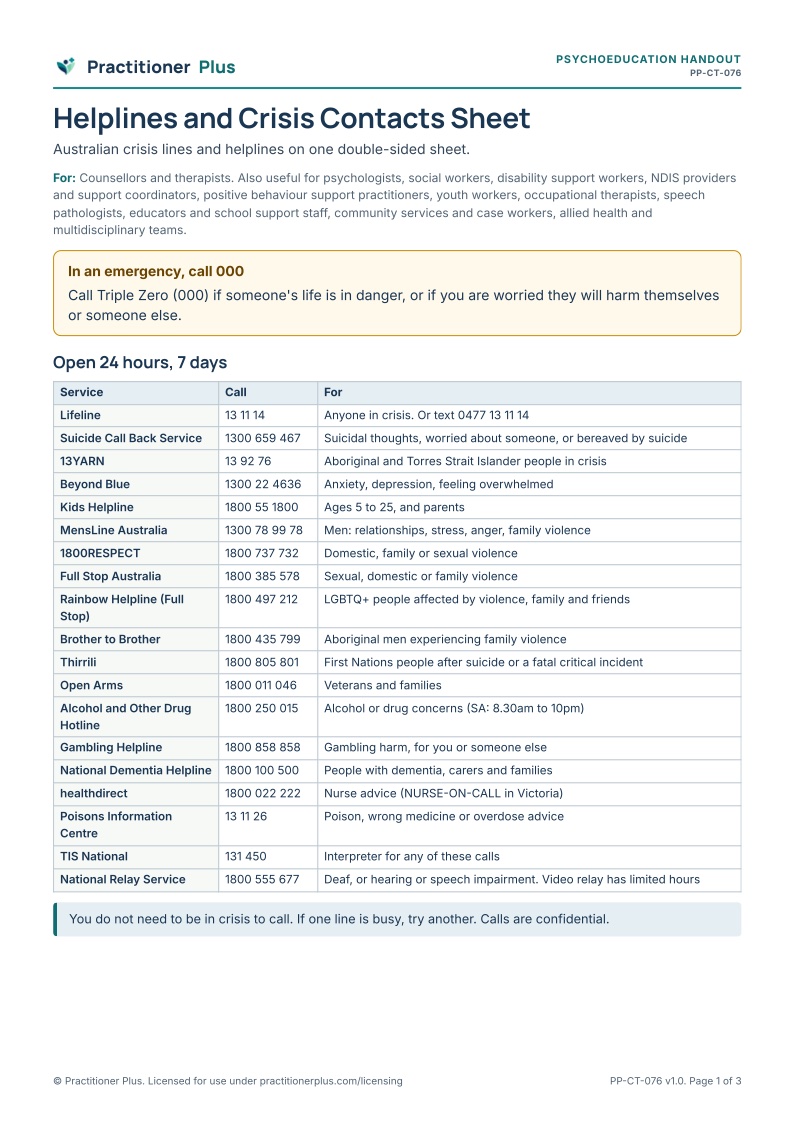
A single sheet of Australian helplines to print, keep on the wall or give to a client. The front lists services that answer 24 hours a day. The back lists services with limited hours, state and territory mental health lines, and child protection numbers. Each number and its hours were checked on the service's own site or an official government site on 6 November 2026.
Purpose
Australian crisis lines and helplines on one double-sided sheet.
Who it is for
Primary profession: Counsellors and therapists. Also relevant for psychologists, social workers, disability support workers, NDIS providers and support coordinators, positive behaviour support practitioners, youth workers, occupational therapists, speech pathologists, educators and school support staff, community services and case workers, allied health and multidisciplinary teams.
Client or participant group: Anyone needing help, and the practitioners and teams supporting them.
Practice setting: Any setting.
Suggested uses
- Printing for your waiting room or staff office
- Giving to a client at the end of a session
- Adding to a safety plan or welcome pack
- Keeping on your phone
Instructions for practitioners
- Print it double-sided, or save it to your phone.
- Add your own after-hours contact if you have one.
- Go through it with the person, and save the numbers that matter to them.
- Check the numbers each year.
Accessibility considerations
Clear headings and tables. The Word version can be edited and filled in on screen.
Scope and limitations
A contact list, not a substitute for crisis care. If someone is in immediate danger, call 000. Details were checked on 6 November 2026 and can change.
Research basis
Safety planning is an evidence-based brief intervention that reduces suicidal behaviour and increases engagement with care. Young people are more likely to seek help when they know where to go, trust the person and feel less stigma.
- Rickwood, D., Deane, F. P., Wilson, C. J., & Ciarrochi, J. (2005). Young people’s help-seeking for mental health problems. Australian e-Journal for the Advancement of Mental Health, 4(3), 218–251. https://doi.org/10.5172/jamh.4.3.218
- Stanley, B., & Brown, G. K. (2012). Safety Planning Intervention: A Brief Intervention to Mitigate Suicide Risk. Cognitive and Behavioral Practice, 19(2), 256–264. https://doi.org/10.1016/j.cbpra.2011.01.001
- Stanley, B., Brown, G. K., Brenner, L. A., Galfalvy, H. C., Currier, G. W., Knox, K. L., Chaudhury, S. R., Bush, A. L., & Green, K. L. (2018). Comparison of the Safety Planning Intervention With Follow-up vs Usual Care of Suicidal Patients Treated in the Emergency Department. JAMA Psychiatry, 75(9), 894. https://doi.org/10.1001/jamapsychiatry.2018.1776
What is included
A 3-page printable A4 PDF, including a practitioner notes page with the research basis (version 1.0).
Originality
Original Practitioner Plus content: wording, activity structure, layout and icons were created for this resource. No third-party worksheets, illustrations or text were reproduced. Written for Practitioner Plus from the sources in the research basis.


