
About this resource
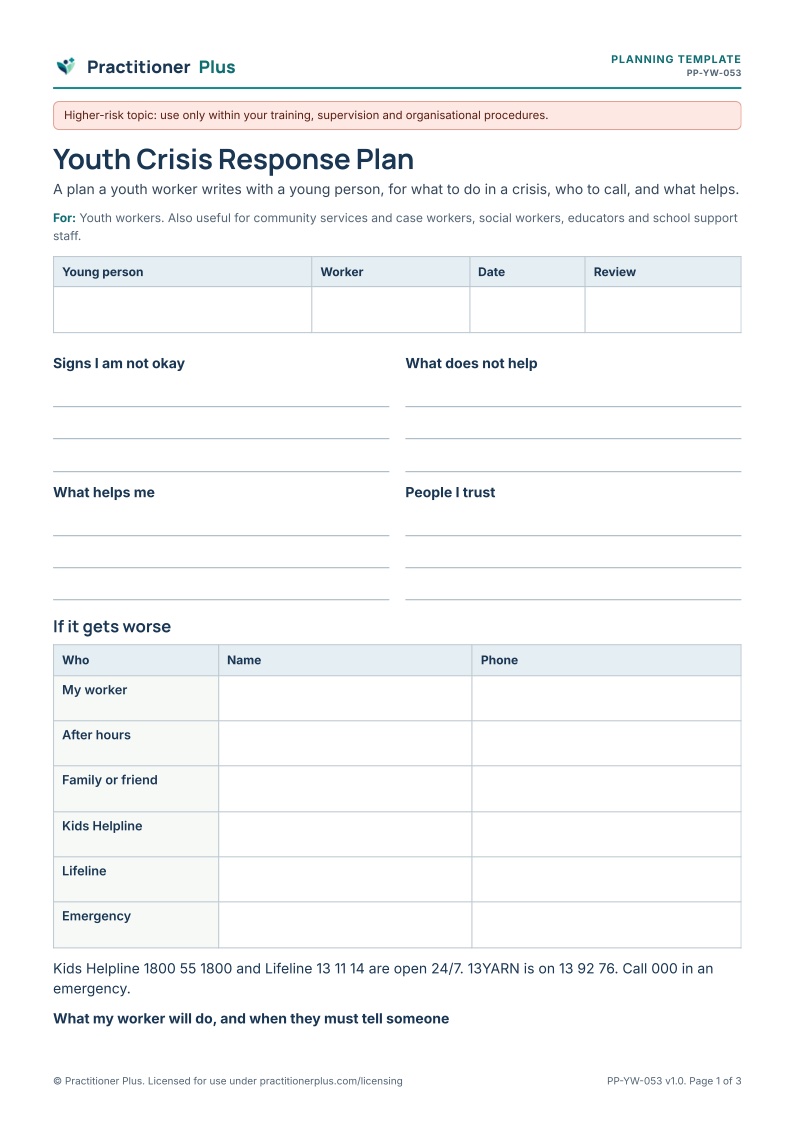
This plan helps a young person and worker agree on warning signs, what helps, who to call and what will happen. It works alongside a safety plan.
Purpose
A plan a youth worker writes with a young person, for what to do in a crisis, who to call, and what helps.
Who it is for
Primary profession: Youth workers. Also relevant for community services and case workers, social workers, educators and school support staff.
Client or participant group: Youth workers and young people.
Practice setting: Youth services.
Suggested uses
- Outreach
- Residential care
- School wellbeing
Instructions for practitioners
- Add your details and delete what does not apply.
- Check it against your professional requirements.
- Explain it to the person in plain language.
- Store completed copies securely.
Accessibility considerations
Clear headings and tables. The Word version can be edited and filled in on screen.
Scope and limitations
A planning tool. Use it within your organisation's risk procedures. It does not replace a clinical assessment.
Higher-risk topic: use only within your training, supervision and organisational procedures.
Research basis
Safety planning is an evidence-based brief intervention that reduces suicidal behaviour and increases engagement with care. Young people are more likely to seek help when they know where to go, trust the person and feel less stigma.
- Rickwood, D., Deane, F. P., Wilson, C. J., & Ciarrochi, J. (2005). Young people’s help-seeking for mental health problems. Australian e-Journal for the Advancement of Mental Health, 4(3), 218–251. https://doi.org/10.5172/jamh.4.3.218
- Stanley, B., & Brown, G. K. (2012). Safety Planning Intervention: A Brief Intervention to Mitigate Suicide Risk. Cognitive and Behavioral Practice, 19(2), 256–264. https://doi.org/10.1016/j.cbpra.2011.01.001
- Stanley, B., Brown, G. K., Brenner, L. A., Galfalvy, H. C., Currier, G. W., Knox, K. L., Chaudhury, S. R., Bush, A. L., & Green, K. L. (2018). Comparison of the Safety Planning Intervention With Follow-up vs Usual Care of Suicidal Patients Treated in the Emergency Department. JAMA Psychiatry, 75(9), 894. https://doi.org/10.1001/jamapsychiatry.2018.1776
What is included
A 3-page printable A4 PDF, including a practitioner notes page with the research basis (version 1.0).
Originality
Original Practitioner Plus content: wording, activity structure, layout and icons were created for this resource. No third-party worksheets, illustrations or text were reproduced. Written for Practitioner Plus from the sources in the research basis.


