
About this resource
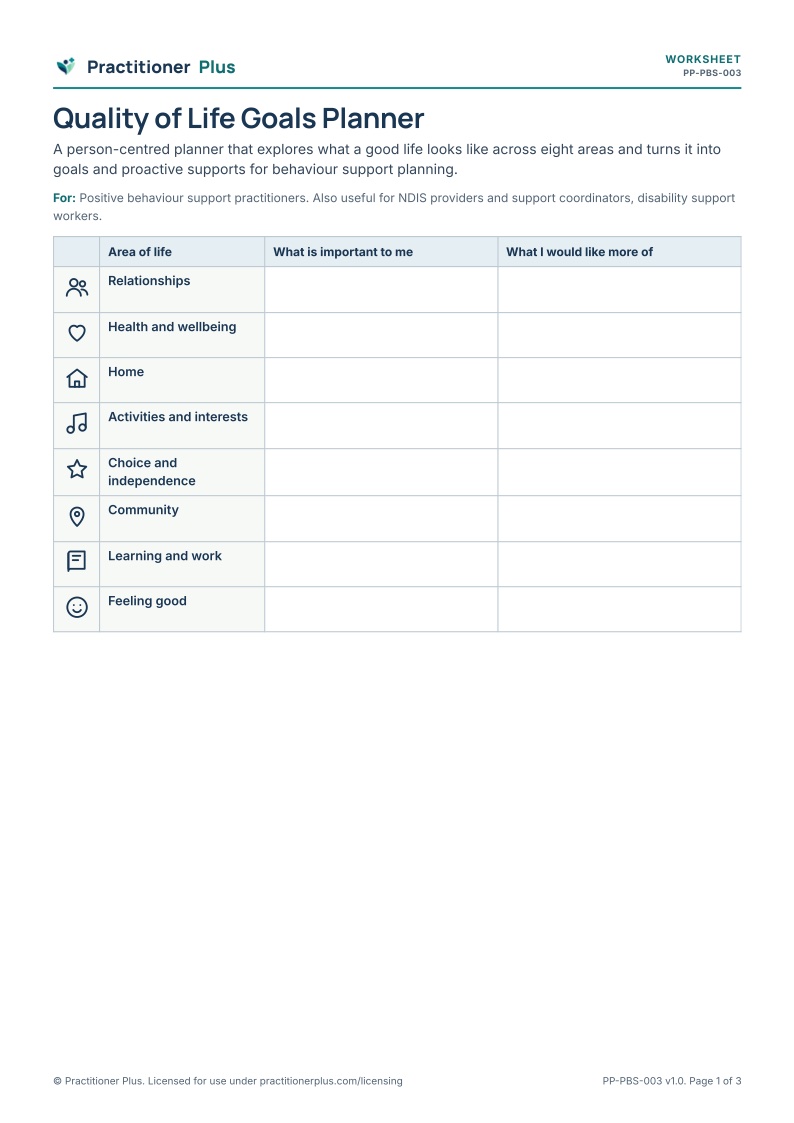
Positive behaviour support aims to improve quality of life, not only to reduce behaviours. This planner explores eight areas of a good life with the person and those who know them well, then turns what matters into goals and proactive supports.
Purpose
To keep quality of life at the centre of behaviour support by identifying meaningful goals and the supports that make them possible.
Who it is for
Primary profession: Positive behaviour support practitioners. Also relevant for NDIS providers and support coordinators, disability support workers.
Client or participant group: People receiving behaviour support, their families and support teams.
Practice setting: Planning meetings and reviews led or supported by a behaviour support practitioner.
Suggested uses
- Early stages of behaviour support planning
- Reviewing whether supports are improving quality of life
- Person-centred planning meetings
- Refocusing a team on the person's goals
Instructions for practitioners
- Gather the person's views first, using their preferred communication.
- Explore each area with the person and those who know them well.
- Choose a small number of meaningful goals.
- Identify proactive supports and skills to build for each goal.
Instructions for clients or participants
- Tell us what a good life looks like for you.
- Choose what you would like more of.
Accessibility considerations
Use photos, objects, observation and trusted supporters to understand preferences for people who communicate without words.
Scope and limitations
A person-centred planning tool. It is not a behaviour support plan and does not recommend restrictive practices.
Research basis
Person-centred planning shows positive but limited evidence of improving community participation and everyday choice for people with intellectual disability. Positive behaviour support aims to improve quality of life and reduce behaviours of concern by understanding their function and changing environments and skills.
- Allen, D., James, W., Evans, J., Hawkins, S., & Jenkins, R. (2005). Positive Behavioural Support: Definition, Current Status and Future Directions. Tizard Learning Disability Review, 10(2), 4–11. https://doi.org/10.1108/13595474200500014
- NDIS Quality and Safeguards Commission. NDIS Practice Standards and Quality Indicators. https://www.ndiscommission.gov.au/rules-and-standards/ndis-practice-standards
- Ratti, V., Hassiotis, A., Crabtree, J., Deb, S., Gallagher, P., & Unwin, G. (2016). The effectiveness of person-centred planning for people with intellectual disabilities: A systematic review. Research in Developmental Disabilities, 57, 63–84. https://doi.org/10.1016/j.ridd.2016.06.015
What is included
A 3-page printable A4 PDF, including a practitioner notes page with the research basis (version 1.0).
Originality
Original Practitioner Plus content: wording, activity structure, layout and icons were created for this resource. No third-party worksheets, illustrations or text were reproduced. Reflects the quality-of-life focus that is central to positive behaviour support.


