
About this resource
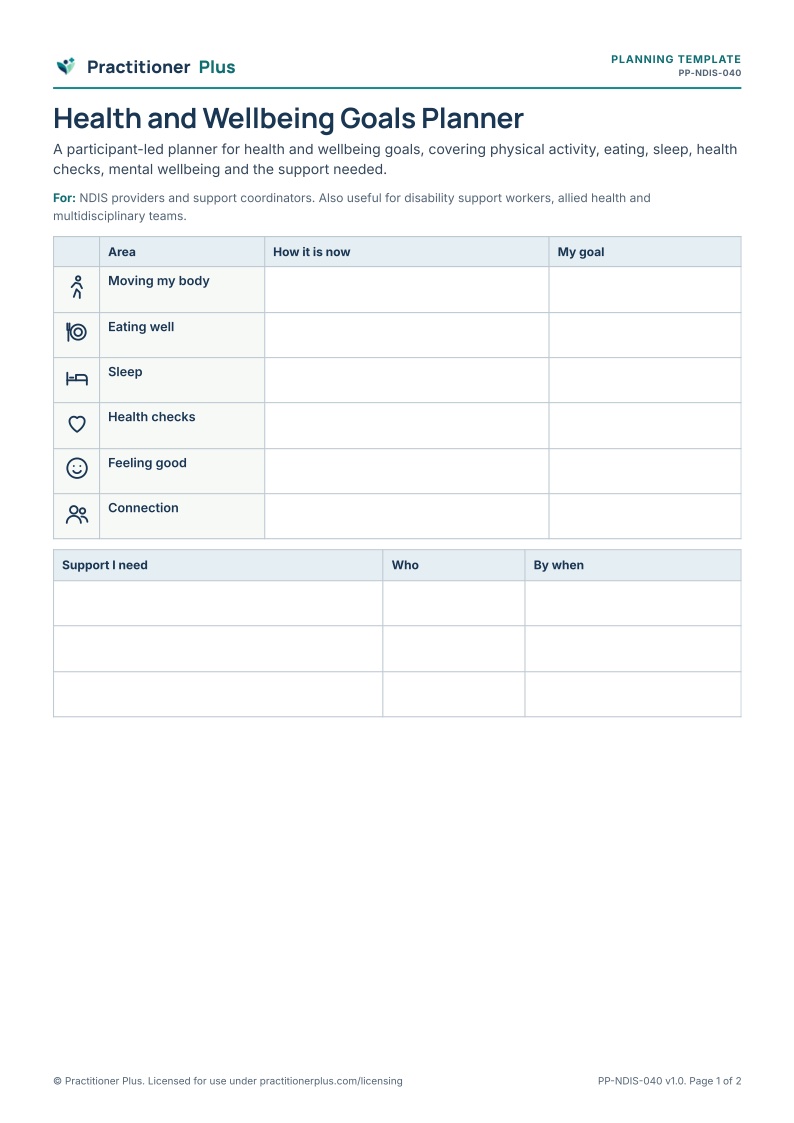
Health and wellbeing matter for a good life. This planner helps participants think about physical activity, eating, sleep, regular health checks, mental wellbeing and connection, choose goals and plan the support needed.
Purpose
To help participants set and work towards health and wellbeing goals.
Who it is for
Primary profession: NDIS providers and support coordinators. Also relevant for disability support workers, allied health and multidisciplinary teams.
Client or participant group: Participants and their support teams.
Practice setting: Planning and support coordination.
Suggested uses
- Planning meetings
- Health goal setting
- Annual health checks
- Support coordination
Instructions for practitioners
- Let the participant choose goals.
- Encourage regular health checks.
- Link with GPs and allied health.
- Check how health supports interact with NDIS and health systems.
Instructions for clients or participants
- Think about each area.
- Choose a goal.
- Plan support.
Accessibility considerations
Use pictures and Easy Read.
Scope and limitations
A planning tool. It does not replace health advice.
Research basis
Specific goals, if-then plans and regular progress monitoring all improve the chances of reaching goals. In rehabilitation for adults with acquired disability, setting goals with the person may improve quality of life and self-efficacy, although the evidence is still limited.
- Gollwitzer, P. M., & Sheeran, P. (2006). Implementation Intentions and Goal Achievement: A Meta‐analysis of Effects and Processes. Advances in Experimental Social Psychology, 69–119. https://doi.org/10.1016/s0065-2601(06)38002-1
- Harkin, B., Webb, T. L., Chang, B. P. I., Prestwich, A., Conner, M., Kellar, I., Benn, Y., & Sheeran, P. (2016). Does monitoring goal progress promote goal attainment? A meta-analysis of the experimental evidence. Psychological Bulletin, 142(2), 198–229. https://doi.org/10.1037/bul0000025
- Levack, W. M., Weatherall, M., Hay-Smith, E. J. C., Dean, S. G., McPherson, K., & Siegert, R. J. (2015). Goal setting and strategies to enhance goal pursuit for adults with acquired disability participating in rehabilitation. Cochrane Database of Systematic Reviews, Article CD009727. https://doi.org/10.1002/14651858.cd009727.pub2
- Locke, E. A., & Latham, G. P. (2002). Building a practically useful theory of goal setting and task motivation: A 35-year odyssey. American Psychologist, 57(9), 705–717. https://doi.org/10.1037/0003-066x.57.9.705
What is included
A 2-page printable A4 PDF, including a practitioner notes page with the research basis (version 1.0).
Originality
Original Practitioner Plus content: wording, activity structure, layout and icons were created for this resource. No third-party worksheets, illustrations or text were reproduced.


