
About this resource
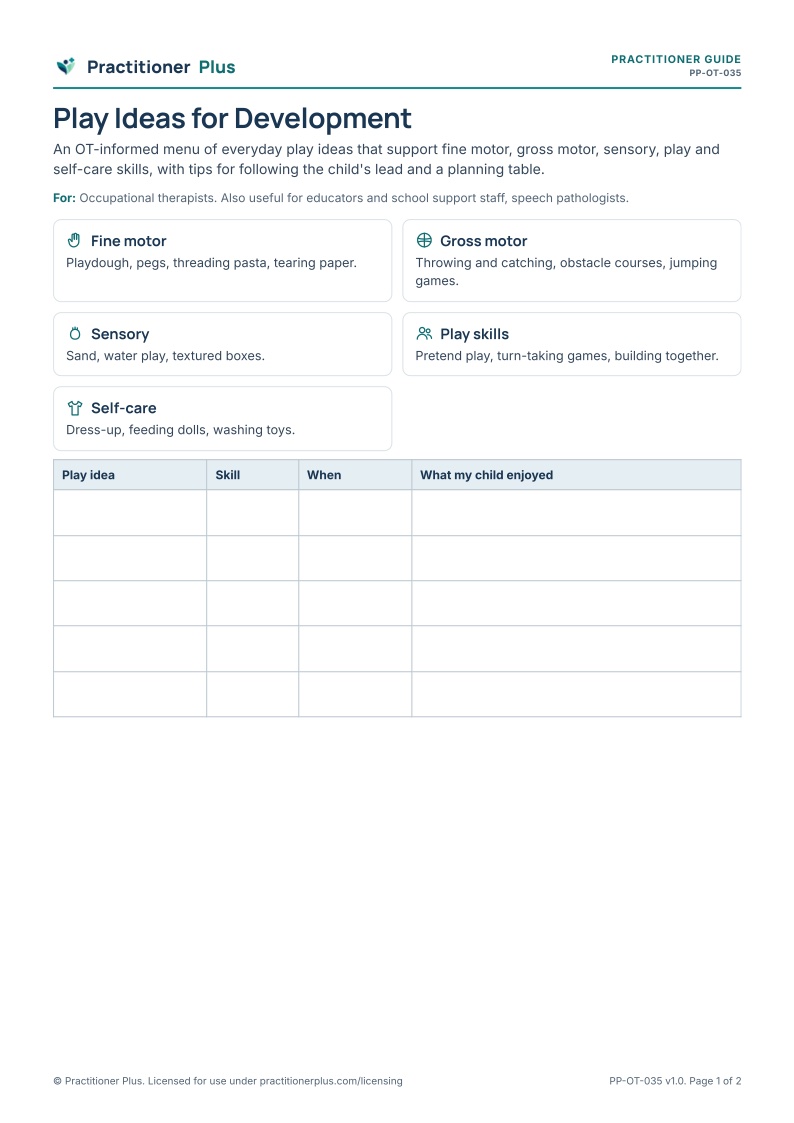
Play is how children learn. This guide offers everyday play ideas that support fine motor, gross motor, sensory, play and self-care skills, using low-cost materials, with tips for following the child's lead and a table for planning.
Purpose
To help families build skill-supporting play into everyday life.
Who it is for
Primary profession: Occupational therapists. Also relevant for educators and school support staff, speech pathologists.
Client or participant group: Families and educators of young children.
Practice setting: Home, early childhood education and occupational therapy.
Suggested uses
- Home programs
- Early childhood settings
- Parent education
- Occupational therapy sessions
Instructions for practitioners
- Choose ideas linked to the child's goals.
- Encourage following the child's interests.
- Keep it fun, not drill.
- Review what the child enjoyed.
Instructions for clients or participants
- Choose a play idea.
- Play together.
- Notice what your child enjoyed.
Accessibility considerations
Use low-cost, everyday materials.
Scope and limitations
General play ideas. They do not assess development. Families with concerns should talk to a health professional.
Research basis
Occupational therapy approaches that practise real tasks, including handwriting instruction, have the strongest evidence for children with disabilities. Parent-implemented language strategies and interactive shared reading support children's language development.
- Mol, S. E., Bus, A. G., de Jong, M. T., & Smeets, D. J. H. (2008). Added Value of Dialogic Parent–Child Book Readings: A Meta-Analysis. Early Education and Development, 19(1), 7–26. https://doi.org/10.1080/10409280701838603
- Novak, I., & Honan, I. (2019). Effectiveness of paediatric occupational therapy for children with disabilities: A systematic review. Australian Occupational Therapy Journal, 66(3), 258–273. https://doi.org/10.1111/1440-1630.12573
- Roberts, M. Y., & Kaiser, A. P. (2011). The Effectiveness of Parent-Implemented Language Interventions: A Meta-Analysis. American Journal of Speech-Language Pathology, 20(3), 180–199. https://doi.org/10.1044/1058-0360(2011/10-0055)
- Santangelo, T., & Graham, S. (2016). A Comprehensive Meta-analysis of Handwriting Instruction. Educational Psychology Review, 28(2), 225–265. https://doi.org/10.1007/s10648-015-9335-1
What is included
A 2-page printable A4 PDF, including a practitioner notes page with the research basis (version 1.0).
Originality
Original Practitioner Plus content: wording, activity structure, layout and icons were created for this resource. No third-party worksheets, illustrations or text were reproduced.


