
About this resource
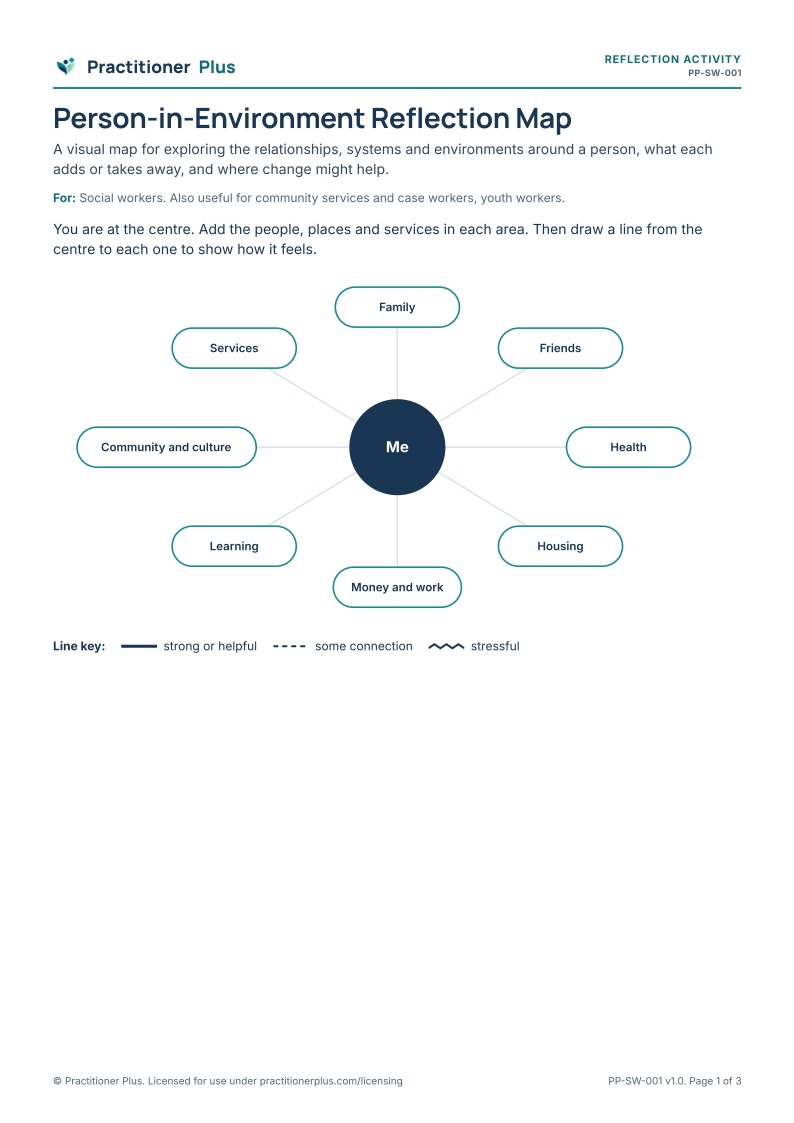
People's wellbeing is shaped by the world around them. This map places the person at the centre, surrounded by eight areas of life. Together you mark how each area feels, using simple line styles, then reflect on what is helping, what is adding stress and where change might make a difference.
Purpose
To build a shared picture of the person's environment, identify sources of support and stress, and guide planning.
Who it is for
Primary profession: Social workers. Also relevant for community services and case workers, youth workers.
Client or participant group: Adolescents and adults working with a social worker, completed collaboratively.
Practice setting: Hospital, community, school and casework settings, usually in an early or review session.
Suggested uses
- Early engagement and psychosocial needs exploration
- Identifying informal supports and gaps
- Reviewing change over time
- Supporting case planning and referral decisions
Instructions for practitioners
- Explain that the person decides what goes on the map and how much to share.
- Start with areas that feel safe, and add people, places and services in their words.
- Use the line key to show how each connection feels.
- Use the table to reflect on what helps, what adds stress and what might change.
- Revisit the map at review to see what has shifted.
Instructions for clients or participants
- Add the people, places and services in your life.
- Draw a line to each one to show how it feels.
- Talk about what helps and what is hard.
Accessibility considerations
Can be drawn on a whiteboard or paper, or completed with sticky notes. Use the person's language for areas of life and accept partial maps.
Scope and limitations
A reflective and engagement tool. It does not replace your organisation's psychosocial assessment framework, risk assessment or safeguarding procedures. If concerns about safety arise, follow those procedures.
Research basis
Biopsychosocial and ecological models describe how health, relationships and wider systems interact in a person's life.
- Bronfenbrenner, U. (1979). The Ecology of Human Development: Experiments by Nature and Design. Harvard University Press. https://doi.org/10.4159/9780674028845
- Engel, G. L. (1977). The Need for a New Medical Model: A Challenge for Biomedicine. Science, 196(4286), 129–136. https://doi.org/10.1126/science.847460
What is included
A 3-page printable A4 PDF, including a practitioner notes page with the research basis (version 1.0).
Originality
Original Practitioner Plus content: wording, activity structure, layout and icons were created for this resource. No third-party worksheets, illustrations or text were reproduced. Concept: person-in-environment and ecological perspectives in social work, and the ecomap technique introduced by Ann Hartman (1978). Layout and prompts are original.


