
About this resource
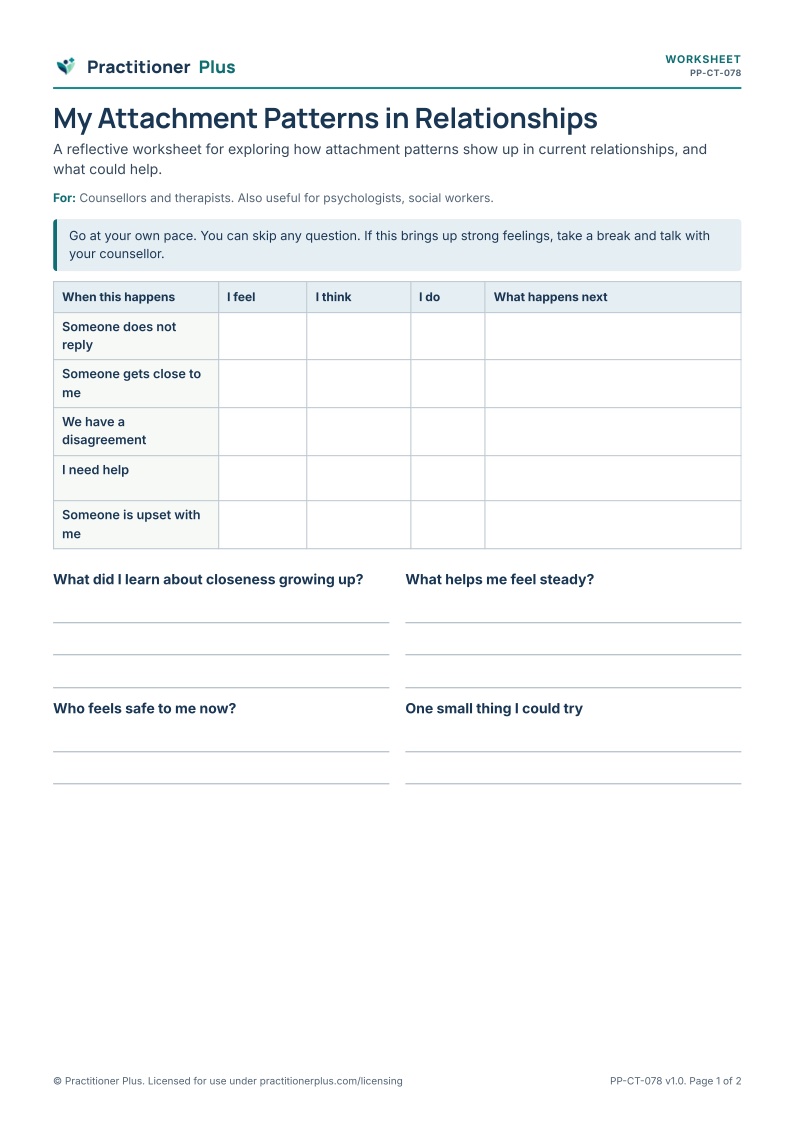
This worksheet helps clients notice what happens when they feel close, or when they feel distant, and what they do next. It links early experience to present relationships, and to small next steps.
Purpose
A reflective worksheet for exploring how attachment patterns show up in current relationships, and what could help.
Who it is for
Primary profession: Counsellors and therapists. Also relevant for psychologists, social workers.
Client or participant group: Adults in counselling.
Practice setting: Private practice, community and organisational settings.
Suggested uses
- Individual counselling
- Between-session reflection
- Couples work
Instructions for practitioners
- Add your details and delete what does not apply.
- Check it against your professional requirements.
- Explain it to the person in plain language.
- Store completed copies securely.
Accessibility considerations
Clear headings and tables. The Word version can be edited and filled in on screen.
Scope and limitations
A therapeutic worksheet to use with a counsellor. It is not a diagnostic tool.
Research basis
Attachment research describes patterns of closeness and independence that develop in early relationships, are linked to how adults regulate emotions, and can change over time.
- Levy, K. N., Ellison, W. D., Scott, L. N., & Bernecker, S. L. (2011). Attachment style. Journal of Clinical Psychology, 67(2), 193–203. https://doi.org/10.1002/jclp.20756
- Mikulincer, M., & Shaver, P. R. (2019). Attachment orientations and emotion regulation. Current Opinion in Psychology, 25, 6–10. https://doi.org/10.1016/j.copsyc.2018.02.006
What is included
A 2-page printable A4 PDF, including a practitioner notes page with the research basis (version 1.0).
Originality
Original Practitioner Plus content: wording, activity structure, layout and icons were created for this resource. No third-party worksheets, illustrations or text were reproduced. Written for Practitioner Plus from the sources in the research basis.


