
About this resource
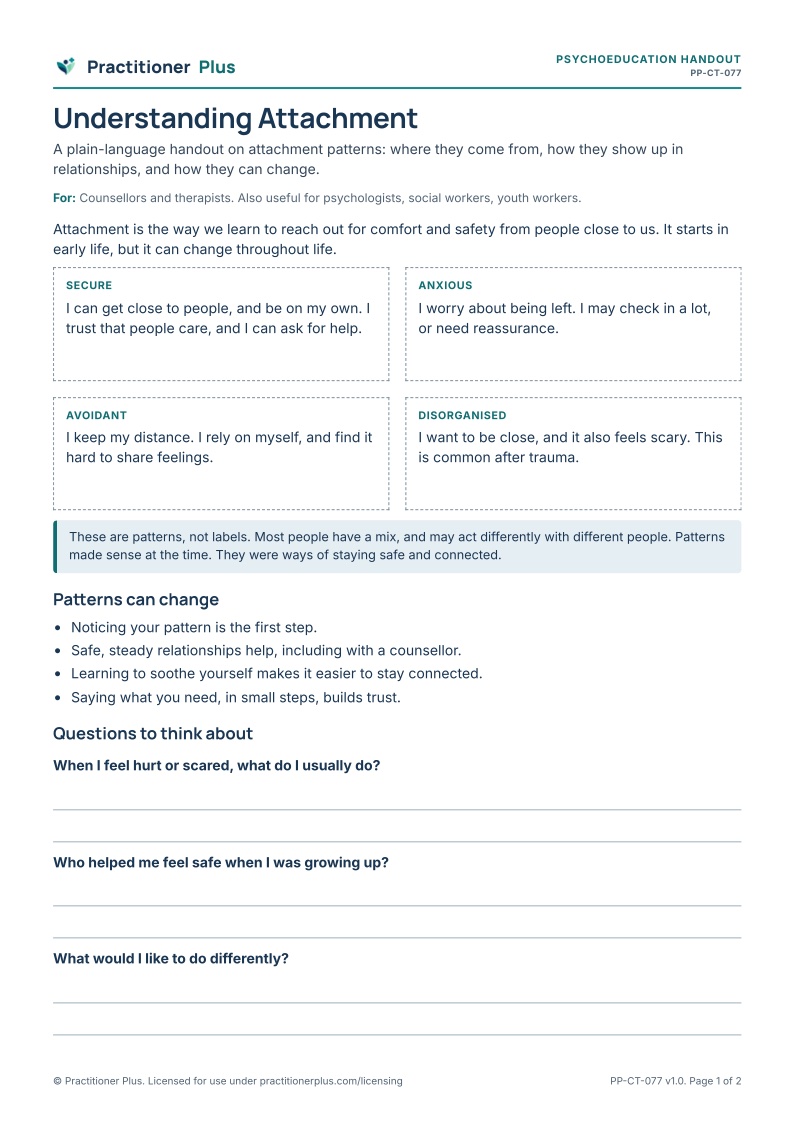
Counsellors asked for attachment resources. This handout explains attachment as a way of staying close to people and staying safe. It describes secure, anxious, avoidant and disorganised patterns, without treating them as labels, and shows how patterns can change.
Purpose
A plain-language handout on attachment patterns: where they come from, how they show up in relationships, and how they can change.
Who it is for
Primary profession: Counsellors and therapists. Also relevant for psychologists, social workers, youth workers.
Client or participant group: Adults and young people in counselling.
Practice setting: Private practice, community and organisational settings.
Suggested uses
- Individual counselling
- Couples work
- Parenting work
Instructions for practitioners
- Introduce it when relationships or closeness come up in sessions.
- Stress that these are patterns, not labels or diagnoses.
- Go gently with people who have trauma histories.
Accessibility considerations
Clear headings and tables. The Word version can be edited and filled in on screen.
Scope and limitations
A psychoeducation handout. It is not a diagnostic tool.
Research basis
Attachment research describes patterns of closeness and independence that develop in early relationships, are linked to how adults regulate emotions, and can change over time.
- Levy, K. N., Ellison, W. D., Scott, L. N., & Bernecker, S. L. (2011). Attachment style. Journal of Clinical Psychology, 67(2), 193–203. https://doi.org/10.1002/jclp.20756
- Mikulincer, M., & Shaver, P. R. (2019). Attachment orientations and emotion regulation. Current Opinion in Psychology, 25, 6–10. https://doi.org/10.1016/j.copsyc.2018.02.006
What is included
A 2-page printable A4 PDF, including a practitioner notes page with the research basis (version 1.0).
Originality
Original Practitioner Plus content: wording, activity structure, layout and icons were created for this resource. No third-party worksheets, illustrations or text were reproduced. Written for Practitioner Plus from the sources in the research basis.


