
About this resource
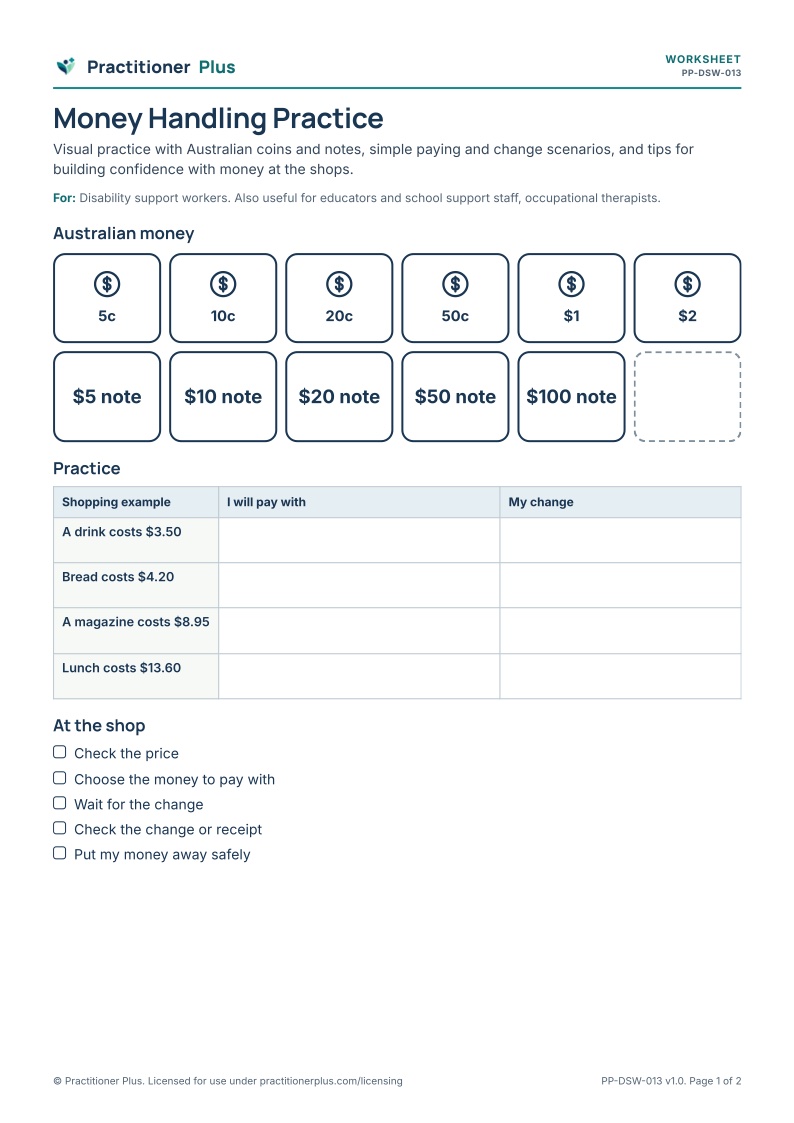
Handling money builds independence. This practice sheet shows Australian coins and notes, then gives simple scenarios for choosing what to pay with and working out change. Tips help workers practise with real money and real shopping trips.
Purpose
To build practical skills and confidence in recognising money, paying and checking change.
Who it is for
Primary profession: Disability support workers. Also relevant for educators and school support staff, occupational therapists.
Client or participant group: Adults and young people building confidence with cash.
Practice setting: Home, day programs and community access, practising with real money.
Suggested uses
- Practising with money at home
- Before community access shopping
- Building budgeting skills
- Working towards independence goals
Instructions for practitioners
- Use real coins and notes where possible.
- Start with recognising money, then paying, then change.
- Practise in real shops when the person is ready.
- Respect the person's right to manage their own money.
Instructions for clients or participants
- Look at the coins and notes.
- Read each shopping example.
- Work out what to pay and the change.
Accessibility considerations
Use real money and large-print scenarios. A calculator or money app can be used.
Scope and limitations
A general skill-building activity. It does not assess financial capacity.
Research basis
Debt and financial stress are strongly linked with poorer mental and physical health, so practical financial support is part of holistic care. Active support, which gives people real opportunities and just-enough help to take part in everyday activities, increases engagement for people with intellectual disability.
- Mansell, J., & Beadle-Brown, J. (2012). Active support: Enabling and empowering people with intellectual disabilities. Jessica Kingsley Publishers.
- Richardson, T., Elliott, P., & Roberts, R. (2013). The relationship between personal unsecured debt and mental and physical health: A systematic review and meta-analysis. Clinical Psychology Review, 33(8), 1148–1162. https://doi.org/10.1016/j.cpr.2013.08.009
What is included
A 2-page printable A4 PDF, including a practitioner notes page with the research basis (version 1.0).
Originality
Original Practitioner Plus content: wording, activity structure, layout and icons were created for this resource. No third-party worksheets, illustrations or text were reproduced.


