
About this resource
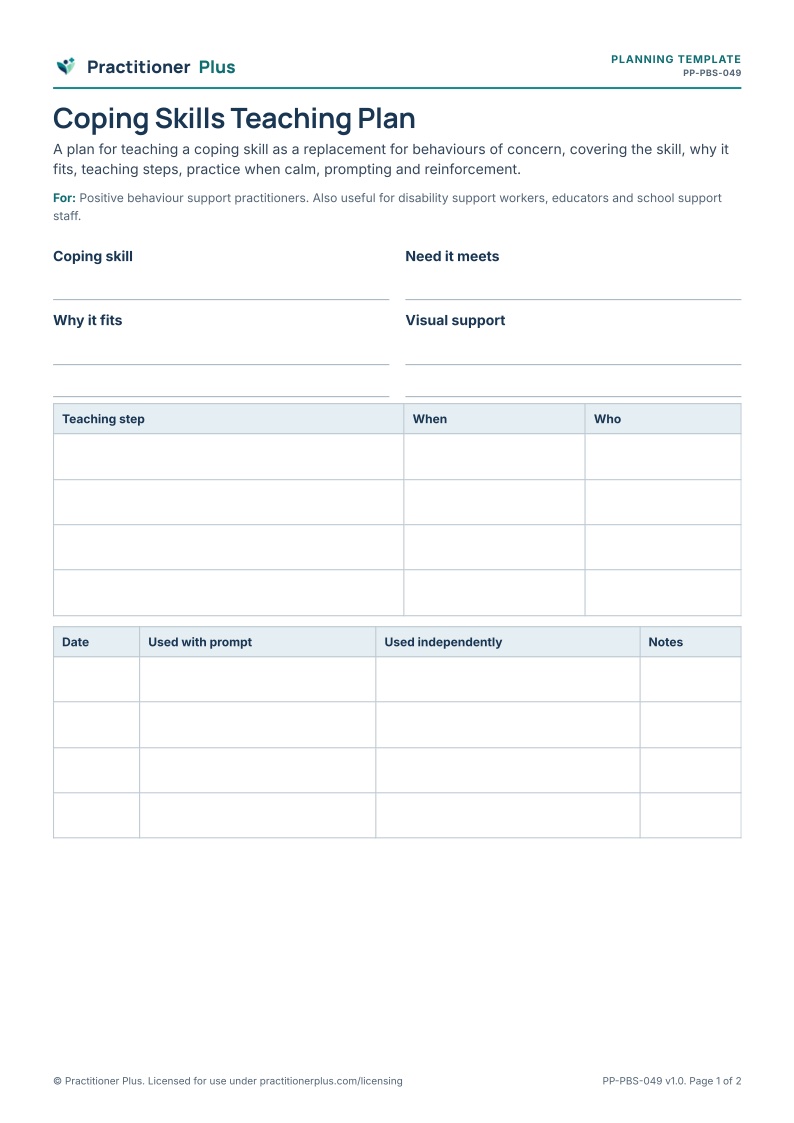
People need effective alternatives to behaviours of concern. This plan records the coping skill, why it fits the person and the function of the behaviour, teaching steps, practice during calm times, prompting in real situations and reinforcement.
Purpose
To teach coping skills systematically so people have alternatives that work.
Who it is for
Primary profession: Positive behaviour support practitioners. Also relevant for disability support workers, educators and school support staff.
Client or participant group: Behaviour support practitioners and teams.
Practice setting: Behaviour support implementation.
Suggested uses
- Behaviour support plans
- Skill teaching
- Team training
- Plan reviews
Instructions for practitioners
- Choose a skill that meets the same need as the behaviour.
- Teach when the person is calm.
- Prompt early in real situations.
- Reinforce every use.
Accessibility considerations
Use visuals and the person's communication.
Scope and limitations
A teaching plan. It is not a behaviour support plan.
Research basis
Positive behaviour support aims to improve quality of life and reduce behaviours of concern by understanding their function and changing environments and skills. Active support, which gives people real opportunities and just-enough help to take part in everyday activities, increases engagement for people with intellectual disability.
- Allen, D., James, W., Evans, J., Hawkins, S., & Jenkins, R. (2005). Positive Behavioural Support: Definition, Current Status and Future Directions. Tizard Learning Disability Review, 10(2), 4–11. https://doi.org/10.1108/13595474200500014
- Mansell, J., & Beadle-Brown, J. (2012). Active support: Enabling and empowering people with intellectual disabilities. Jessica Kingsley Publishers.
- NDIS Quality and Safeguards Commission. NDIS Practice Standards and Quality Indicators. https://www.ndiscommission.gov.au/rules-and-standards/ndis-practice-standards
What is included
A 2-page printable A4 PDF, including a practitioner notes page with the research basis (version 1.0).
Originality
Original Practitioner Plus content: wording, activity structure, layout and icons were created for this resource. No third-party worksheets, illustrations or text were reproduced.


