
About this resource
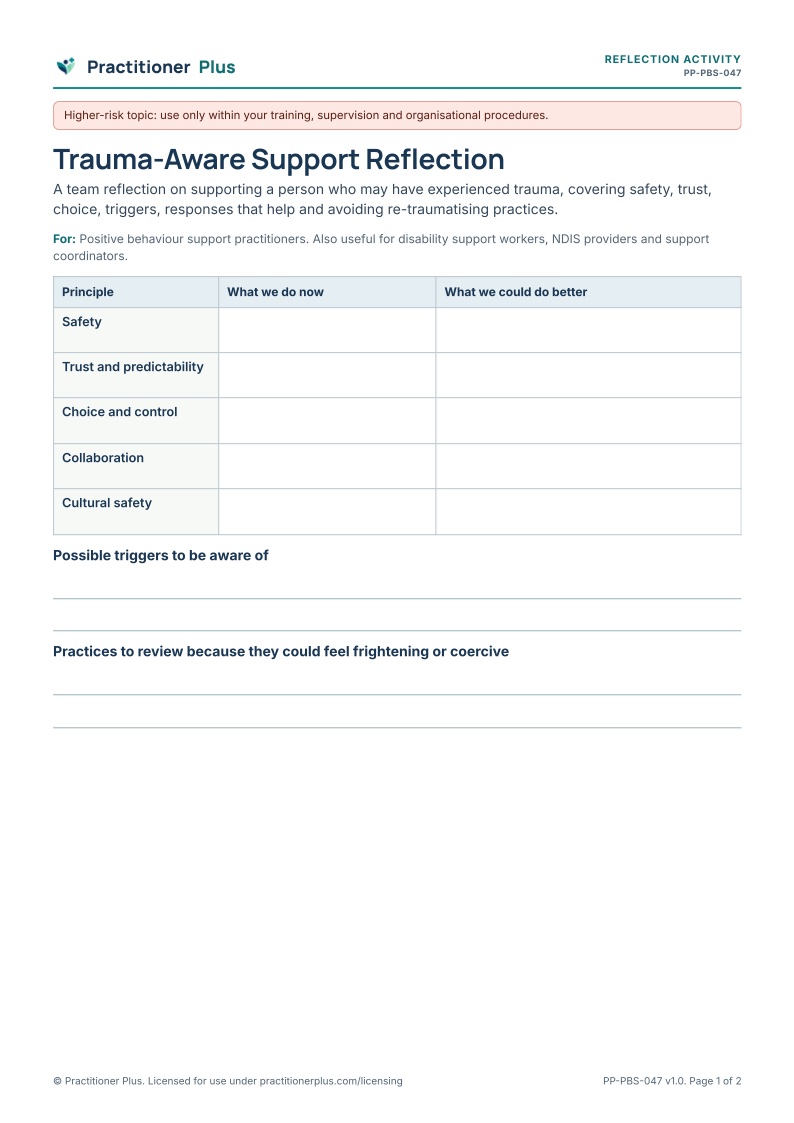
Many people with disability have experienced trauma, which can shape how they respond to support. This reflection helps teams consider safety, trust, choice, possible triggers, responses that help and practices that could re-traumatise, and plan changes with the behaviour support practitioner.
Purpose
To make support safer and more trauma-aware.
Who it is for
Primary profession: Positive behaviour support practitioners. Also relevant for disability support workers, NDIS providers and support coordinators.
Client or participant group: Teams supporting people with behaviour support needs and possible trauma histories.
Practice setting: Supported living, day programs and family homes.
Suggested uses
- Behaviour support assessment
- Team reflection
- Training
- Plan reviews
Instructions for practitioners
- Do not require the person to disclose trauma.
- Focus on safety, predictability and choice.
- Review practices that could feel coercive or frightening.
- Seek specialist trauma input where needed.
Accessibility considerations
Include the person's views where possible.
Scope and limitations
A reflection tool. It is not a trauma assessment or treatment and does not recommend restrictive practices.
Higher-risk topic: use only within your training, supervision and organisational procedures.
Research basis
Trauma-informed practice prioritises safety, trust, choice, collaboration and empowerment, and avoids re-traumatising people. Positive behaviour support aims to improve quality of life and reduce behaviours of concern by understanding their function and changing environments and skills.
- Allen, D., James, W., Evans, J., Hawkins, S., & Jenkins, R. (2005). Positive Behavioural Support: Definition, Current Status and Future Directions. Tizard Learning Disability Review, 10(2), 4–11. https://doi.org/10.1108/13595474200500014
- Kezelman, C., & Stavropoulos, P. (2012). Practice guidelines for treatment of complex trauma and trauma informed care and service delivery. Adults Surviving Child Abuse (now Blue Knot Foundation). https://professionals.blueknot.org.au/resources/publications/practice-guidelines/
- NDIS Quality and Safeguards Commission. NDIS Practice Standards and Quality Indicators. https://www.ndiscommission.gov.au/rules-and-standards/ndis-practice-standards
- Substance Abuse and Mental Health Services Administration. (2014). SAMHSA's concept of trauma and guidance for a trauma-informed approach (HHS Publication No. SMA 14-4884). SAMHSA. https://store.samhsa.gov/product/samhsas-concept-trauma-and-guidance-trauma-informed-approach/sma14-4884
What is included
A 2-page printable A4 PDF, including a practitioner notes page with the research basis (version 1.0).
Originality
Original Practitioner Plus content: wording, activity structure, layout and icons were created for this resource. No third-party worksheets, illustrations or text were reproduced.


