
About this resource
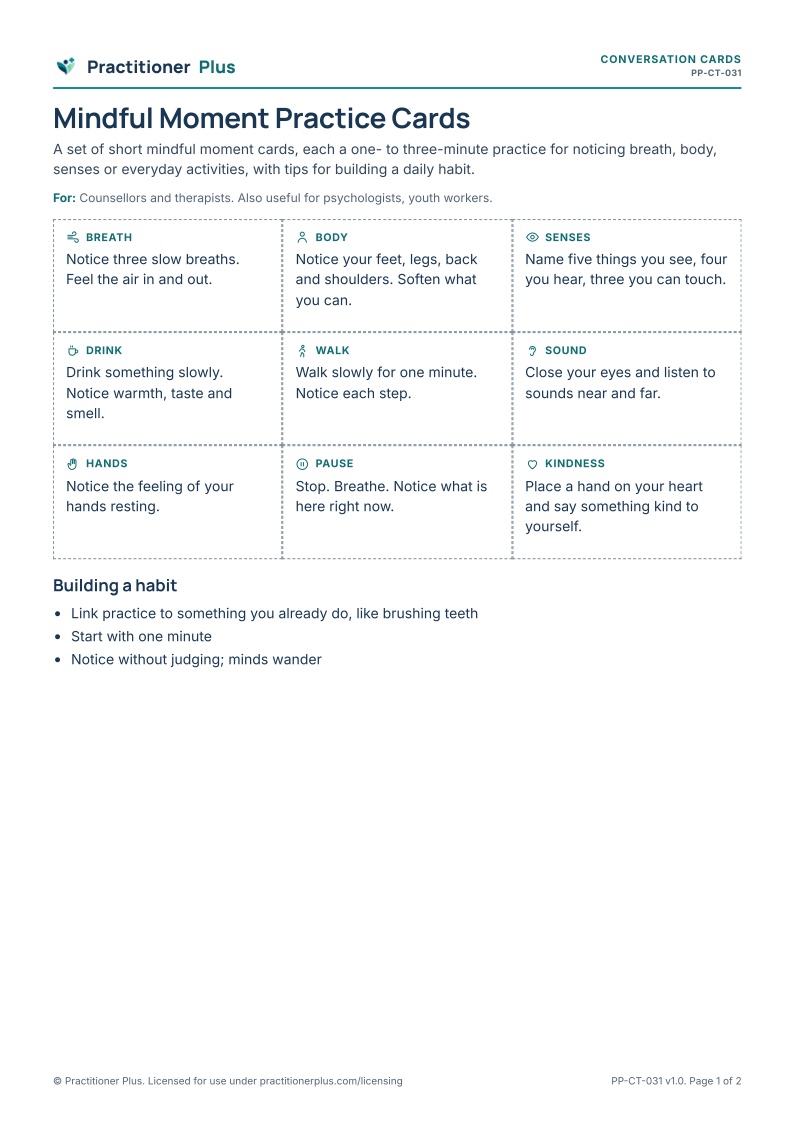
Short practices are easier to fit into daily life. These cards each offer a one- to three-minute practice, such as noticing breath, a body check, five senses, mindful drinking or mindful walking, with tips for linking practice to existing habits.
Purpose
To make brief mindfulness practice easy to start and repeat.
Who it is for
Primary profession: Counsellors and therapists. Also relevant for psychologists, youth workers.
Client or participant group: Adolescents and adults learning mindfulness skills.
Practice setting: Counselling sessions and daily practice at home.
Suggested uses
- Introducing mindfulness
- Daily practice
- Stress and anxiety
- Group sessions
Instructions for practitioners
- Practise a card together in session.
- Encourage linking practice to a daily habit.
- Offer choice; some practices suit some people better.
- Adapt or avoid body-focused practices for clients who find them distressing.
Instructions for clients or participants
- Pick a card.
- Practise for one to three minutes.
- Notice what you notice, without judging.
Accessibility considerations
Cards can be read aloud or recorded.
Scope and limitations
General mindfulness practices for use alongside counselling.
Research basis
Mindfulness-based approaches show moderate benefits for anxiety, depression and stress across many groups.
- Khoury, B., Lecomte, T., Fortin, G., Masse, M., Therien, P., Bouchard, V., Chapleau, M. A., Paquin, K., & Hofmann, S. G. (2013). Mindfulness-based therapy: A comprehensive meta-analysis. Clinical Psychology Review, 33(6), 763–771. https://doi.org/10.1016/j.cpr.2013.05.005
What is included
A 2-page printable A4 PDF, including a practitioner notes page with the research basis (version 1.0).
Originality
Original Practitioner Plus content: wording, activity structure, layout and icons were created for this resource. No third-party worksheets, illustrations or text were reproduced.


