
About this resource
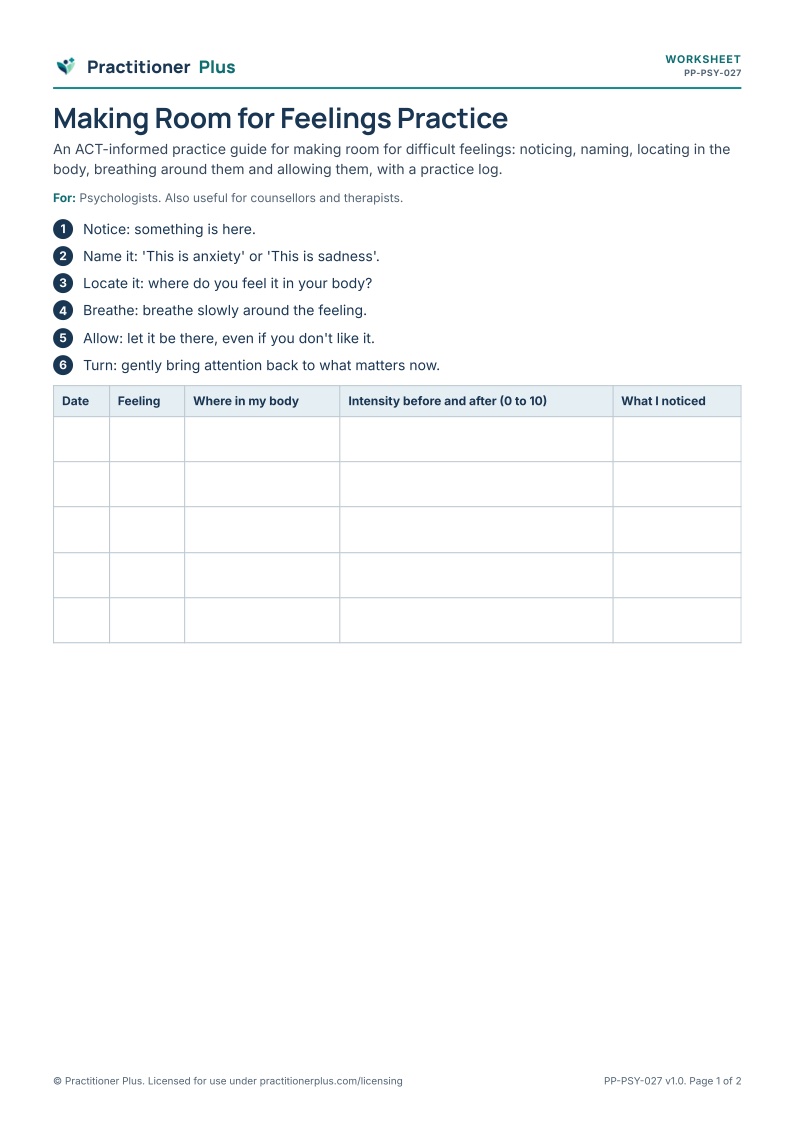
Struggling against feelings can make them bigger. This practice guides clients through noticing a feeling, naming it, finding where it sits in the body, breathing around it and allowing it to be there, then returning to what matters. A log records practice and what was noticed.
Purpose
To help clients practise willingness to experience difficult feelings rather than struggling with them.
Who it is for
Primary profession: Psychologists. Also relevant for counsellors and therapists.
Client or participant group: Adolescents and adults in ACT-informed treatment.
Practice setting: Psychology sessions and between-session practice.
Suggested uses
- Anxiety and avoidance
- Grief and painful emotions
- ACT-informed therapy
- Between-session practice
Instructions for practitioners
- Guide the practice in session first.
- Start with mild to moderate feelings.
- Clarify that acceptance is not giving up or liking the feeling.
- Avoid using with overwhelming trauma-related distress without additional supports.
Instructions for clients or participants
- Notice and name the feeling.
- Find it in your body and breathe around it.
- Let it be there, then turn to what matters.
Accessibility considerations
Can be followed as a spoken practice.
Scope and limitations
An educational ACT-informed worksheet for use within treatment.
Research basis
Acceptance and commitment therapy (ACT), which includes clarifying values and taking committed action, performs better than usual care and similarly to established treatments for anxiety, depression and related problems. Understanding, naming and choosing strategies for emotions are central to emotion regulation; putting feelings into words and finer emotion distinctions are linked to better regulation.
- A-Tjak, J. G., Davis, M. L., Morina, N., Powers, M. B., Smits, J. A., & Emmelkamp, P. M. (2015). A Meta-Analysis of the Efficacy of Acceptance and Commitment Therapy for Clinically Relevant Mental and Physical Health Problems. Psychotherapy and Psychosomatics, 84(1), 30–36. https://doi.org/10.1159/000365764
- Gross, J. J. (2015). Emotion Regulation: Current Status and Future Prospects. Psychological Inquiry, 26(1), 1–26. https://doi.org/10.1080/1047840x.2014.940781
- Hayes, S. C., Strosahl, K. D., & Wilson, K. G. (2012). Acceptance and commitment therapy: The process and practice of mindful change (2nd ed.). Guilford Press.
- Kashdan, T. B., Barrett, L. F., & McKnight, P. E. (2015). Unpacking Emotion Differentiation: Transforming Unpleasant Experience by Perceiving Distinctions in Negativity. Current Directions in Psychological Science, 24(1), 10–16. https://doi.org/10.1177/0963721414550708
- Kircanski, K., Lieberman, M. D., & Craske, M. G. (2012). Feelings Into Words: Contributions of Language to Exposure Therapy. Psychological Science, 23(10), 1086–1091. https://doi.org/10.1177/0956797612443830
What is included
A 2-page printable A4 PDF, including a practitioner notes page with the research basis (version 1.0).
Originality
Original Practitioner Plus content: wording, activity structure, layout and icons were created for this resource. No third-party worksheets, illustrations or text were reproduced. Reflects acceptance strategies used in acceptance and commitment therapy.


