
About this resource
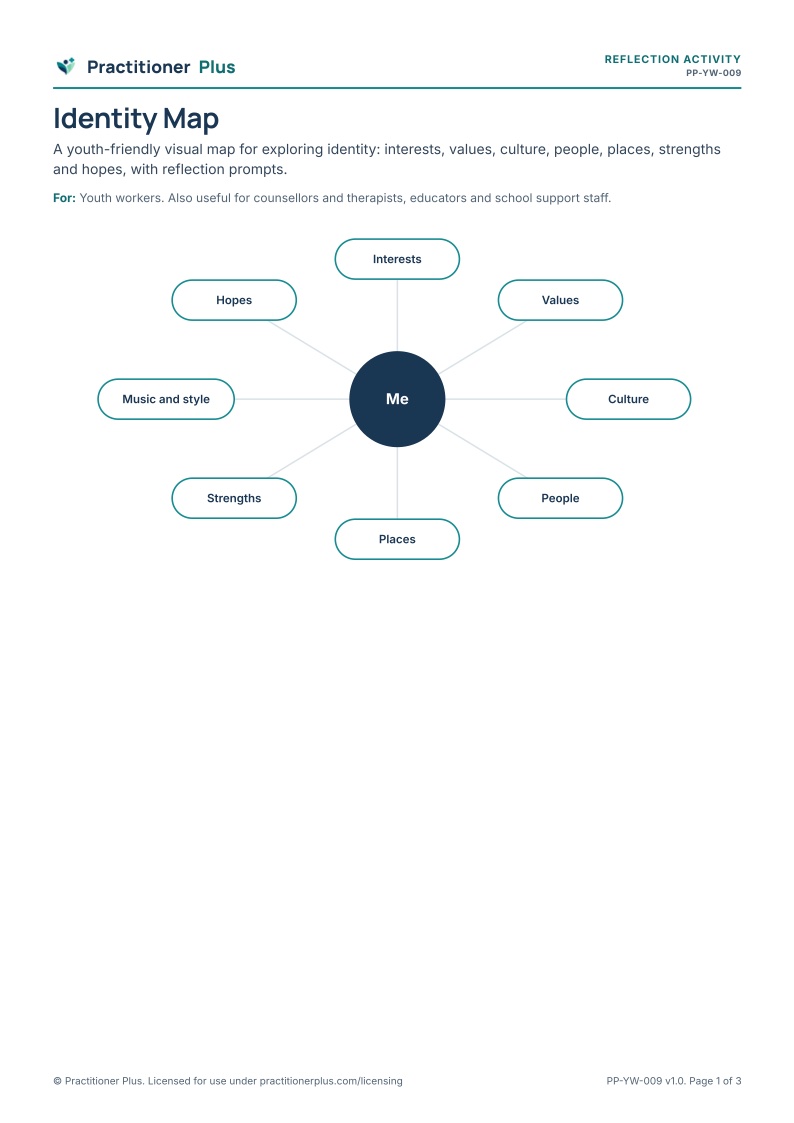
Identity is built from many pieces. This visual map invites young people to fill in eight areas, from interests and values to culture, people and places that matter, then reflect on what they noticed and which parts of themselves they want to grow.
Purpose
To help young people explore and express who they are, building self-understanding and confidence.
Who it is for
Primary profession: Youth workers. Also relevant for counsellors and therapists, educators and school support staff.
Client or participant group: Young people aged about 12 to 25.
Practice setting: Youth services, schools and one-to-one or group sessions.
Suggested uses
- Getting to know a young person
- Group identity and belonging sessions
- Building confidence and self-esteem
- Transition points such as starting a new school
Instructions for practitioners
- Let the young person choose which areas to fill in and how.
- Accept drawings, words, song lyrics or symbols.
- Be curious, not evaluative.
- Respect privacy about identity; never pressure disclosure.
Instructions for clients or participants
- Fill in the areas that feel right.
- Use words, drawings or anything that fits.
- Think about what you noticed.
Accessibility considerations
Can be completed digitally, drawn or talked through.
Scope and limitations
A reflective engagement activity. It is not an assessment.
Research basis
School-based social and emotional learning programs improve students' social skills, behaviour and academic results. Narrative approaches help people separate themselves from problems and author preferred stories of their lives.
- Durlak, J. A., Weissberg, R. P., Dymnicki, A. B., Taylor, R. D., & Schellinger, K. B. (2011). The Impact of Enhancing Students’ Social and Emotional Learning: A Meta-Analysis of School-Based Universal Interventions. Child Development, 82(1), 405–432. https://doi.org/10.1111/j.1467-8624.2010.01564.x
- White, M., & Epston, D. (1990). Narrative means to therapeutic ends. W. W. Norton.
What is included
A 3-page printable A4 PDF, including a practitioner notes page with the research basis (version 1.0).
Originality
Original Practitioner Plus content: wording, activity structure, layout and icons were created for this resource. No third-party worksheets, illustrations or text were reproduced.


