
About this resource
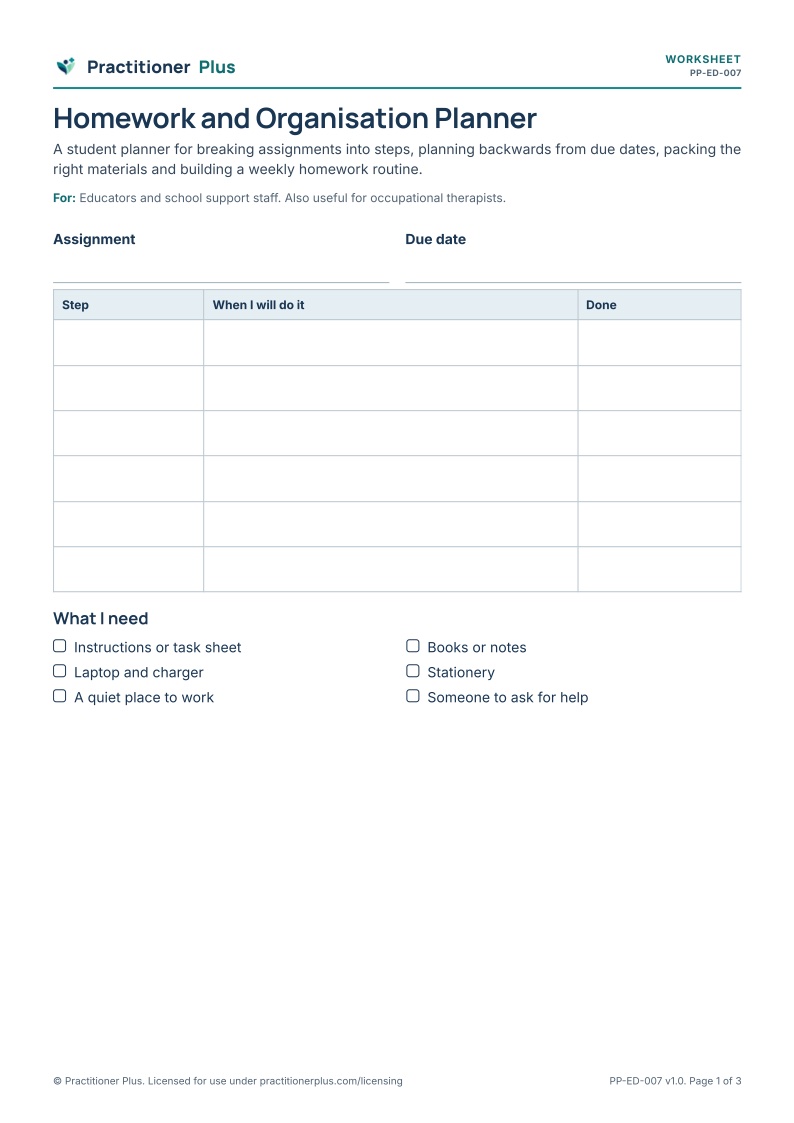
Big assignments can feel impossible to start. This planner helps students break an assignment into steps, plan backwards from the due date, check they have the materials they need and set up a weekly homework routine, with space for reflection.
Purpose
To support executive functioning skills such as planning, organising and starting tasks.
Who it is for
Primary profession: Educators and school support staff. Also relevant for occupational therapists.
Client or participant group: Upper primary and secondary students who find organisation and planning hard.
Practice setting: Classroom, learning support, homework clubs and home, with teacher guidance.
Suggested uses
- Introducing assignment planning in class
- Learning support sessions
- Homework clubs
- Sharing strategies with families
Instructions for practitioners
- Model breaking down an assignment with the whole class.
- Help students plan backwards from the due date.
- Check in on progress at each milestone.
- Share the routine with families where helpful.
Instructions for clients or participants
- Break your assignment into small steps.
- Plan when you will do each one.
- Pack what you need.
- Tick steps off as you go.
Accessibility considerations
Use colour coding or symbols. Steps can be written by the student or with support.
Scope and limitations
A general organisation tool. Students with significant executive functioning difficulties may need individual support from their learning support team or allied health professionals.
Research basis
Executive functions such as planning, working memory and self-control develop over time and can be supported with external structure and practice. Specific goals, if-then plans and regular progress monitoring all improve the chances of reaching goals.
- Diamond, A. (2013). Executive Functions. Annual Review of Psychology, 64(1), 135–168. https://doi.org/10.1146/annurev-psych-113011-143750
- Gollwitzer, P. M., & Sheeran, P. (2006). Implementation Intentions and Goal Achievement: A Meta‐analysis of Effects and Processes. Advances in Experimental Social Psychology, 69–119. https://doi.org/10.1016/s0065-2601(06)38002-1
- Harkin, B., Webb, T. L., Chang, B. P. I., Prestwich, A., Conner, M., Kellar, I., Benn, Y., & Sheeran, P. (2016). Does monitoring goal progress promote goal attainment? A meta-analysis of the experimental evidence. Psychological Bulletin, 142(2), 198–229. https://doi.org/10.1037/bul0000025
- Locke, E. A., & Latham, G. P. (2002). Building a practically useful theory of goal setting and task motivation: A 35-year odyssey. American Psychologist, 57(9), 705–717. https://doi.org/10.1037/0003-066x.57.9.705
What is included
A 3-page printable A4 PDF, including a practitioner notes page with the research basis (version 1.0).
Originality
Original Practitioner Plus content: wording, activity structure, layout and icons were created for this resource. No third-party worksheets, illustrations or text were reproduced.


