
About this resource
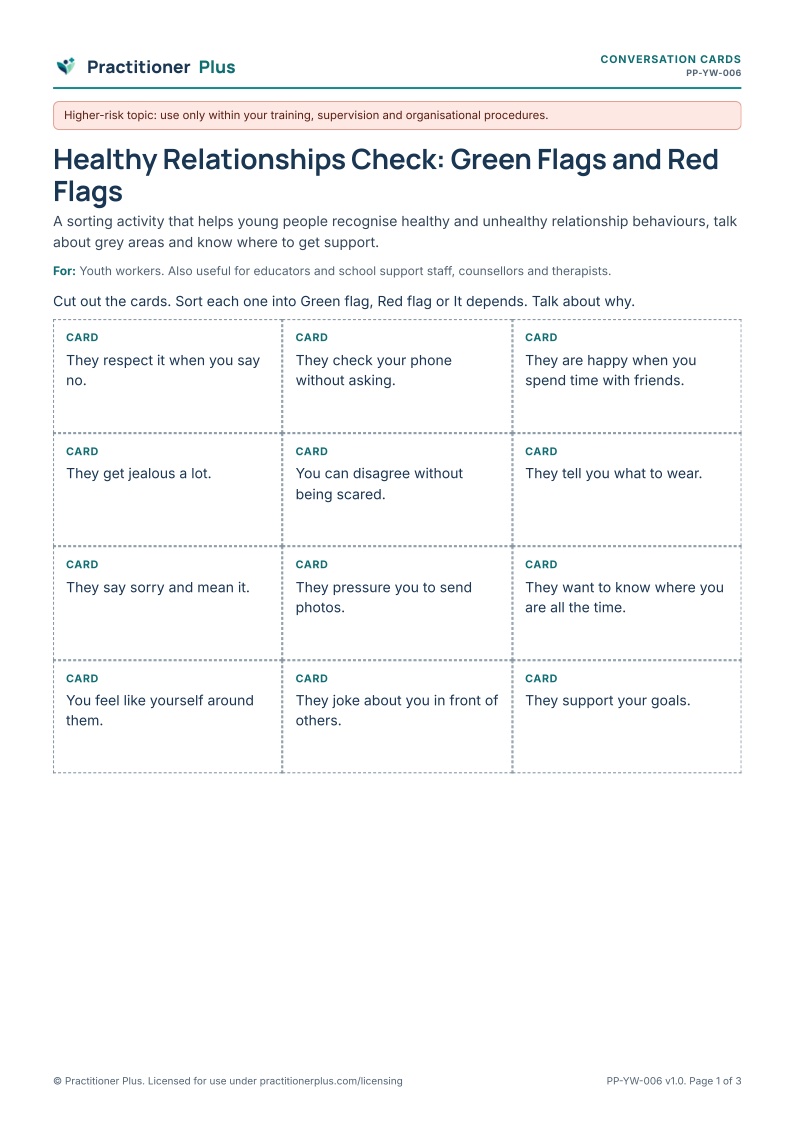
Healthy relationships feel safe and respectful. This activity uses statement cards that young people sort into green flags, red flags or it depends, followed by discussion of grey areas, what to do if something feels wrong and where to get confidential support.
Purpose
To build young people's ability to recognise respect, control and warning signs in friendships and romantic relationships.
Who it is for
Primary profession: Youth workers. Also relevant for educators and school support staff, counsellors and therapists.
Client or participant group: Young people aged about 13 to 21, in groups or one to one.
Practice setting: Youth services, schools and respectful relationships programs.
Suggested uses
- Respectful relationships sessions
- One-to-one conversations about a friendship or relationship
- Group discussion starters
- Building awareness before issues arise
Instructions for practitioners
- Set group agreements about respect and privacy before starting.
- Let young people sort the cards and explain their thinking.
- Spend time on it depends cards; context matters.
- Be prepared for disclosures and follow your organisation's procedures.
- Share support services and check they are current.
Instructions for clients or participants
- Sort each card into green flag, red flag or it depends.
- Talk about why.
- Know who you can talk to if something does not feel right.
Accessibility considerations
Cards can be read aloud and sorted physically. Adapt examples to the age group and cultural context.
Scope and limitations
An awareness activity. It does not assess risk in a specific relationship. Disclosures of abuse or harm must be responded to under your organisation's safeguarding procedures.
Higher-risk topic: use only within your training, supervision and organisational procedures.
Research basis
Primary prevention of violence focuses on respectful relationships, consent and challenging harmful attitudes. School-based social and emotional learning programs improve students' social skills, behaviour and academic results.
- Durlak, J. A., Weissberg, R. P., Dymnicki, A. B., Taylor, R. D., & Schellinger, K. B. (2011). The Impact of Enhancing Students’ Social and Emotional Learning: A Meta-Analysis of School-Based Universal Interventions. Child Development, 82(1), 405–432. https://doi.org/10.1111/j.1467-8624.2010.01564.x
- Our Watch. (2021). Change the story: A shared framework for the primary prevention of violence against women in Australia (2nd ed.). https://www.ourwatch.org.au/change-the-story
What is included
A 3-page printable A4 PDF, including a practitioner notes page with the research basis (version 1.0).
Originality
Original Practitioner Plus content: wording, activity structure, layout and icons were created for this resource. No third-party worksheets, illustrations or text were reproduced. Support service details should be checked against official websites before publication.


