
About this resource
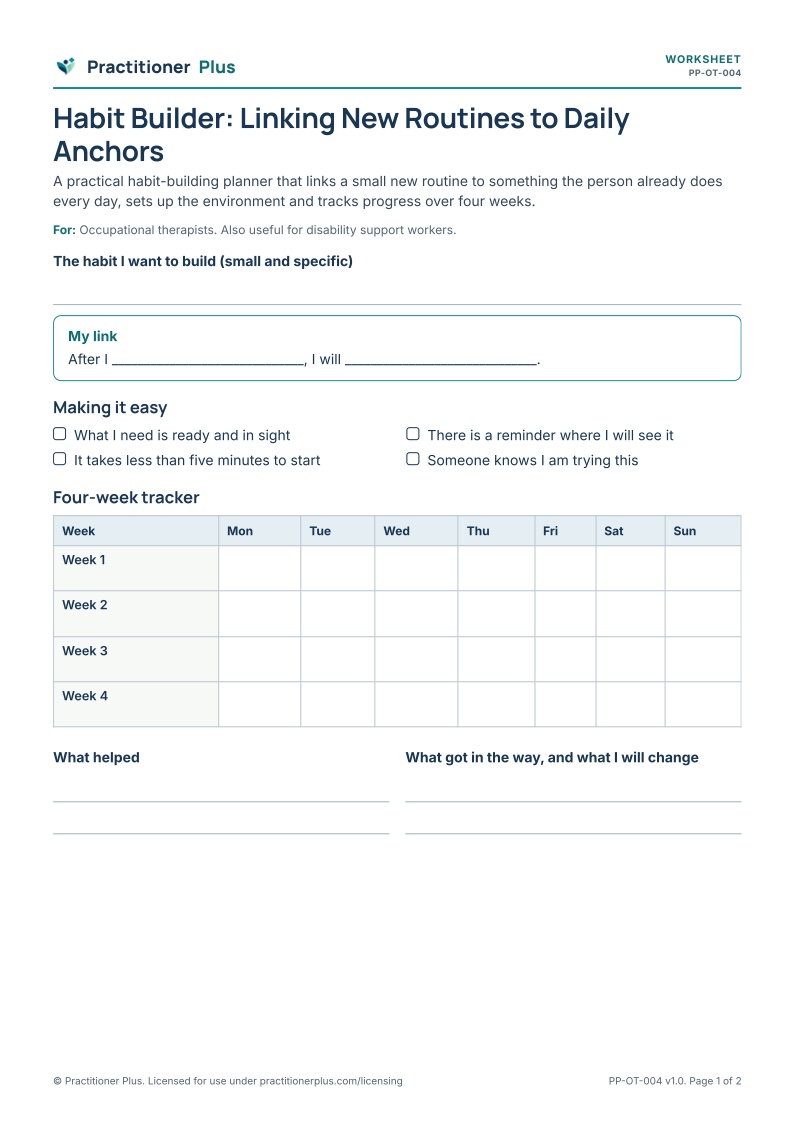
New routines stick more easily when they are small, linked to something that already happens every day and supported by the environment. This planner walks through choosing a habit, choosing an anchor, setting up the space and tracking progress for four weeks.
Purpose
To make new routines easier to start and keep by linking them to existing anchors, starting small and shaping the environment.
Who it is for
Primary profession: Occupational therapists. Also relevant for disability support workers.
Client or participant group: Adolescents and adults building a new everyday routine, with an occupational therapist or support worker.
Practice setting: Home and community, reviewed in therapy or support sessions.
Suggested uses
- Building daily living routines
- Medication, exercise or self-care routines
- Rebuilding routines after illness or change
- Supporting independence in supported living
Instructions for practitioners
- Choose one small, specific habit that matters to the person.
- Identify a reliable daily anchor and write the link: After I..., I will...
- Adjust the environment so the habit is easy and visible.
- Track for four weeks and problem-solve barriers at each review.
Instructions for clients or participants
- Choose one small habit.
- Link it to something you already do each day.
- Tick each day you do it.
- Talk about what helped and what got in the way.
Accessibility considerations
Use photos of the anchor and the habit. The tracker can be kept on a fridge or phone, and a support person can prompt the first steps.
Scope and limitations
A general routine-building tool. It does not replace individual occupational therapy assessment or intervention planning.
Research basis
Specific goals, if-then plans and regular progress monitoring all improve the chances of reaching goals. Habits form gradually through repeating a behaviour in a consistent context; the time this takes varies widely between people.
- Gollwitzer, P. M., & Sheeran, P. (2006). Implementation Intentions and Goal Achievement: A Meta‐analysis of Effects and Processes. Advances in Experimental Social Psychology, 69–119. https://doi.org/10.1016/s0065-2601(06)38002-1
- Harkin, B., Webb, T. L., Chang, B. P. I., Prestwich, A., Conner, M., Kellar, I., Benn, Y., & Sheeran, P. (2016). Does monitoring goal progress promote goal attainment? A meta-analysis of the experimental evidence. Psychological Bulletin, 142(2), 198–229. https://doi.org/10.1037/bul0000025
- Lally, P., van Jaarsveld, C. H. M., Potts, H. W. W., & Wardle, J. (2010). How are habits formed: Modelling habit formation in the real world. European Journal of Social Psychology, 40(6), 998–1009. https://doi.org/10.1002/ejsp.674
- Locke, E. A., & Latham, G. P. (2002). Building a practically useful theory of goal setting and task motivation: A 35-year odyssey. American Psychologist, 57(9), 705–717. https://doi.org/10.1037/0003-066x.57.9.705
What is included
A 2-page printable A4 PDF, including a practitioner notes page with the research basis (version 1.0).
Originality
Original Practitioner Plus content: wording, activity structure, layout and icons were created for this resource. No third-party worksheets, illustrations or text were reproduced. Reflects widely described habit formation principles such as context cues and starting small.


