
About this resource
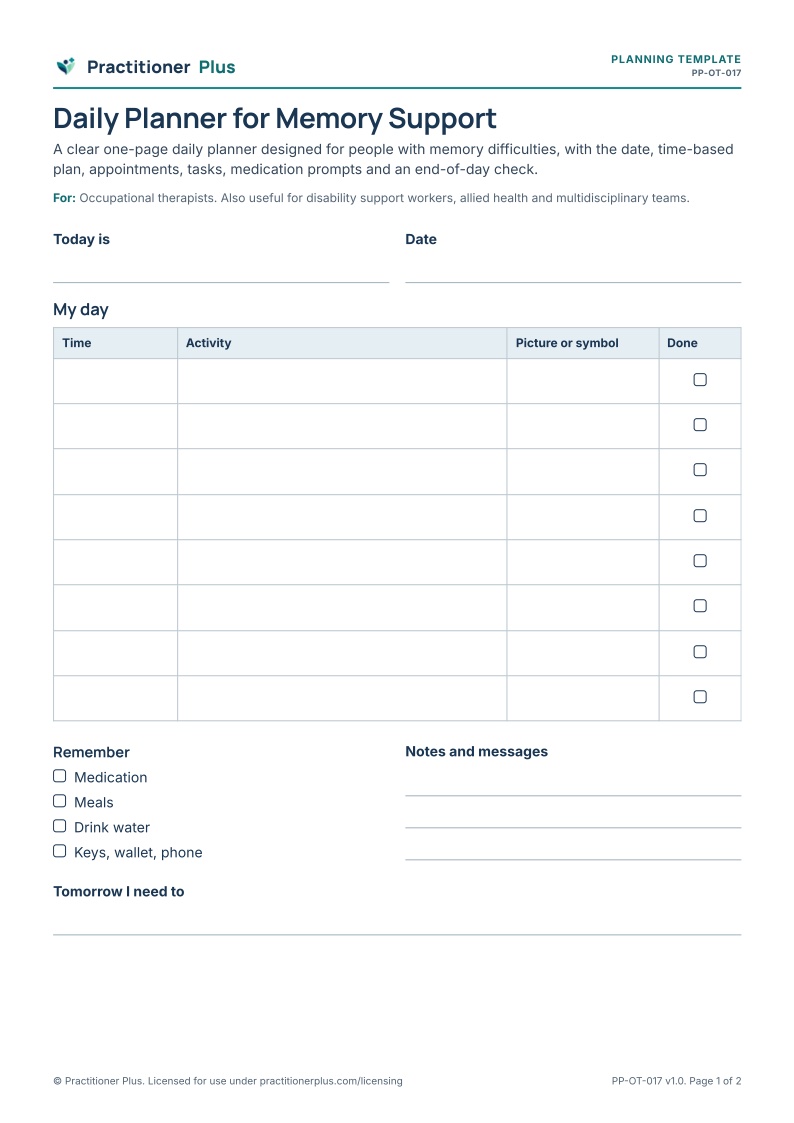
A consistent planner used in the same way each day can support memory and independence. This one-page daily planner has a clear date, a time-based plan, appointments, tasks, prompts for medication and meals, and an end-of-day check to plan tomorrow.
Purpose
To provide a consistent daily planner that supports memory and routine.
Who it is for
Primary profession: Occupational therapists. Also relevant for disability support workers, allied health and multidisciplinary teams.
Client or participant group: Adults with memory difficulties, and their supporters.
Practice setting: Home and community, as part of occupational therapy memory strategies.
Suggested uses
- Daily memory support
- Building routines after brain injury or stroke
- Supporting independence at home
- Shared use with family or workers
Instructions for practitioners
- Set up a daily routine for filling in the planner.
- Keep it in the same place every day.
- Practise using it until it becomes a habit.
- Review with the person and adjust the layout as needed.
Instructions for clients or participants
- Fill in the date each morning.
- Check your planner through the day.
- Tick tasks when done.
Accessibility considerations
Large print and clear layout. Can be printed in a larger size.
Scope and limitations
A planning template. It does not assess memory.
Research basis
External memory aids and strategy training are recommended practice in cognitive rehabilitation after brain injury. Communication skills training for carers improves quality of life and interactions for people living with dementia.
- Cicerone, K. D., Goldin, Y., Ganci, K., Rosenbaum, A., Wethe, J. V., Langenbahn, D. M., Malec, J. F., Bergquist, T. F., Kingsley, K., Nagele, D., Trexler, L., Fraas, M., Bogdanova, Y., & Harley, J. P. (2019). Evidence-Based Cognitive Rehabilitation: Systematic Review of the Literature From 2009 Through 2014. Archives of Physical Medicine and Rehabilitation, 100(8), 1515–1533. https://doi.org/10.1016/j.apmr.2019.02.011
- Eggenberger, E., Heimerl, K., & Bennett, M. I. (2013). Communication skills training in dementia care: a systematic review of effectiveness, training content, and didactic methods in different care settings. International Psychogeriatrics, 25(3), 345–358. https://doi.org/10.1017/s1041610212001664
What is included
A 2-page printable A4 PDF, including a practitioner notes page with the research basis (version 1.0).
Originality
Original Practitioner Plus content: wording, activity structure, layout and icons were created for this resource. No third-party worksheets, illustrations or text were reproduced.


