
About this resource
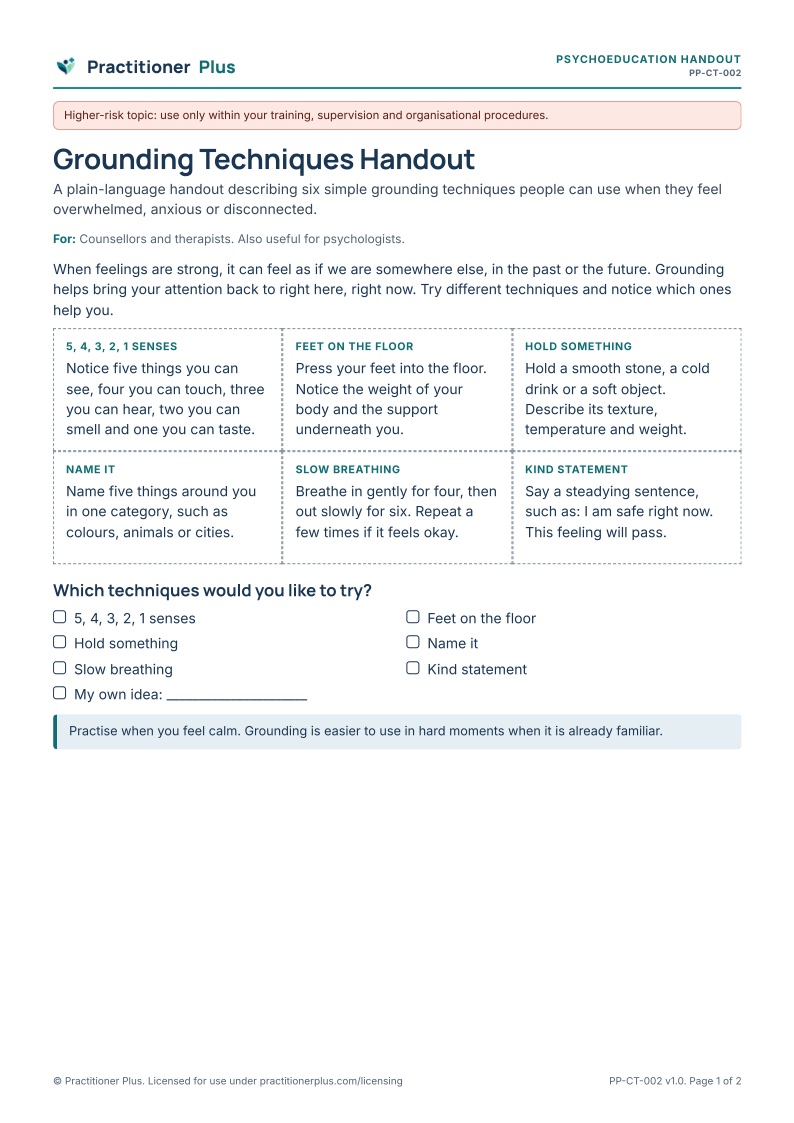
Grounding techniques help people bring their attention back to the present moment. This handout explains what grounding is in everyday language and describes six options using the senses, the body and the mind, so people can choose what suits them.
Purpose
To introduce practical grounding options people can choose from when they feel overwhelmed.
Who it is for
Primary profession: Counsellors and therapists. Also relevant for psychologists.
Client or participant group: Adolescents and adults, shared by a practitioner during or after a session.
Practice setting: Counselling and psychology sessions, practised in session before use at home.
Suggested uses
- Introducing grounding as a coping skill
- Planning what to do in difficult moments
- A take-home reminder after practising a technique in session
- Adding to a coping or safety plan
Instructions for practitioners
- Explain grounding in plain language and check what the person already does to feel steady.
- Practise one or two techniques together in the session.
- Ask the person to tick the techniques they would like to try.
- Encourage them to practise when they feel calm, so the skill is easier to use when it is needed.
Instructions for clients or participants
- Try one technique at a time when you feel calm.
- Tick the ones you would like to use.
- Stop any technique that feels uncomfortable.
Accessibility considerations
Demonstrate each technique, offer alternatives to breath and body focus, and make clear people can stop at any time.
Scope and limitations
Grounding is not right for everyone or every situation. Some techniques, such as focusing on the breath or the body, can be uncomfortable for some people. Offer choice, invite people to stop at any time, and adapt the techniques to the person's experiences and needs.
Higher-risk topic: use only within your training, supervision and organisational procedures.
Research basis
Mindfulness-based approaches show moderate benefits for anxiety, depression and stress across many groups. Trauma-informed practice prioritises safety, trust, choice, collaboration and empowerment, and avoids re-traumatising people.
- Kezelman, C., & Stavropoulos, P. (2012). Practice guidelines for treatment of complex trauma and trauma informed care and service delivery. Adults Surviving Child Abuse (now Blue Knot Foundation). https://professionals.blueknot.org.au/resources/publications/practice-guidelines/
- Khoury, B., Lecomte, T., Fortin, G., Masse, M., Therien, P., Bouchard, V., Chapleau, M. A., Paquin, K., & Hofmann, S. G. (2013). Mindfulness-based therapy: A comprehensive meta-analysis. Clinical Psychology Review, 33(6), 763–771. https://doi.org/10.1016/j.cpr.2013.05.005
- Substance Abuse and Mental Health Services Administration. (2014). SAMHSA's concept of trauma and guidance for a trauma-informed approach (HHS Publication No. SMA 14-4884). SAMHSA. https://store.samhsa.gov/product/samhsas-concept-trauma-and-guidance-trauma-informed-approach/sma14-4884
What is included
A 2-page printable A4 PDF, including a practitioner notes page with the research basis (version 1.0).
Originality
Original Practitioner Plus content: wording, activity structure and layout were created for this resource. No third-party worksheets, illustrations or text were reproduced.


