
About this resource
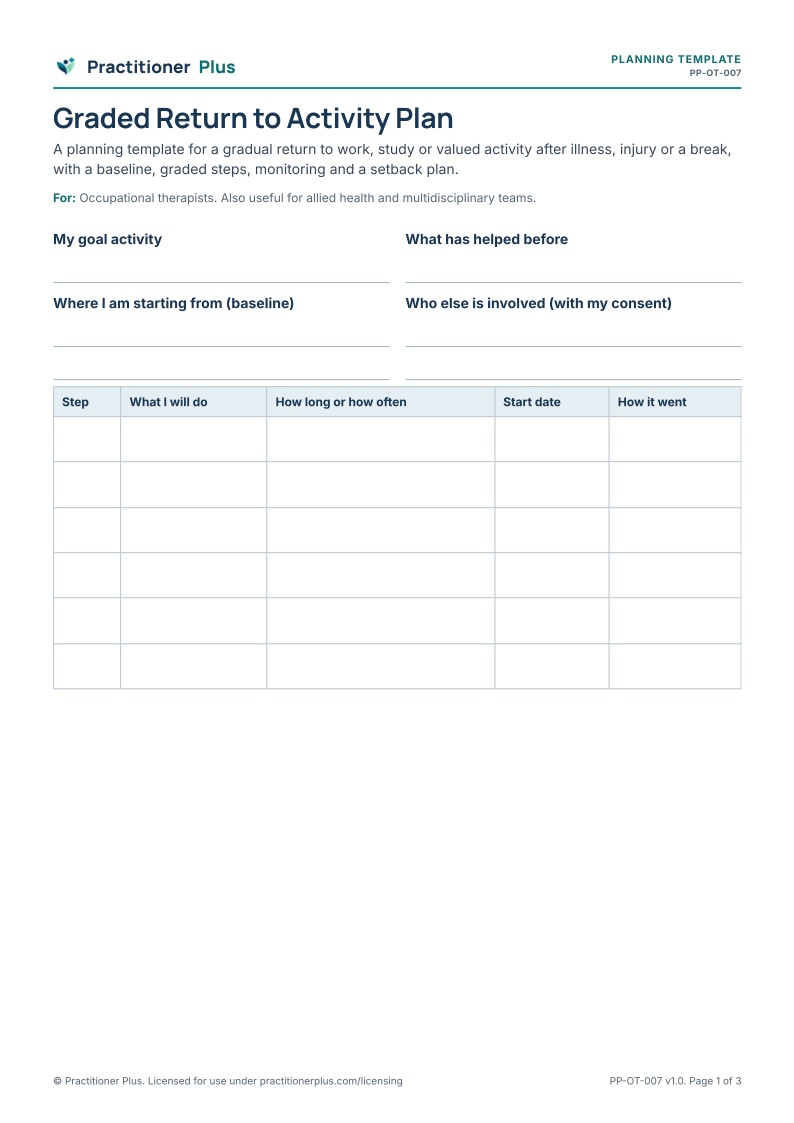
Returning too fast can lead to setbacks; returning too slowly can erode confidence. This template helps the person and therapist set a realistic baseline, plan graded steps in time and demand, monitor how each step goes and agree what to do if things get harder.
Purpose
To plan a realistic, graded return that builds tolerance and confidence, with a clear plan for setbacks.
Who it is for
Primary profession: Occupational therapists. Also relevant for allied health and multidisciplinary teams.
Client or participant group: Adults and young people returning to work, study or valued activity after illness, injury or time away.
Practice setting: Community, rehabilitation, workplace and private occupational therapy practice.
Suggested uses
- Return to work or study planning
- Returning to valued activities after illness
- Coordinating with employers or schools, with consent
- Reviewing progress through a graded plan
Instructions for practitioners
- Agree the goal activity and a realistic starting baseline.
- Plan small, graded steps in time, demand and environment.
- Agree how the person will monitor each step.
- Plan for setbacks: what to do and when to step back.
- Coordinate with medical practitioners, employers or schools as appropriate and with consent.
Instructions for clients or participants
- Agree your starting point.
- Follow the steps and note how each one goes.
- Use the setback plan if you need to.
Accessibility considerations
Use a visual timeline. The plan can be shared with employers or schools only with the person's consent.
Scope and limitations
A planning template. It does not provide medical clearance or replace return-to-work processes, workers compensation requirements or medical advice.
Research basis
In rehabilitation for adults with acquired disability, setting goals with the person may improve quality of life and self-efficacy, although the evidence is still limited. Energy conservation education reduces the impact of fatigue, as shown in people with multiple sclerosis.
- Levack, W. M., Weatherall, M., Hay-Smith, E. J. C., Dean, S. G., McPherson, K., & Siegert, R. J. (2015). Goal setting and strategies to enhance goal pursuit for adults with acquired disability participating in rehabilitation. Cochrane Database of Systematic Reviews, Article CD009727. https://doi.org/10.1002/14651858.cd009727.pub2
- Mathiowetz, V. G., Finlayson, M. L., Matuska, K. M., Chen, H. Y., & Luo, P. (2005). Randomized controlled trial of an energy conservation course for persons with multiple sclerosis. Multiple Sclerosis Journal, 11(5), 592–601. https://doi.org/10.1191/1352458505ms1198oa
What is included
A 3-page printable A4 PDF, including a practitioner notes page with the research basis (version 1.0).
Originality
Original Practitioner Plus content: wording, activity structure, layout and icons were created for this resource. No third-party worksheets, illustrations or text were reproduced. Reflects widely used graded activity principles.


