
About this resource
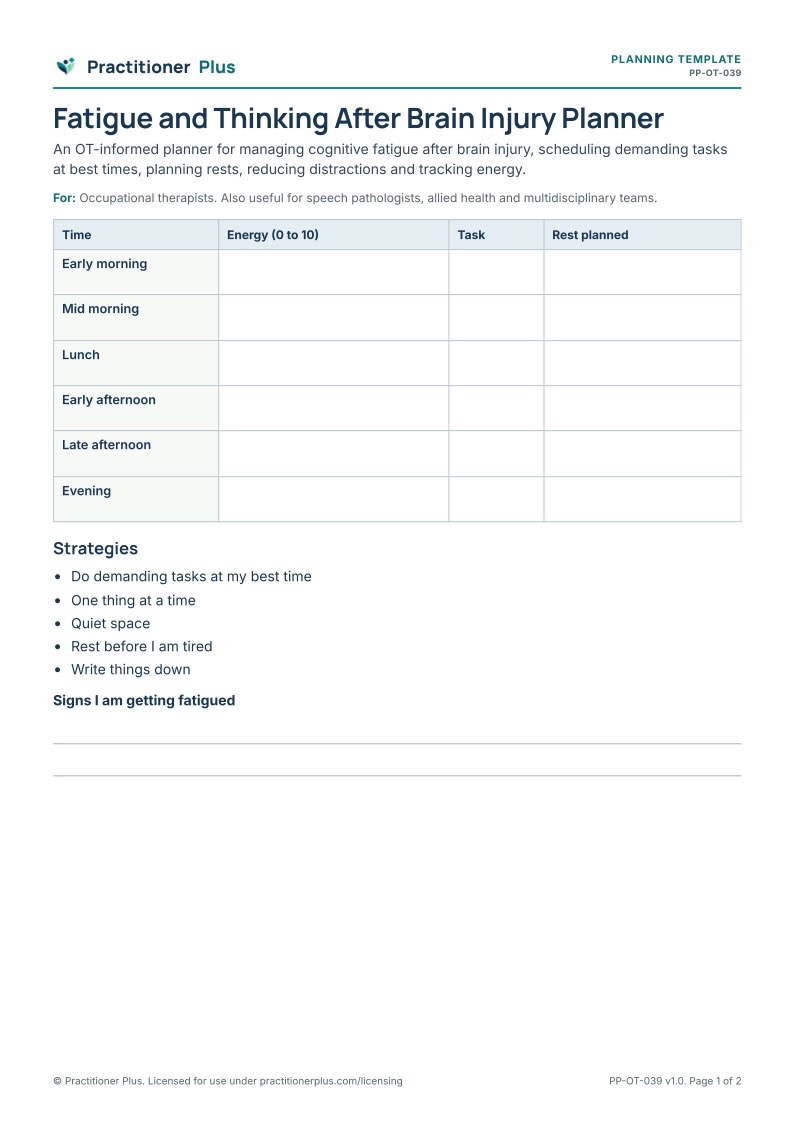
Fatigue after brain injury affects thinking as well as energy. This planner helps people notice their best times, schedule demanding tasks then, plan rests before fatigue builds, reduce distractions and track energy and symptoms.
Purpose
To help people manage fatigue and thinking demands across the day.
Who it is for
Primary profession: Occupational therapists. Also relevant for speech pathologists, allied health and multidisciplinary teams.
Client or participant group: Adults after acquired brain injury or stroke, and their families.
Practice setting: Rehabilitation and community occupational therapy.
Suggested uses
- Brain injury rehabilitation
- Return to work or study
- Family education
- Daily planning
Instructions for practitioners
- Track energy patterns first.
- Plan rests before fatigue builds.
- Adapt environments to reduce demands.
- Review regularly as recovery progresses.
Instructions for clients or participants
- Track your energy.
- Plan hard tasks at your best time.
- Rest before you are exhausted.
Accessibility considerations
Large print. Phone reminders.
Scope and limitations
A planning tool. It does not replace medical or neuropsychological assessment.
Research basis
Energy conservation education reduces the impact of fatigue, as shown in people with multiple sclerosis. External memory aids and strategy training are recommended practice in cognitive rehabilitation after brain injury.
- Cicerone, K. D., Goldin, Y., Ganci, K., Rosenbaum, A., Wethe, J. V., Langenbahn, D. M., Malec, J. F., Bergquist, T. F., Kingsley, K., Nagele, D., Trexler, L., Fraas, M., Bogdanova, Y., & Harley, J. P. (2019). Evidence-Based Cognitive Rehabilitation: Systematic Review of the Literature From 2009 Through 2014. Archives of Physical Medicine and Rehabilitation, 100(8), 1515–1533. https://doi.org/10.1016/j.apmr.2019.02.011
- Mathiowetz, V. G., Finlayson, M. L., Matuska, K. M., Chen, H. Y., & Luo, P. (2005). Randomized controlled trial of an energy conservation course for persons with multiple sclerosis. Multiple Sclerosis Journal, 11(5), 592–601. https://doi.org/10.1191/1352458505ms1198oa
What is included
A 2-page printable A4 PDF, including a practitioner notes page with the research basis (version 1.0).
Originality
Original Practitioner Plus content: wording, activity structure, layout and icons were created for this resource. No third-party worksheets, illustrations or text were reproduced.


