
About this resource
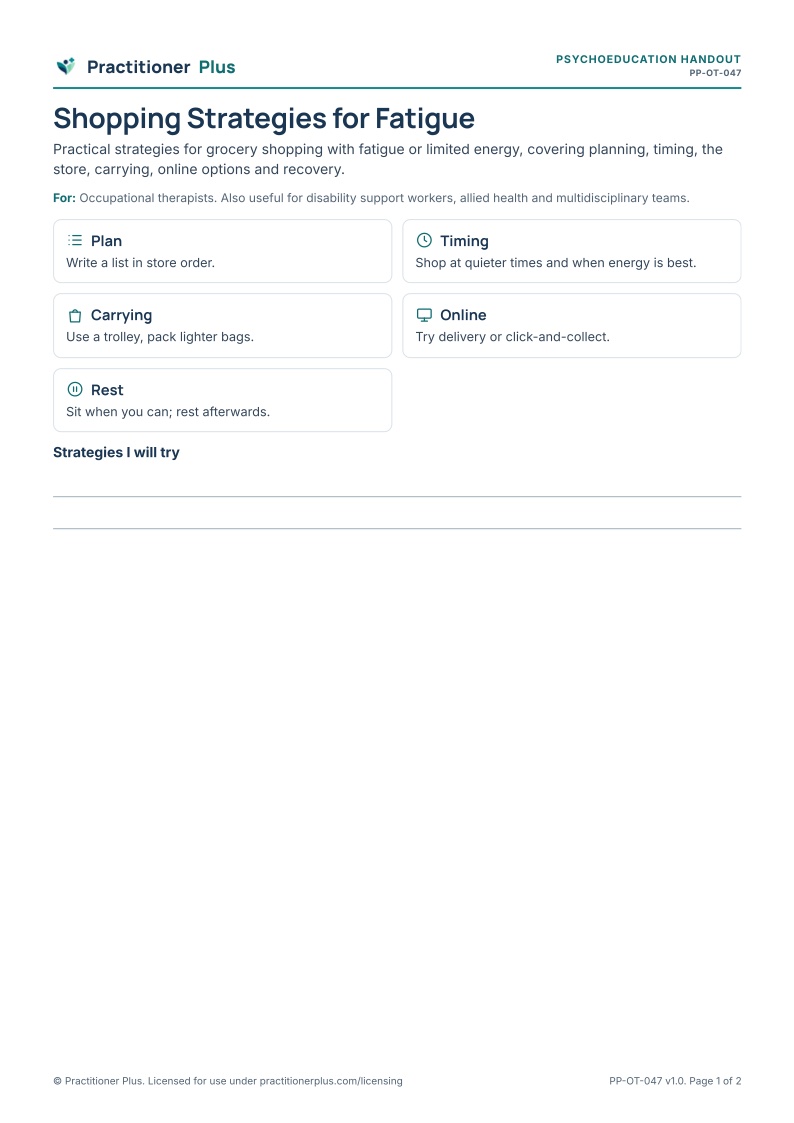
Shopping can use a lot of energy. This handout offers strategies for planning lists by store layout, choosing quieter times, using trolleys and seating, managing carrying, using online or delivery options and planning recovery.
Purpose
To make shopping manageable and less tiring.
Who it is for
Primary profession: Occupational therapists. Also relevant for disability support workers, allied health and multidisciplinary teams.
Client or participant group: Adults with fatigue, chronic illness or limited energy.
Practice setting: Community and home, with occupational therapy input.
Suggested uses
- Fatigue management
- Chronic illness
- Rehabilitation
- Independent living
Instructions for practitioners
- Tailor strategies to the person's energy and situation.
- Consider delivery or click-and-collect.
- Plan rest after shopping.
- Review what helps.
Instructions for clients or participants
- Choose strategies.
- Try them next time.
- Note your energy after.
Accessibility considerations
Large print.
Scope and limitations
General strategies.
Research basis
Energy conservation education reduces the impact of fatigue, as shown in people with multiple sclerosis.
- Mathiowetz, V. G., Finlayson, M. L., Matuska, K. M., Chen, H. Y., & Luo, P. (2005). Randomized controlled trial of an energy conservation course for persons with multiple sclerosis. Multiple Sclerosis Journal, 11(5), 592–601. https://doi.org/10.1191/1352458505ms1198oa
What is included
A 2-page printable A4 PDF, including a practitioner notes page with the research basis (version 1.0).
Originality
Original Practitioner Plus content: wording, activity structure, layout and icons were created for this resource. No third-party worksheets, illustrations or text were reproduced.


