
About this resource
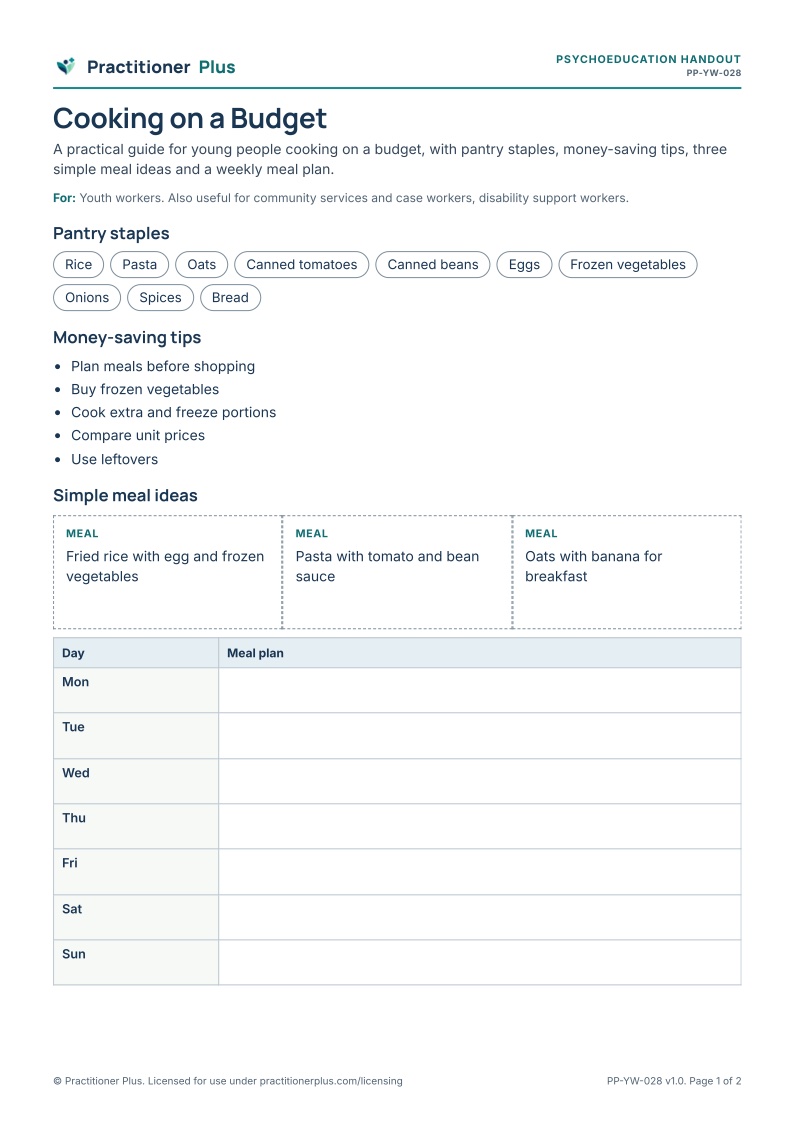
Cooking at home saves money. This guide covers pantry staples, money-saving tips, three simple meal ideas and a weekly meal plan to help young people eat well on a tight budget.
Purpose
To build confidence cooking cheap, simple meals.
Who it is for
Primary profession: Youth workers. Also relevant for community services and case workers, disability support workers.
Client or participant group: Young people aged about 15 to 25 living independently or preparing to.
Practice setting: Youth services, independent living programs and group cooking sessions.
Suggested uses
- Independent living skills
- Group cooking sessions
- Leaving care
- Food security support
Instructions for practitioners
- Cook together where possible.
- Respect cultural and dietary needs.
- Link with food relief if needed.
- Keep it practical and fun.
Instructions for clients or participants
- Check your pantry.
- Plan your meals.
- Try one new meal this week.
Accessibility considerations
Pictures can be added. Recipes can be shared on phones.
Scope and limitations
General information. It does not replace dietary advice for health conditions.
Research basis
Debt and financial stress are strongly linked with poorer mental and physical health, so practical financial support is part of holistic care.
- Richardson, T., Elliott, P., & Roberts, R. (2013). The relationship between personal unsecured debt and mental and physical health: A systematic review and meta-analysis. Clinical Psychology Review, 33(8), 1148–1162. https://doi.org/10.1016/j.cpr.2013.08.009
What is included
A 2-page printable A4 PDF, including a practitioner notes page with the research basis (version 1.0).
Originality
Original Practitioner Plus content: wording, activity structure, layout and icons were created for this resource. No third-party worksheets, illustrations or text were reproduced.


