
About this resource
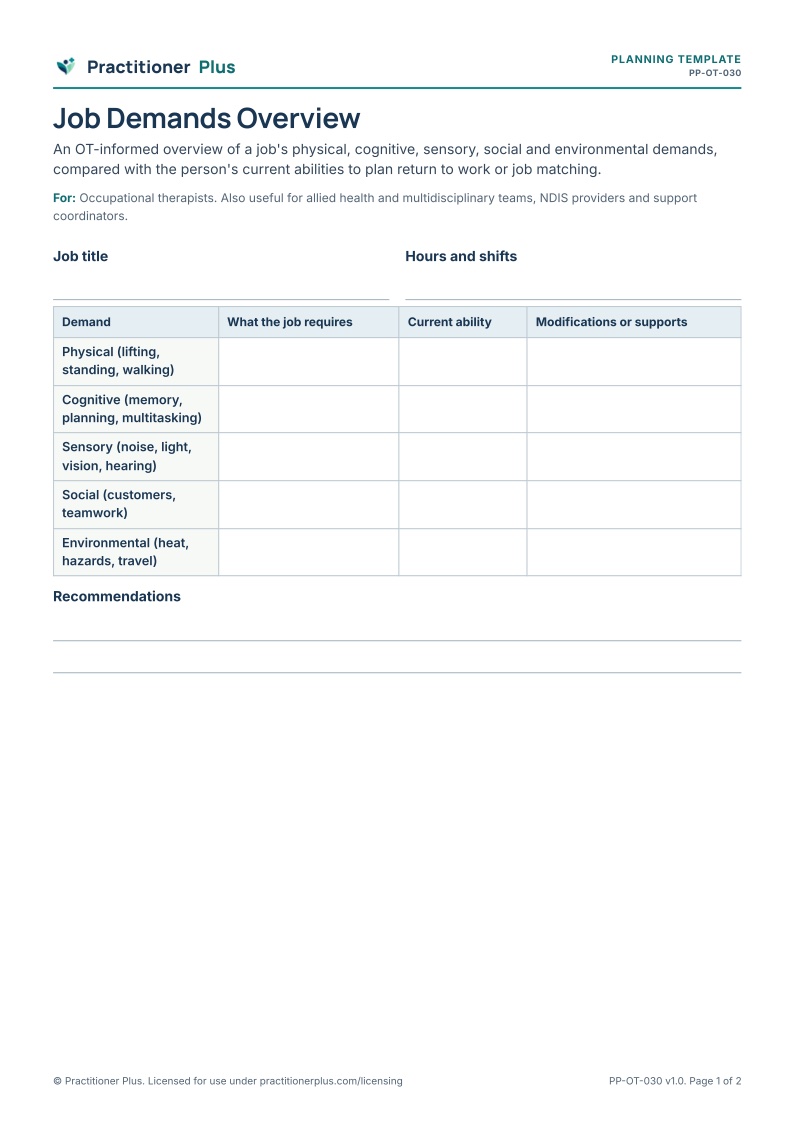
Understanding what a job involves helps plan a safe return to work or a good job match. This overview records physical, cognitive, sensory, social and environmental demands, compares them with the person's current abilities and identifies modifications and supports.
Purpose
To match job demands with the person's abilities and identify supports or modifications.
Who it is for
Primary profession: Occupational therapists. Also relevant for allied health and multidisciplinary teams, NDIS providers and support coordinators.
Client or participant group: Occupational therapists supporting return to work or job matching.
Practice setting: Rehabilitation, return to work and employment services.
Suggested uses
- Return to work planning
- Job matching
- Workplace modification planning
- Employment support
Instructions for practitioners
- Gather information from the person, the employer and the workplace where possible.
- Compare demands with current abilities honestly.
- Identify modifications and graded return options.
- Consider a formal job demands analysis where needed.
Accessibility considerations
Complete with the person. Use photos of tasks, with consent.
Scope and limitations
An overview tool. It is not a formal job demands analysis or functional capacity evaluation.
Research basis
Supported employment that focuses on rapid job search and ongoing support has strong evidence for helping people with serious mental illness find and keep work. Occupational therapy models describe how the person, their environment and their activities interact, and how a balance of meaningful activity supports health and participation.
- Bond, G. R., Drake, R. E., & Becker, D. R. (2008). An update on randomized controlled trials of evidence-based supported employment. Psychiatric Rehabilitation Journal, 31(4), 280–290. https://doi.org/10.2975/31.4.2008.280.290
- Law, M., Cooper, B., Strong, S., Stewart, D., Rigby, P., & Letts, L. (1996). The Person-Environment-Occupation Model: A Transactive Approach to Occupational Performance. Canadian Journal of Occupational Therapy, 63(1), 9–23. https://doi.org/10.1177/000841749606300103
- Wagman, P., Håkansson, C., & Björklund, A. (2012). Occupational balance as used in occupational therapy: A concept analysis. Scandinavian Journal of Occupational Therapy, 19(4), 322–327. https://doi.org/10.3109/11038128.2011.596219
- World Health Organization. (2001). International classification of functioning, disability and health (ICF). WHO. https://www.who.int/standards/classifications/international-classification-of-functioning-disability-and-health
What is included
A 2-page printable A4 PDF, including a practitioner notes page with the research basis (version 1.0).
Originality
Original Practitioner Plus content: wording, activity structure, layout and icons were created for this resource. No third-party worksheets, illustrations or text were reproduced.


