
About this resource
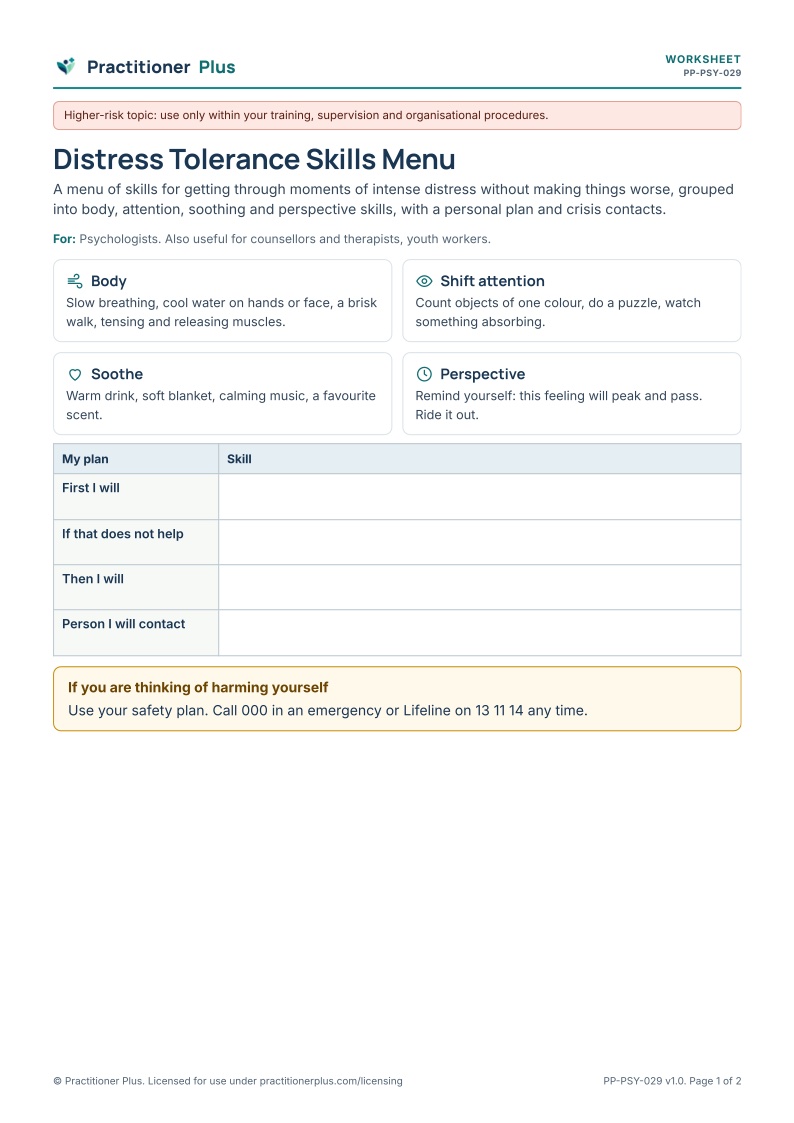
Some moments of distress are too intense to solve straight away. The aim is to get through them without making things worse. This menu groups skills into body-based, attention-shifting, self-soothing and perspective skills, then helps clients build a personal plan and record crisis contacts.
Purpose
To help clients build a personal set of skills for surviving intense distress safely.
Who it is for
Primary profession: Psychologists. Also relevant for counsellors and therapists, youth workers.
Client or participant group: Adolescents and adults who experience intense emotions, in treatment with a psychologist.
Practice setting: Psychology sessions, with practice between sessions.
Suggested uses
- Emotion regulation work
- Crisis prevention planning
- Between-session practice
- Group skills programs
Instructions for practitioners
- Practise skills when calm before using them in distress.
- Link the menu to the client's safety plan where self-harm or suicide risk is present.
- Check physical health before body-based skills, such as cold water, for clients with heart conditions.
- Review what worked.
Instructions for clients or participants
- Circle skills you want to try.
- Practise them when you are calm.
- Write your personal plan.
Accessibility considerations
Use pictures or a phone note version.
Scope and limitations
An educational skills worksheet for use within treatment. It does not replace a safety plan or crisis support.
Higher-risk topic: use only within your training, supervision and organisational procedures.
Research basis
These skills are adapted from dialectical behaviour therapy (DBT) skills training, an established treatment approach for emotion dysregulation; full DBT is delivered by trained clinicians. Understanding, naming and choosing strategies for emotions are central to emotion regulation; putting feelings into words and finer emotion distinctions are linked to better regulation.
- Gross, J. J. (2015). Emotion Regulation: Current Status and Future Prospects. Psychological Inquiry, 26(1), 1–26. https://doi.org/10.1080/1047840x.2014.940781
- Kashdan, T. B., Barrett, L. F., & McKnight, P. E. (2015). Unpacking Emotion Differentiation: Transforming Unpleasant Experience by Perceiving Distinctions in Negativity. Current Directions in Psychological Science, 24(1), 10–16. https://doi.org/10.1177/0963721414550708
- Kircanski, K., Lieberman, M. D., & Craske, M. G. (2012). Feelings Into Words: Contributions of Language to Exposure Therapy. Psychological Science, 23(10), 1086–1091. https://doi.org/10.1177/0956797612443830
- Linehan, M. M. (2015). DBT skills training manual (2nd ed.). Guilford Press.
What is included
A 2-page printable A4 PDF, including a practitioner notes page with the research basis (version 1.0).
Originality
Original Practitioner Plus content: wording, activity structure, layout and icons were created for this resource. No third-party worksheets, illustrations or text were reproduced. Reflects widely used distress tolerance approaches; skills are described in original wording.


