
About this resource
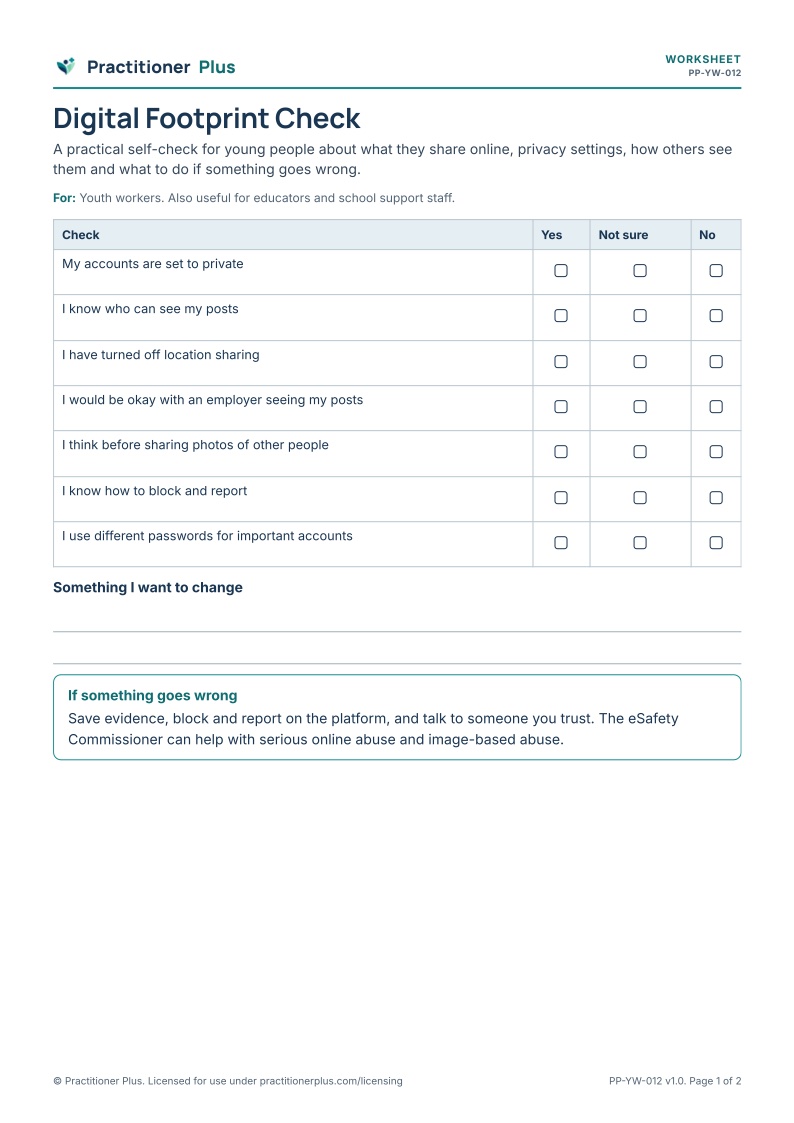
What we post online can last a long time. This check helps young people look at their accounts and habits, privacy settings and what they share, think about how others might see them, and know where to go if something goes wrong, such as image-based abuse or online bullying.
Purpose
To help young people think about what they share and take practical steps to protect themselves online.
Who it is for
Primary profession: Youth workers. Also relevant for educators and school support staff.
Client or participant group: Young people aged about 12 to 25.
Practice setting: Youth services, school programs and group sessions on online safety.
Suggested uses
- Online safety sessions
- One-to-one conversations about social media
- Preparing for job applications
- Group discussion
Instructions for practitioners
- Use a curious, non-judgemental approach.
- Let young people check their own accounts privately.
- Discuss what to do if something goes wrong, including reporting.
- Follow your organisation's procedures if a young person discloses harm or exploitation.
Instructions for clients or participants
- Answer the questions honestly.
- Check your privacy settings.
- Pick one change to make.
Accessibility considerations
Can be discussed rather than written. Works in groups or one to one.
Scope and limitations
A general online safety activity. It does not replace specialist responses to online exploitation or image-based abuse.
Research basis
Australian eSafety guidance supports young people, families and educators to stay safe online and to report harm.
- eSafety Commissioner. Advice and resources for young people, parents and educators. https://www.esafety.gov.au/
What is included
A 2-page printable A4 PDF, including a practitioner notes page with the research basis (version 1.0).
Originality
Original Practitioner Plus content: wording, activity structure, layout and icons were created for this resource. No third-party worksheets, illustrations or text were reproduced.


