
About this resource
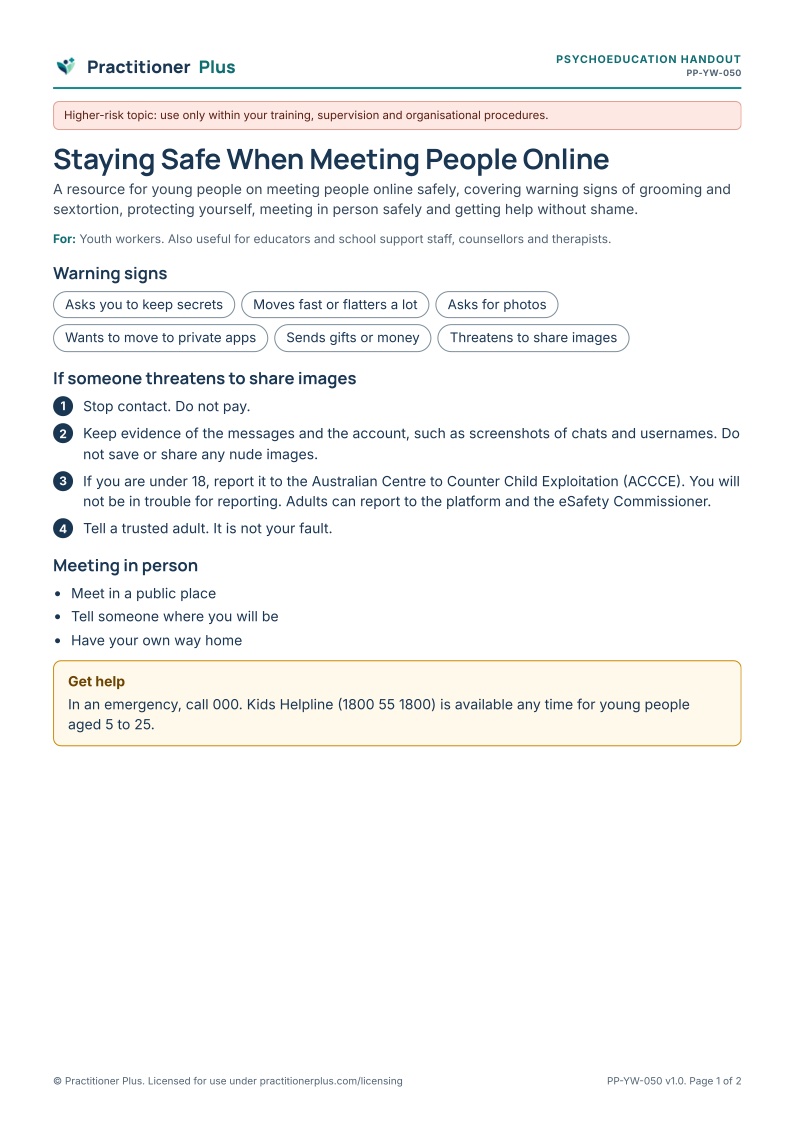
Lots of young people meet people online. This resource covers warning signs of grooming and sextortion, protecting yourself, meeting in person safely and getting help without shame, including reporting to the eSafety Commissioner and police.
Purpose
To help young people recognise risks online and get help early.
Who it is for
Primary profession: Youth workers. Also relevant for educators and school support staff, counsellors and therapists.
Client or participant group: Young people aged about 12 to 25.
Practice setting: Youth services, schools and online safety programs.
Suggested uses
- Online safety education
- One-to-one conversations
- Following concerns
- School programs
Instructions for practitioners
- Use a non-judgemental approach.
- Reassure young people they will not be blamed.
- Follow child safety and reporting procedures for exploitation.
- Help preserve evidence and report.
Instructions for clients or participants
- Read the warning signs.
- Know what to do.
- Tell someone you trust.
Accessibility considerations
Plain language. Can be shared privately.
Scope and limitations
General information. Online sexual exploitation requires urgent reporting and specialist support.
Higher-risk topic: use only within your training, supervision and organisational procedures.
Research basis
Australian eSafety guidance supports young people, families and educators to stay safe online and to report harm.
- eSafety Commissioner. Advice and resources for young people, parents and educators. https://www.esafety.gov.au/
What is included
A 2-page printable A4 PDF, including a practitioner notes page with the research basis (version 1.0).
Originality
Original Practitioner Plus content: wording, activity structure, layout and icons were created for this resource. No third-party worksheets, illustrations or text were reproduced.


