
About this resource
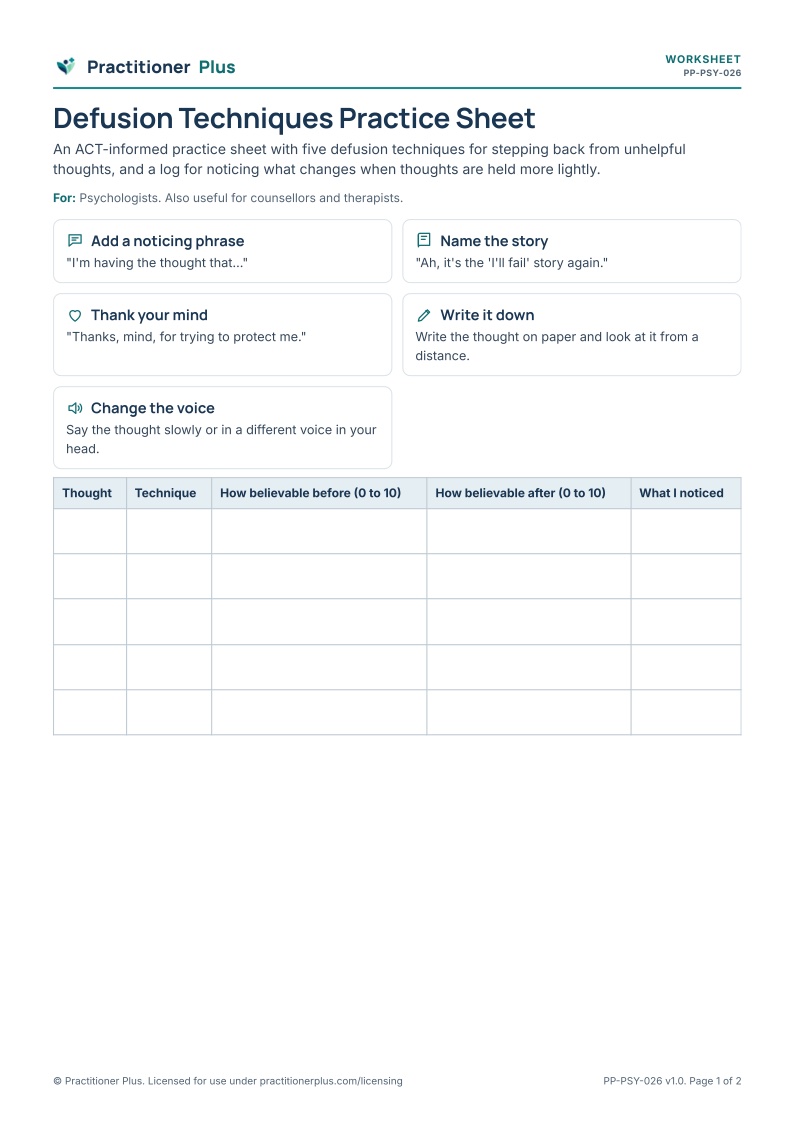
Defusion means stepping back from thoughts and seeing them as words and pictures in the mind, not commands or facts. This sheet describes five practical techniques, such as adding a noticing phrase and naming the story, and a log for noticing the effect of practising them.
Purpose
To help clients practise relating to thoughts as thoughts rather than facts.
Who it is for
Primary profession: Psychologists. Also relevant for counsellors and therapists.
Client or participant group: Adolescents and adults in ACT-informed treatment.
Practice setting: Psychology sessions and between-session practice.
Suggested uses
- ACT-informed therapy
- Self-critical or anxious thoughts
- Rumination
- Between-session practice
Instructions for practitioners
- Practise each technique in session first.
- Present defusion as a way to change your relationship with thoughts, not to get rid of them.
- Avoid techniques that might feel invalidating for distressing content.
- Review the log together.
Instructions for clients or participants
- Choose a sticky thought.
- Try a technique.
- Notice what changes.
Accessibility considerations
Techniques can be practised verbally.
Scope and limitations
An educational ACT-informed worksheet for use within treatment.
Research basis
Acceptance and commitment therapy (ACT), which includes clarifying values and taking committed action, performs better than usual care and similarly to established treatments for anxiety, depression and related problems. Mindfulness-based approaches show moderate benefits for anxiety, depression and stress across many groups.
- A-Tjak, J. G., Davis, M. L., Morina, N., Powers, M. B., Smits, J. A., & Emmelkamp, P. M. (2015). A Meta-Analysis of the Efficacy of Acceptance and Commitment Therapy for Clinically Relevant Mental and Physical Health Problems. Psychotherapy and Psychosomatics, 84(1), 30–36. https://doi.org/10.1159/000365764
- Hayes, S. C., Strosahl, K. D., & Wilson, K. G. (2012). Acceptance and commitment therapy: The process and practice of mindful change (2nd ed.). Guilford Press.
- Khoury, B., Lecomte, T., Fortin, G., Masse, M., Therien, P., Bouchard, V., Chapleau, M. A., Paquin, K., & Hofmann, S. G. (2013). Mindfulness-based therapy: A comprehensive meta-analysis. Clinical Psychology Review, 33(6), 763–771. https://doi.org/10.1016/j.cpr.2013.05.005
What is included
A 2-page printable A4 PDF, including a practitioner notes page with the research basis (version 1.0).
Originality
Original Practitioner Plus content: wording, activity structure, layout and icons were created for this resource. No third-party worksheets, illustrations or text were reproduced. Reflects defusion strategies used in acceptance and commitment therapy.


