
About this resource
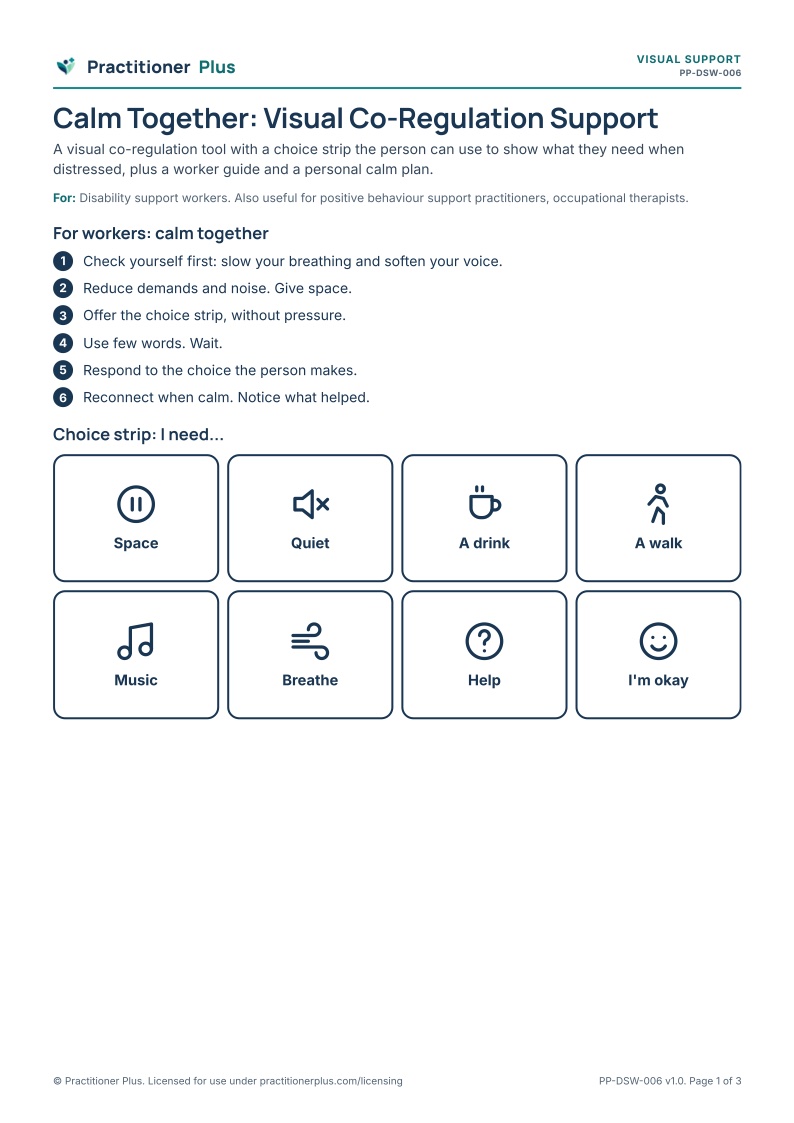
When someone is distressed, words can be hard to process. This tool pairs a simple worker guide on co-regulation with a visual choice strip the person can point to, and a personal calm plan that records the person's early signs and what does and does not help them.
Purpose
To help workers support a person to regulate through calm, predictable support and visual choices.
Who it is for
Primary profession: Disability support workers. Also relevant for positive behaviour support practitioners, occupational therapists.
Client or participant group: Children and adults with disability who benefit from visual supports when distressed, and their support workers.
Practice setting: Home, supported living, day programs and community settings.
Suggested uses
- Supporting a person through distress
- Teaching the choice strip at calm times
- Recording a person's calm plan for the team
- Onboarding new workers to a person's needs
Instructions for practitioners
- Complete the calm plan with the person and people who know them well.
- Teach the choice strip when the person is calm.
- In distress, regulate yourself first, lower demands and offer the strip.
- Respect the person's choice and give time.
- Follow the person's behaviour support plan if they have one.
Instructions for clients or participants
- Point to what you need.
- Take your time.
Accessibility considerations
Personalise symbols, size and number of choices. Use photos of real items where symbols are not meaningful.
Scope and limitations
A general co-regulation support. It is not a behaviour support plan, does not recommend restrictive practices and does not replace guidance from the person's behaviour support practitioner or therapists.
Research basis
Children learn to self-regulate through warm, responsive co-regulation from adults and predictable environments. Understanding, naming and choosing strategies for emotions are central to emotion regulation; putting feelings into words and finer emotion distinctions are linked to better regulation. Visual schedules and other visual supports are established evidence-based practices for autistic children and young people, and are widely used with others who benefit from visual information.
- Gross, J. J. (2015). Emotion Regulation: Current Status and Future Prospects. Psychological Inquiry, 26(1), 1–26. https://doi.org/10.1080/1047840x.2014.940781
- Kashdan, T. B., Barrett, L. F., & McKnight, P. E. (2015). Unpacking Emotion Differentiation: Transforming Unpleasant Experience by Perceiving Distinctions in Negativity. Current Directions in Psychological Science, 24(1), 10–16. https://doi.org/10.1177/0963721414550708
- Kircanski, K., Lieberman, M. D., & Craske, M. G. (2012). Feelings Into Words: Contributions of Language to Exposure Therapy. Psychological Science, 23(10), 1086–1091. https://doi.org/10.1177/0956797612443830
- Knight, V., Sartini, E., & Spriggs, A. D. (2015). Evaluating Visual Activity Schedules as Evidence-Based Practice for Individuals with Autism Spectrum Disorders. Journal of Autism and Developmental Disorders, 45(1), 157–178. https://doi.org/10.1007/s10803-014-2201-z
- Murray, D. W., Rosanbalm, K., Christopoulos, C., & Hamoudi, A. (2015). Self-regulation and toxic stress: Foundations for understanding self-regulation from an applied developmental perspective (OPRE Report 2015-21). Office of Planning, Research and Evaluation, US Department of Health and Human Services. https://acf.gov/opre/report/self-regulation-and-toxic-stress-foundations-understanding-self-regulation-applied
- Steinbrenner, J. R., Hume, K., Odom, S. L., Morin, K. L., Nowell, S. W., Tomaszewski, B., Szendrey, S., McIntyre, N. S., Yücesoy-Özkan, S., & Savage, M. N. (2020). Evidence-based practices for children, youth, and young adults with autism. FPG Child Development Institute, University of North Carolina. https://ncaep.fpg.unc.edu/wp-content/uploads/EBP-Report-2020.pdf
What is included
A 4-page printable A4 PDF, including a practitioner notes page with the research basis (version 1.0).
Originality
Original Practitioner Plus content: wording, activity structure, layout and icons were created for this resource. No third-party worksheets, illustrations or text were reproduced. Symbols are original line drawings created for Practitioner Plus.


