
About this resource
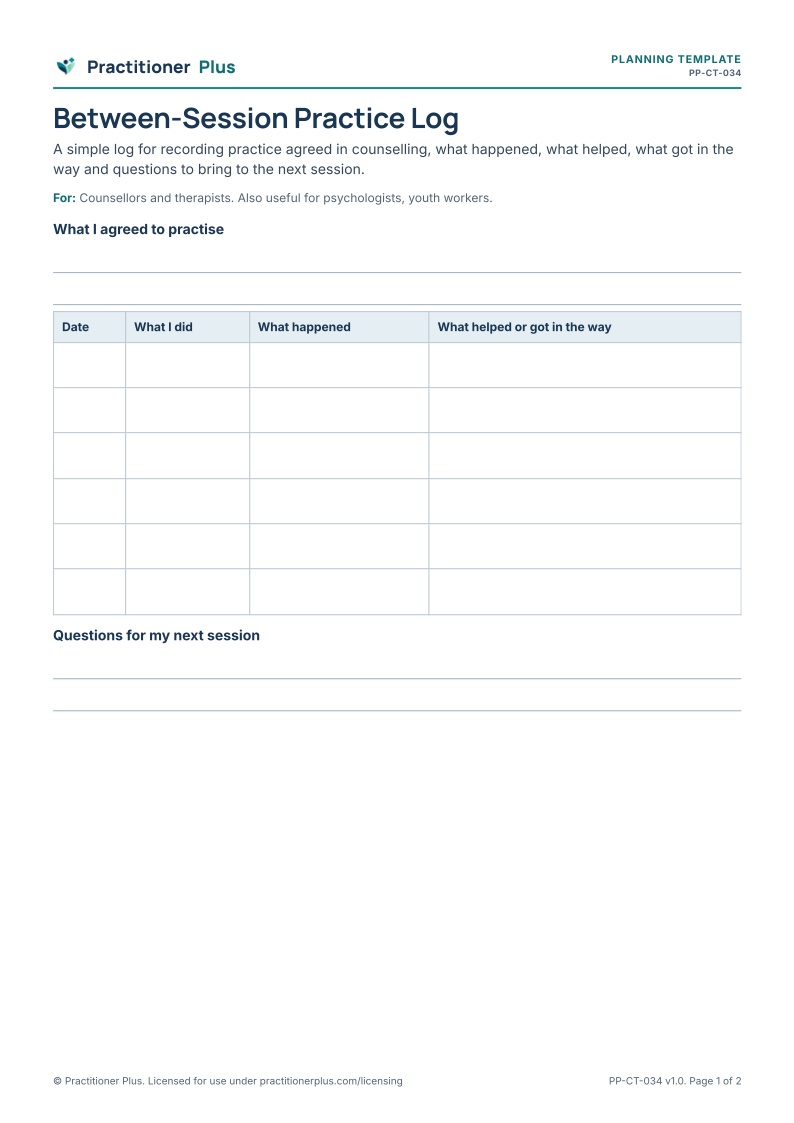
Change often happens between sessions. This log records the practice agreed in counselling, when it was tried, what happened, what helped, what got in the way and questions to bring back, so the next session can build on real experience.
Purpose
To support practice between sessions and make reviews more useful.
Who it is for
Primary profession: Counsellors and therapists. Also relevant for psychologists, youth workers.
Client or participant group: Adolescents and adults in counselling.
Practice setting: Between counselling sessions.
Suggested uses
- Any between-session practice
- Skills practice
- Behavioural experiments
- Reviewing progress
Instructions for practitioners
- Agree a small, specific practice.
- Explain that any attempt is useful information.
- Review the log at the start of the next session.
- Problem-solve barriers without blame.
Instructions for clients or participants
- Write what you agreed to try.
- Record what happened.
- Bring the log to your next session.
Accessibility considerations
Can be kept on a phone or as voice notes.
Scope and limitations
A practice log for use within counselling.
Research basis
Practising skills between sessions is linked to better outcomes in cognitive and behavioural therapies. Specific goals, if-then plans and regular progress monitoring all improve the chances of reaching goals.
- Gollwitzer, P. M., & Sheeran, P. (2006). Implementation Intentions and Goal Achievement: A Meta‐analysis of Effects and Processes. Advances in Experimental Social Psychology, 69–119. https://doi.org/10.1016/s0065-2601(06)38002-1
- Harkin, B., Webb, T. L., Chang, B. P. I., Prestwich, A., Conner, M., Kellar, I., Benn, Y., & Sheeran, P. (2016). Does monitoring goal progress promote goal attainment? A meta-analysis of the experimental evidence. Psychological Bulletin, 142(2), 198–229. https://doi.org/10.1037/bul0000025
- Kazantzis, N., Whittington, C., & Dattilio, F. (2010). Meta-analysis of homework effects in cognitive and behavioral therapy: A replication and extension. Clinical Psychology: Science and Practice, 17(2), 144–156. https://doi.org/10.1111/j.1468-2850.2010.01204.x
- Locke, E. A., & Latham, G. P. (2002). Building a practically useful theory of goal setting and task motivation: A 35-year odyssey. American Psychologist, 57(9), 705–717. https://doi.org/10.1037/0003-066x.57.9.705
What is included
A 2-page printable A4 PDF, including a practitioner notes page with the research basis (version 1.0).
Originality
Original Practitioner Plus content: wording, activity structure, layout and icons were created for this resource. No third-party worksheets, illustrations or text were reproduced.


