
About this resource
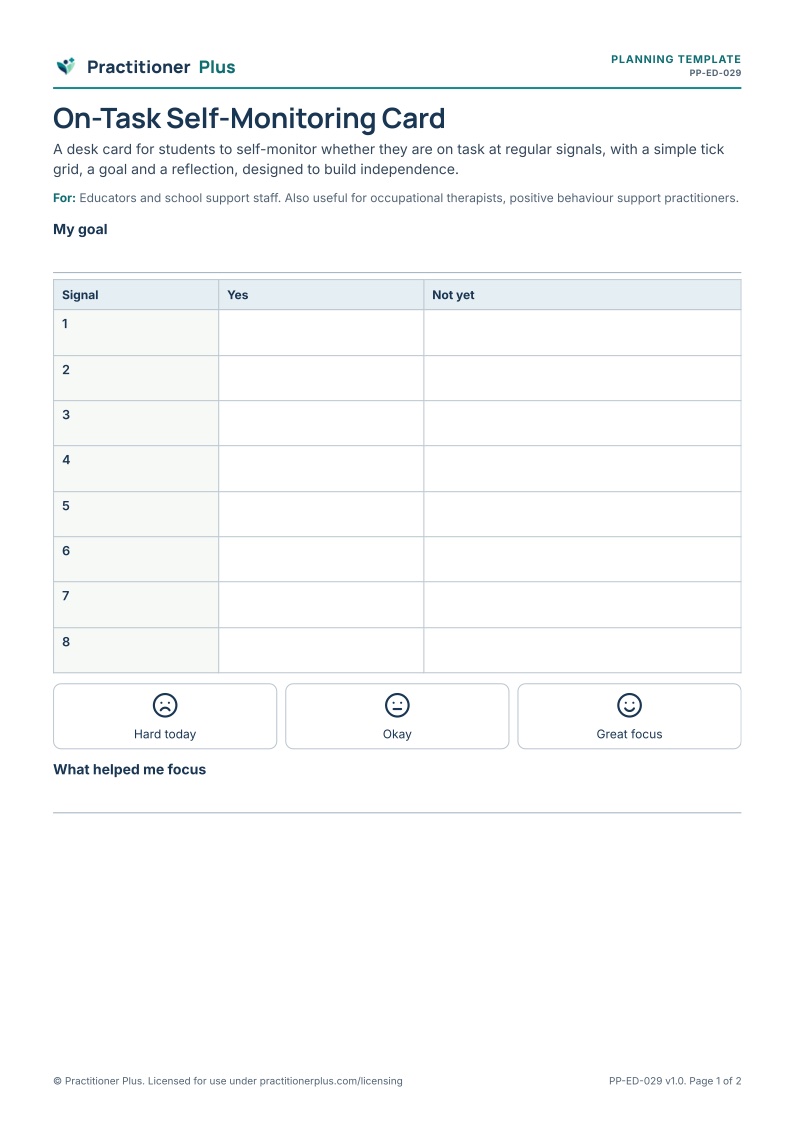
Self-monitoring helps students notice their own focus. At regular signals, students ask themselves whether they were on task and tick yes or not yet. They set a goal, reflect and celebrate progress. Teachers can check accuracy occasionally.
Purpose
To build students' awareness of their own focus and independence.
Who it is for
Primary profession: Educators and school support staff. Also relevant for occupational therapists, positive behaviour support practitioners.
Client or participant group: Primary and lower secondary students working on focus.
Practice setting: Classrooms.
Suggested uses
- Independent work time
- Students working on focus
- Individual learning plans
- Building self-regulation
Instructions for practitioners
- Teach what on task looks like for the activity.
- Use a gentle signal, such as a vibrating timer.
- Check accuracy occasionally and praise honesty.
- Fade the card as skills grow.
Instructions for clients or participants
- When you get the signal, ask: was I on task?
- Tick yes or not yet.
- Reflect at the end.
Accessibility considerations
Use symbols for yes and not yet.
Scope and limitations
A classroom strategy. It is not a disciplinary tool.
Research basis
Specific goals, if-then plans and regular progress monitoring all improve the chances of reaching goals. Executive functions such as planning, working memory and self-control develop over time and can be supported with external structure and practice. Children learn to self-regulate through warm, responsive co-regulation from adults and predictable environments.
- Diamond, A. (2013). Executive Functions. Annual Review of Psychology, 64(1), 135–168. https://doi.org/10.1146/annurev-psych-113011-143750
- Gollwitzer, P. M., & Sheeran, P. (2006). Implementation Intentions and Goal Achievement: A Meta‐analysis of Effects and Processes. Advances in Experimental Social Psychology, 69–119. https://doi.org/10.1016/s0065-2601(06)38002-1
- Harkin, B., Webb, T. L., Chang, B. P. I., Prestwich, A., Conner, M., Kellar, I., Benn, Y., & Sheeran, P. (2016). Does monitoring goal progress promote goal attainment? A meta-analysis of the experimental evidence. Psychological Bulletin, 142(2), 198–229. https://doi.org/10.1037/bul0000025
- Locke, E. A., & Latham, G. P. (2002). Building a practically useful theory of goal setting and task motivation: A 35-year odyssey. American Psychologist, 57(9), 705–717. https://doi.org/10.1037/0003-066x.57.9.705
- Murray, D. W., Rosanbalm, K., Christopoulos, C., & Hamoudi, A. (2015). Self-regulation and toxic stress: Foundations for understanding self-regulation from an applied developmental perspective (OPRE Report 2015-21). Office of Planning, Research and Evaluation, US Department of Health and Human Services. https://acf.gov/opre/report/self-regulation-and-toxic-stress-foundations-understanding-self-regulation-applied
What is included
A 2-page printable A4 PDF, including a practitioner notes page with the research basis (version 1.0).
Originality
Original Practitioner Plus content: wording, activity structure, layout and icons were created for this resource. No third-party worksheets, illustrations or text were reproduced.


