
About this resource
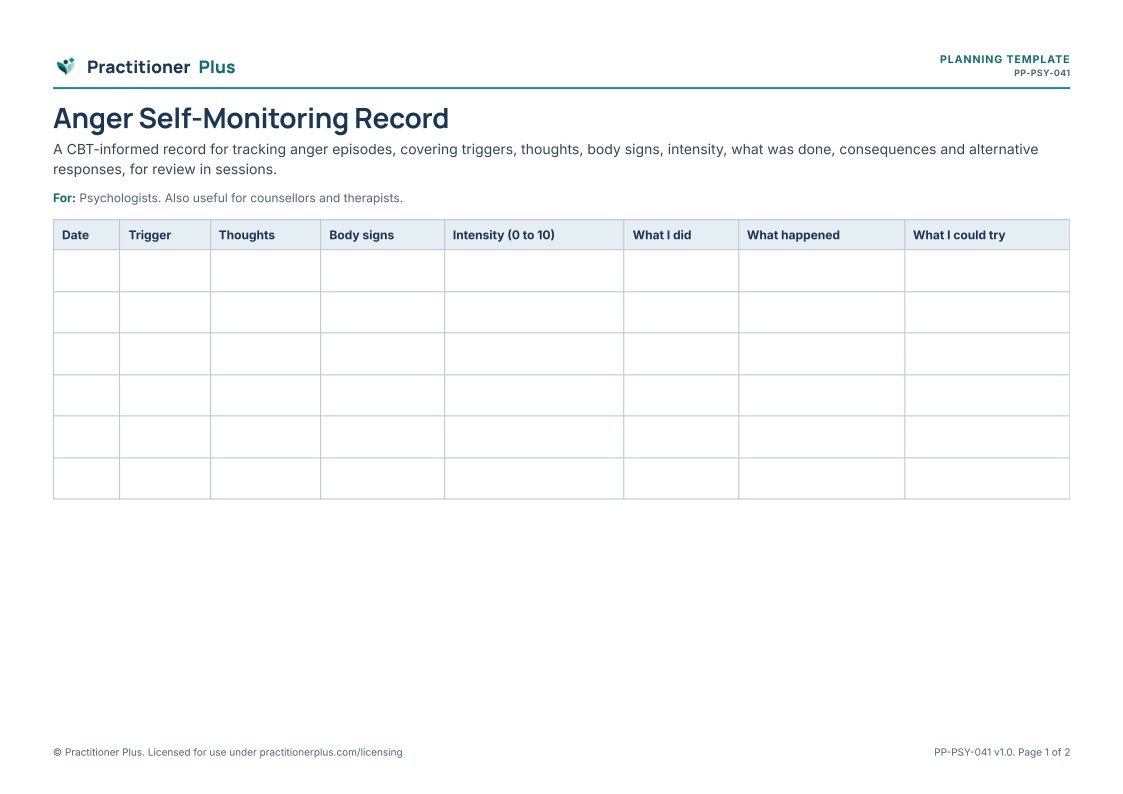
Tracking anger helps clients see patterns. This record captures the trigger, thoughts, body signs, intensity, what the client did, what happened next and an alternative response, for review in sessions.
Purpose
To identify anger patterns and practise alternative responses.
Who it is for
Primary profession: Psychologists. Also relevant for counsellors and therapists.
Client or participant group: Adolescents and adults working on anger in treatment.
Practice setting: Between psychology sessions, reviewed together.
Suggested uses
- Anger management treatment
- Identifying triggers
- Practising alternatives
- Progress review
Instructions for practitioners
- Review the record each session.
- Look for patterns in triggers and thoughts.
- Practise alternatives in session.
- Assess risk where anger involves harm to others and follow procedures.
Instructions for clients or participants
- Fill in a row after anger episodes.
- Rate intensity from 0 to 10.
- Write an alternative response.
Accessibility considerations
Can be completed on a phone.
Scope and limitations
An educational self-monitoring tool for use within treatment. It does not replace specialist family violence programs where relevant.
Research basis
Cognitive behavioural anger interventions are effective for a range of anger problems. Specific goals, if-then plans and regular progress monitoring all improve the chances of reaching goals. Cognitive behavioural therapy (CBT) has a strong research base for anxiety, depression and many related problems; this resource uses CBT techniques to support, not replace, a structured treatment plan.
- Beck, J. S. (2021). Cognitive behavior therapy: Basics and beyond (3rd ed.). Guilford Press.
- Del Vecchio, T., & O'Leary, K. (2004). Effectiveness of anger treatments for specific anger problems: A meta-analytic review. Clinical Psychology Review, 24(1), 15–34. https://doi.org/10.1016/j.cpr.2003.09.006
- Gollwitzer, P. M., & Sheeran, P. (2006). Implementation Intentions and Goal Achievement: A Meta‐analysis of Effects and Processes. Advances in Experimental Social Psychology, 69–119. https://doi.org/10.1016/s0065-2601(06)38002-1
- Harkin, B., Webb, T. L., Chang, B. P. I., Prestwich, A., Conner, M., Kellar, I., Benn, Y., & Sheeran, P. (2016). Does monitoring goal progress promote goal attainment? A meta-analysis of the experimental evidence. Psychological Bulletin, 142(2), 198–229. https://doi.org/10.1037/bul0000025
- Hofmann, S. G., Asnaani, A., Vonk, I. J. J., Sawyer, A. T., & Fang, A. (2012). The Efficacy of Cognitive Behavioral Therapy: A Review of Meta-analyses. Cognitive Therapy and Research, 36(5), 427–440. https://doi.org/10.1007/s10608-012-9476-1
- Locke, E. A., & Latham, G. P. (2002). Building a practically useful theory of goal setting and task motivation: A 35-year odyssey. American Psychologist, 57(9), 705–717. https://doi.org/10.1037/0003-066x.57.9.705
What is included
A 2-page printable A4 PDF, including a practitioner notes page with the research basis (version 1.0).
Originality
Original Practitioner Plus content: wording, activity structure, layout and icons were created for this resource. No third-party worksheets, illustrations or text were reproduced.


