
About this resource
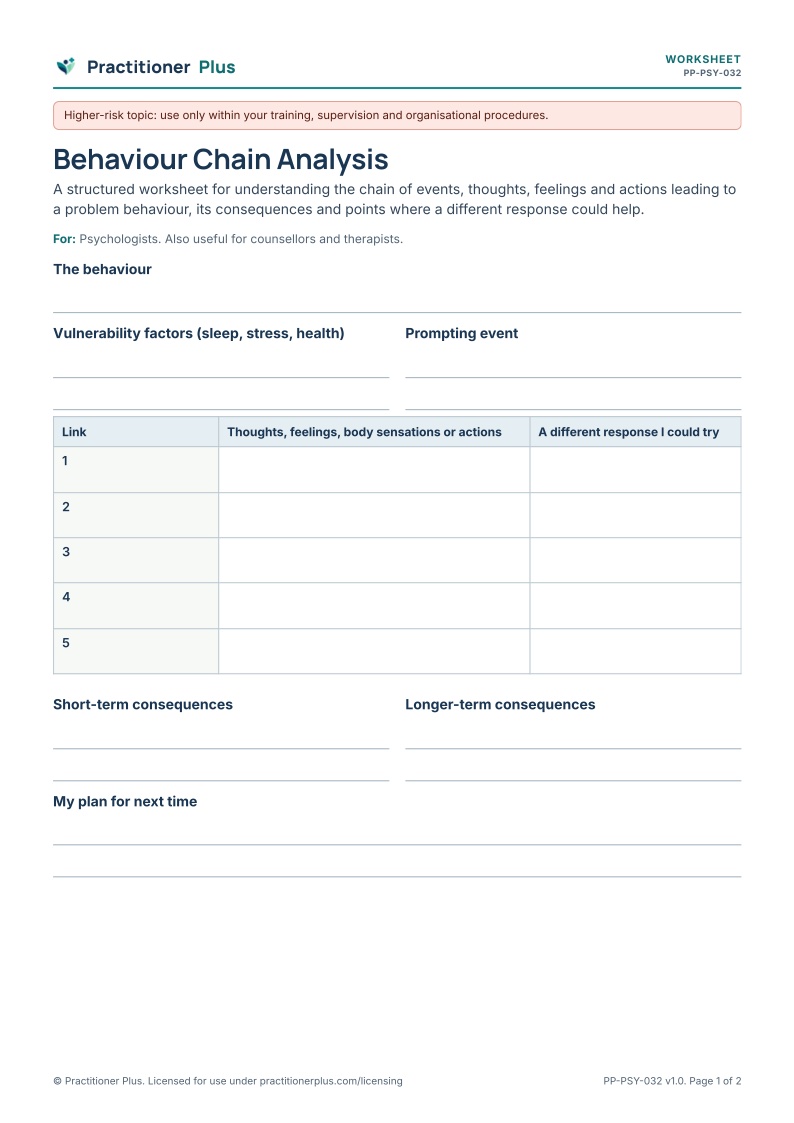
Behaviours usually follow a chain of events, thoughts, feelings and urges. This worksheet maps vulnerability factors, the prompting event, each link in the chain, the behaviour, short and longer-term consequences, and the points where a different skill or response could break the chain.
Purpose
To identify the links leading to a behaviour and the points where change is possible.
Who it is for
Primary profession: Psychologists. Also relevant for counsellors and therapists.
Client or participant group: Adolescents and adults in treatment who want to understand and change a problem behaviour.
Practice setting: Psychology sessions, completed collaboratively.
Suggested uses
- Understanding impulsive or harmful behaviours
- Emotion regulation treatment
- Relapse prevention
- Planning skill use
Instructions for practitioners
- Complete collaboratively and without judgement.
- Go link by link in detail.
- Identify specific points for alternative skills.
- Where the behaviour is self-harm or risk-taking, follow risk assessment and safety planning procedures.
Instructions for clients or participants
- Describe the behaviour.
- Work backwards to the prompting event.
- Find points where you could do something different.
Accessibility considerations
Can be completed verbally or as a drawn chain.
Scope and limitations
An educational worksheet for use within treatment. It does not replace risk assessment or safety planning.
Higher-risk topic: use only within your training, supervision and organisational procedures.
Research basis
These skills are adapted from dialectical behaviour therapy (DBT) skills training, an established treatment approach for emotion dysregulation; full DBT is delivered by trained clinicians. Understanding, naming and choosing strategies for emotions are central to emotion regulation; putting feelings into words and finer emotion distinctions are linked to better regulation.
- Gross, J. J. (2015). Emotion Regulation: Current Status and Future Prospects. Psychological Inquiry, 26(1), 1–26. https://doi.org/10.1080/1047840x.2014.940781
- Kashdan, T. B., Barrett, L. F., & McKnight, P. E. (2015). Unpacking Emotion Differentiation: Transforming Unpleasant Experience by Perceiving Distinctions in Negativity. Current Directions in Psychological Science, 24(1), 10–16. https://doi.org/10.1177/0963721414550708
- Kircanski, K., Lieberman, M. D., & Craske, M. G. (2012). Feelings Into Words: Contributions of Language to Exposure Therapy. Psychological Science, 23(10), 1086–1091. https://doi.org/10.1177/0956797612443830
- Linehan, M. M. (2015). DBT skills training manual (2nd ed.). Guilford Press.
What is included
A 2-page printable A4 PDF, including a practitioner notes page with the research basis (version 1.0).
Originality
Original Practitioner Plus content: wording, activity structure, layout and icons were created for this resource. No third-party worksheets, illustrations or text were reproduced. Reflects widely used chain analysis approaches in behavioural therapies, described in original wording.


