
About this resource
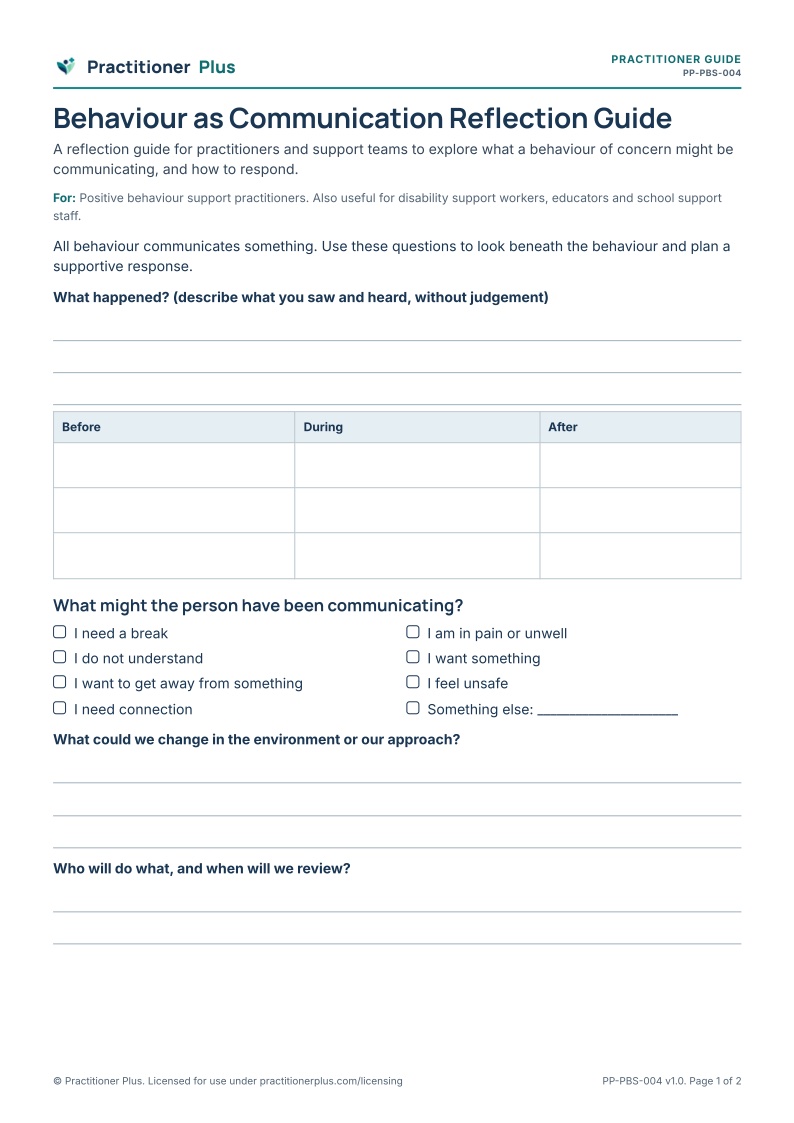
Behaviour often communicates a need. This guide helps teams step back from a specific behaviour and reflect on context, possible needs and supportive responses, using a consistent set of questions.
Purpose
To help teams explore what a behaviour may be communicating and plan supportive responses.
Who it is for
Primary profession: Positive behaviour support practitioners. Also relevant for disability support workers, educators and school support staff.
Client or participant group: Practitioners, support workers, educators and support teams.
Practice setting: Team reflection and supervision after incidents.
Suggested uses
- Team reflection after an incident
- Supervision and practice discussions
- Preparing for a functional behaviour assessment conversation
- Training new support workers in a person-centred approach
Instructions for practitioners
- Describe what happened in neutral, observable terms.
- Work through the context questions: before, during and after.
- Consider what need the behaviour might be meeting.
- Identify supportive responses and changes to the environment.
- Agree who will do what, and when the team will review.
Accessibility considerations
Include the person's perspective using their preferred communication method.
Scope and limitations
This guide supports reflection. It is not a functional behaviour assessment or a behaviour support plan, and it does not replace the requirements for behaviour support under the NDIS where they apply.
Research basis
Positive behaviour support aims to improve quality of life and reduce behaviours of concern by understanding their function and changing environments and skills. Understanding what happens before and after behaviour is the basis of functional assessment, which guides support.
- Allen, D., James, W., Evans, J., Hawkins, S., & Jenkins, R. (2005). Positive Behavioural Support: Definition, Current Status and Future Directions. Tizard Learning Disability Review, 10(2), 4–11. https://doi.org/10.1108/13595474200500014
- Hanley, G. P., Iwata, B. A., & McCord, B. E. (2003). FUNCTIONAL ANALYSIS OF PROBLEM BEHAVIOR: A REVIEW. Journal of Applied Behavior Analysis, 36(2), 147–185. https://doi.org/10.1901/jaba.2003.36-147
- NDIS Quality and Safeguards Commission. NDIS Practice Standards and Quality Indicators. https://www.ndiscommission.gov.au/rules-and-standards/ndis-practice-standards
What is included
A 2-page printable A4 PDF, including a practitioner notes page with the research basis (version 1.0).
Originality
Original Practitioner Plus content: wording, activity structure and layout were created for this resource. No third-party worksheets, illustrations or text were reproduced.


