
About this resource
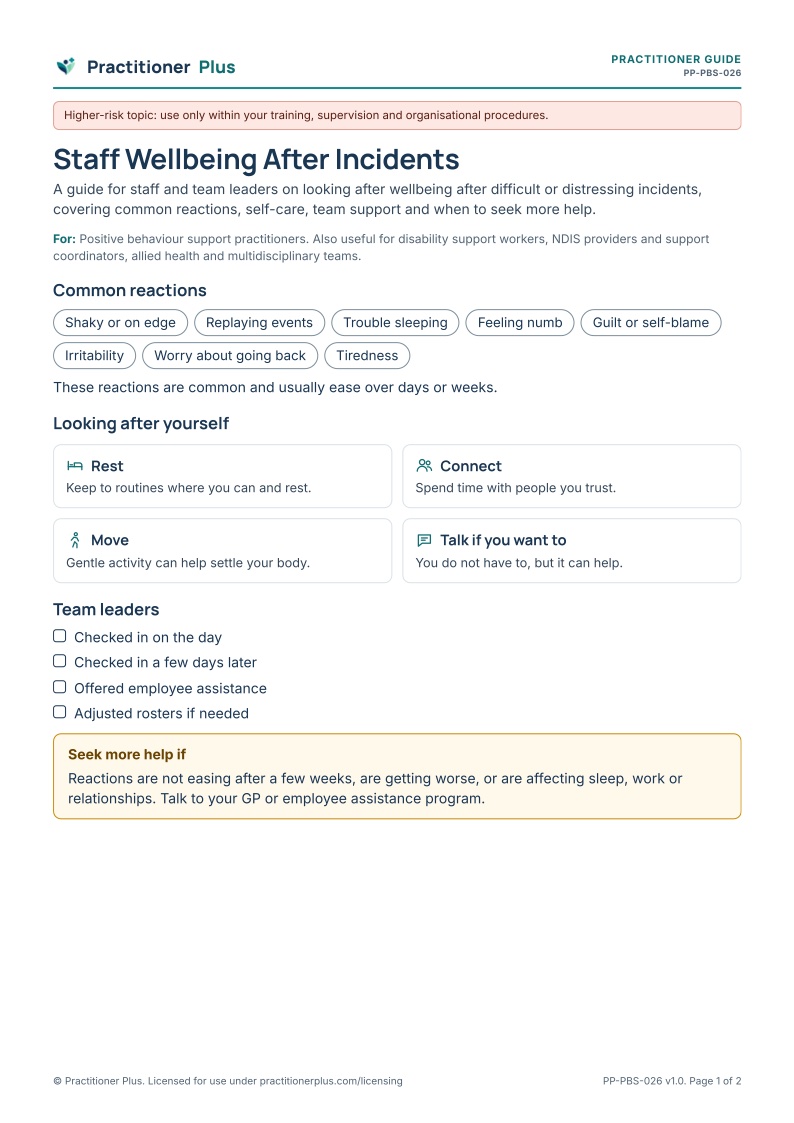
Difficult incidents can affect staff for days or longer. This guide describes common reactions, practical self-care, how team leaders can support staff, and when to seek more help, such as employee assistance programs or a GP. It supports a culture where looking after staff is part of good practice.
Purpose
To support staff to recover well after difficult incidents and know when to seek help.
Who it is for
Primary profession: Positive behaviour support practitioners. Also relevant for disability support workers, NDIS providers and support coordinators, allied health and multidisciplinary teams.
Client or participant group: Support workers, team leaders and practitioners after difficult incidents.
Practice setting: Disability, behaviour support and community services.
Suggested uses
- After incidents
- Team leader training
- Supervision
- Staff induction
Instructions for practitioners
- Check in with staff after incidents, and again a few days later.
- Offer employee assistance or other supports.
- Normalise reactions without pressuring people to talk.
- Notice staff who may need more help.
Accessibility considerations
Share in different formats. Offer private conversations.
Scope and limitations
General information. It does not replace employee assistance programs, medical care or work health and safety obligations.
Higher-risk topic: use only within your training, supervision and organisational procedures.
Research basis
Repeated exposure to others' trauma can affect practitioners, and organisational support and reflective practice help. Burnout reflects mismatches between people and their work demands, and is addressed through both organisational and individual strategies.
- Maslach, C., & Leiter, M. P. (2016). Understanding the burnout experience: recent research and its implications for psychiatry. World Psychiatry, 15(2), 103–111. https://doi.org/10.1002/wps.20311
- Pearlman, L. A., & Saakvitne, K. W. (1995). Trauma and the therapist: Countertransference and vicarious traumatization in psychotherapy with incest survivors. W. W. Norton.
What is included
A 2-page printable A4 PDF, including a practitioner notes page with the research basis (version 1.0).
Originality
Original Practitioner Plus content: wording, activity structure, layout and icons were created for this resource. No third-party worksheets, illustrations or text were reproduced.


