
About this resource
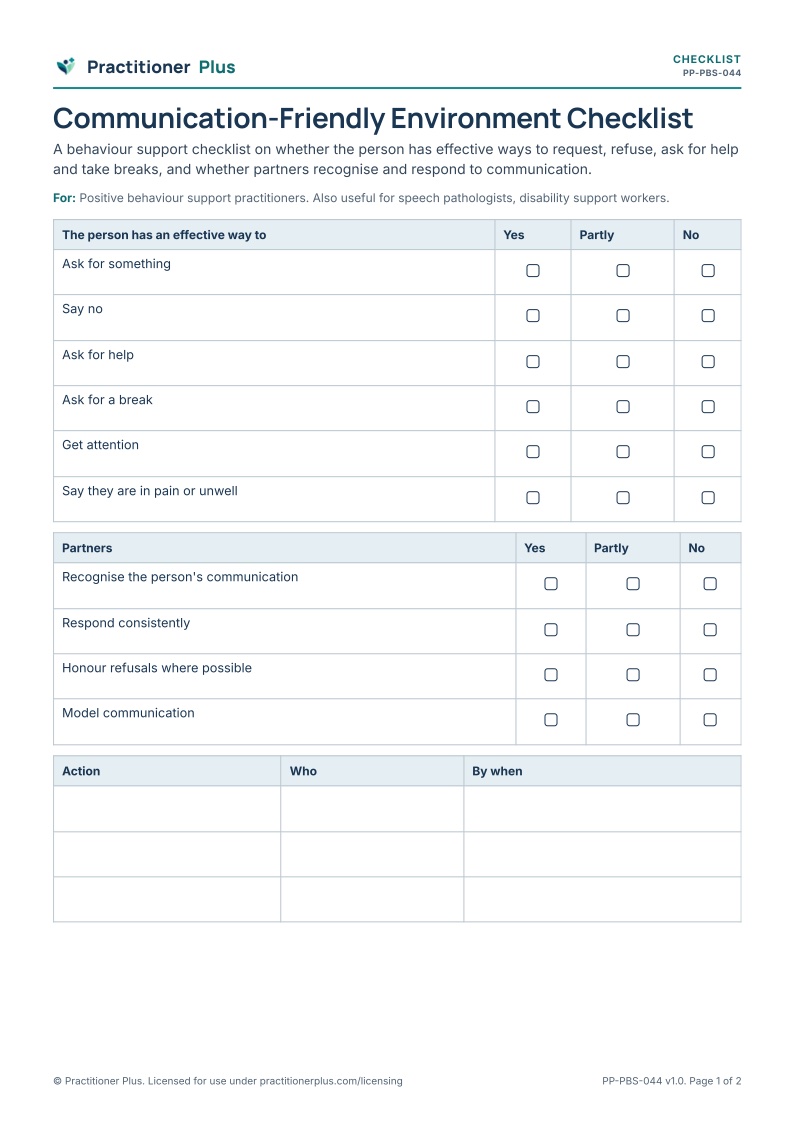
Behaviour often communicates needs. This checklist reviews whether the person has effective ways to request, refuse, ask for help, ask for a break and get attention, and whether communication partners recognise and respond consistently, with actions and speech pathology links.
Purpose
To make sure people have effective, respected ways to communicate needs.
Who it is for
Primary profession: Positive behaviour support practitioners. Also relevant for speech pathologists, disability support workers.
Client or participant group: Teams supporting people whose behaviour may be serving a communication function.
Practice setting: Behaviour support assessment and planning.
Suggested uses
- Behaviour support assessment
- Plan development
- Team training
- Collaboration with speech pathologists
Instructions for practitioners
- Observe across settings.
- Involve a speech pathologist.
- Make sure communication attempts are honoured.
- Teach and practise alternatives.
Accessibility considerations
Include the person's AAC and communication methods.
Scope and limitations
A checklist. It does not replace functional or communication assessment.
Research basis
Training communication partners improves communication for people who use AAC and people with aphasia. Positive behaviour support aims to improve quality of life and reduce behaviours of concern by understanding their function and changing environments and skills.
- Allen, D., James, W., Evans, J., Hawkins, S., & Jenkins, R. (2005). Positive Behavioural Support: Definition, Current Status and Future Directions. Tizard Learning Disability Review, 10(2), 4–11. https://doi.org/10.1108/13595474200500014
- Kent-Walsh, J., Murza, K. A., Malani, M. D., & Binger, C. (2015). Effects of Communication Partner Instruction on the Communication of Individuals using AAC: A Meta-Analysis. Augmentative and Alternative Communication, 31(4), 271–284. https://doi.org/10.3109/07434618.2015.1052153
- NDIS Quality and Safeguards Commission. NDIS Practice Standards and Quality Indicators. https://www.ndiscommission.gov.au/rules-and-standards/ndis-practice-standards
- Simmons-Mackie, N., Raymer, A., & Cherney, L. R. (2016). Communication Partner Training in Aphasia: An Updated Systematic Review. Archives of Physical Medicine and Rehabilitation, 97(12), 2202–2221.e8. https://doi.org/10.1016/j.apmr.2016.03.023
What is included
A 2-page printable A4 PDF, including a practitioner notes page with the research basis (version 1.0).
Originality
Original Practitioner Plus content: wording, activity structure, layout and icons were created for this resource. No third-party worksheets, illustrations or text were reproduced.


