
About this resource
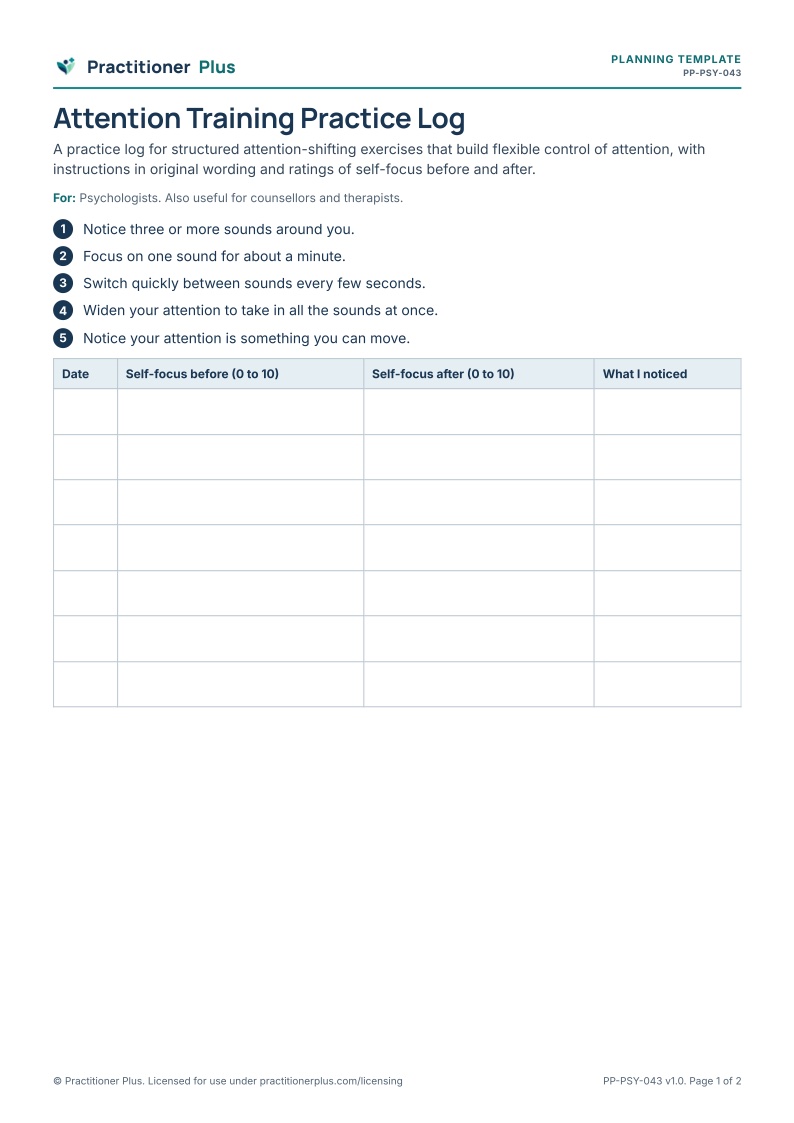
Practising moving attention on purpose can loosen the grip of worry and self-focus. This log provides a simple exercise in original wording: focusing on one sound, switching between sounds and widening attention to many sounds, with ratings of self-focus before and after.
Purpose
To support practice of flexible attention control.
Who it is for
Primary profession: Psychologists. Also relevant for counsellors and therapists.
Client or participant group: Adolescents and adults with worry, rumination or self-focused attention in treatment.
Practice setting: Between psychology sessions.
Suggested uses
- Worry and rumination
- Social anxiety
- Metacognitive and attention-focused approaches
- Between-session practice
Instructions for practitioners
- Demonstrate the exercise in session.
- Explain it is about flexible attention, not distraction or relaxation.
- Encourage daily practice.
- Review ratings and experiences.
Instructions for clients or participants
- Do the exercise daily.
- Rate self-focus before and after.
- Note what you noticed.
Accessibility considerations
Can be practised with recorded instructions.
Scope and limitations
An educational practice log for use within treatment.
Research basis
Mindfulness-based approaches show moderate benefits for anxiety, depression and stress across many groups. Scheduling worry and shifting from abstract to concrete thinking are supported strategies for reducing unhelpful worry and rumination.
- Borkovec, T., Wilkinson, L., Folensbee, R., & Lerman, C. (1983). Stimulus control applications to the treatment of worry. Behaviour Research and Therapy, 21(3), 247–251. https://doi.org/10.1016/0005-7967(83)90206-1
- Khoury, B., Lecomte, T., Fortin, G., Masse, M., Therien, P., Bouchard, V., Chapleau, M. A., Paquin, K., & Hofmann, S. G. (2013). Mindfulness-based therapy: A comprehensive meta-analysis. Clinical Psychology Review, 33(6), 763–771. https://doi.org/10.1016/j.cpr.2013.05.005
- Watkins, E. R. (2008). Constructive and unconstructive repetitive thought. Psychological Bulletin, 134(2), 163–206. https://doi.org/10.1037/0033-2909.134.2.163
What is included
A 2-page printable A4 PDF, including a practitioner notes page with the research basis (version 1.0).
Originality
Original Practitioner Plus content: wording, activity structure, layout and icons were created for this resource. No third-party worksheets, illustrations or text were reproduced. Reflects attention-shifting practices described in attention-focused therapies, written in original wording.


